

Effect of digital virtual reality simulator on pre-clinical dental surgical skill training: a retrospective study | BMC Medical Education
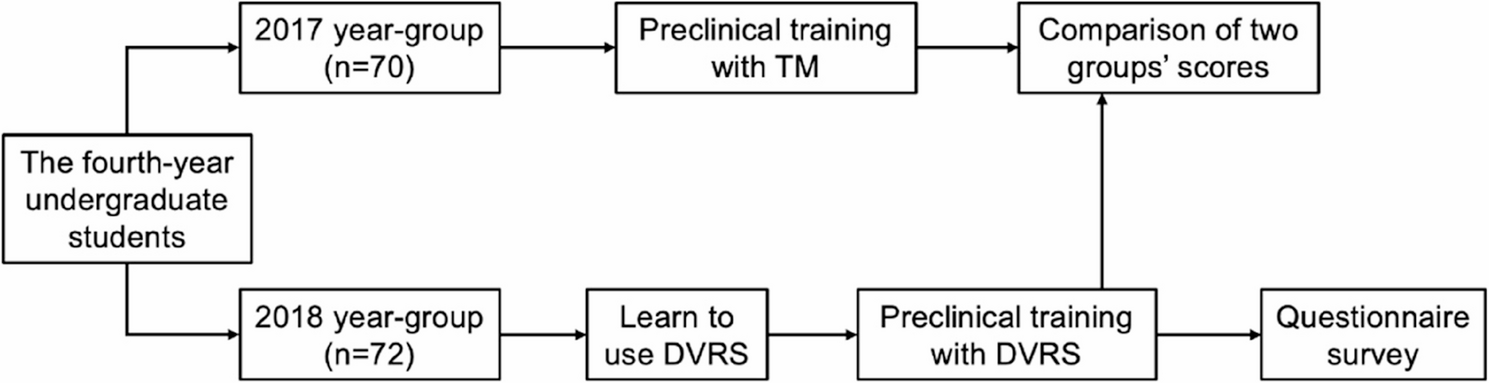
Medical students primarily gain essential clinical skills through experiential learning or preclinical training, a domain where traditional pedagogies increasingly fall short. The traditional manikin approach is fraught with limitations, most notably, its divergence from authentic clinical contexts and its inefficiency in providing real-time corrective feedback [11]. Further, it neglects the fundamental aspect of early doctor-patient interaction, thereby undermining the development of empathetic patient care. Our present study showed that the superiority of the VR was apparent, evidenced by significantly enhancing not only theoretical knowledge but also practical skills [12, 13].
Empirical research endorses the integration of theory and practice as a means to refine clinical acumen and augment practical skills within medical education [14, 15]. Recent advancements in simulation technologies have greatly enhanced dental education, particularly in areas such as digital simulators, virtual reality (VR), haptic feedback, simulated and virtual patients, role-play, and simulation-based serious games [16,17,18,19,20,21,22,23,24,25]. VR in preclinical training has gained considerable attention and holds great promise in various fields, including healthcare [26, 27]. VR technology provides a simulated environment that allows trainees to experience realistic scenarios without any physical risks or constraints [28, 29]. VR-based simulators allow dental students to practice procedures in a risk-free environment [16,17,18]. Recent studies show that VR enhances procedural skills and confidence by enabling repeated practice in a controlled setting [16,17,18]. Haptic technology integrates tactile sensations into VR simulations, helping students develop manual dexterity by simulating the feeling of resistance during dental procedures [19, 20]. Virtual patients provide students with realistic clinical scenarios for diagnosis and treatment planning without real patients [21]. Role-playing improves communication and patient interaction skills [22]. By simulating real-world dental situations, students gain confidence in managing patient relationships [23]. Serious games engage students through interactive, game-like environments that mimic dental procedures and these games enhance both technical skills and motivation [24, 25].
DVRS encompasses an inclusive array of interfaces: a receiving interface, an operating interface, an explanatory interface, and a scoring interface-each integral to the span of diagnosis and treatment procedures [30]. The clinical receiving interface emulates the scenario of a dental department, simulating both the oral treatment environment and patient information. Within this virtual context, students independently conduct examinations and receptions, honing their clinical competencies in patient communication, medical history documentation, and treatment planning, as well as interaction with virtual patients in realistically simulated scenarios. The operating interface provides immediate feedback on any procedural deviations or errors, presenting operation details and key steps with clarity. Lastly, the scoring interface rigorously evaluates the students’ performance against established operational standards, offering prompt assessments. Through high-definition displays and stereoscopic reflection technology, the images are spatially registered with hand-force feedback. The dual-hand force feedback technology allows for precise tactile perception, providing a more “sensory” operation feedback. Taken together, the format of DVRS provides greater alignment with actual clinical practice, and the detailed explanations in DVRS complement hands-on activities, reinforcing theoretical knowledge concurrently with practical application. This integration underscores the importance of merging cognitive understanding with tangible experience, resulting in marked improvements in both conceptual understanding and technical proficiency among DVRS trainees.
DVRS provides realistic operational experiences and sensations, deepening students’ grasp of pertinent knowledge, in line with educational objectives. Additionally, DVRS offers several advantages, such as safe failure, standardization and repeatability. While introducing an innovative edge to medical education, DVRS do come with their share of limitations, notably the requirement of specialized equipment, smooth computer operation, and a higher investment cost. The small sample size of our study may limit the generalizability of the findings. Moreover, as a retrospective study rather than a randomized controlled trial (RCT), it lacks the rigor of prospective research designs. Future research should track students’ clinical acumen, real patient outcomes, complication rates, and skill development. Furthermore, conducting multi-center studies with larger sample sizes would enhance the robustness of the research and provide more comprehensive insights.
In conclusion, we had a positive experience with the DVRS pedagogical mode in dental surgery course. DVRS led to improvements in students’ theoretical knowledge and preclinical dental surgical skills. Also, students expressed satisfaction with DVRS, highlighting its high operability, true-to-life scenarios and timely feedback.