

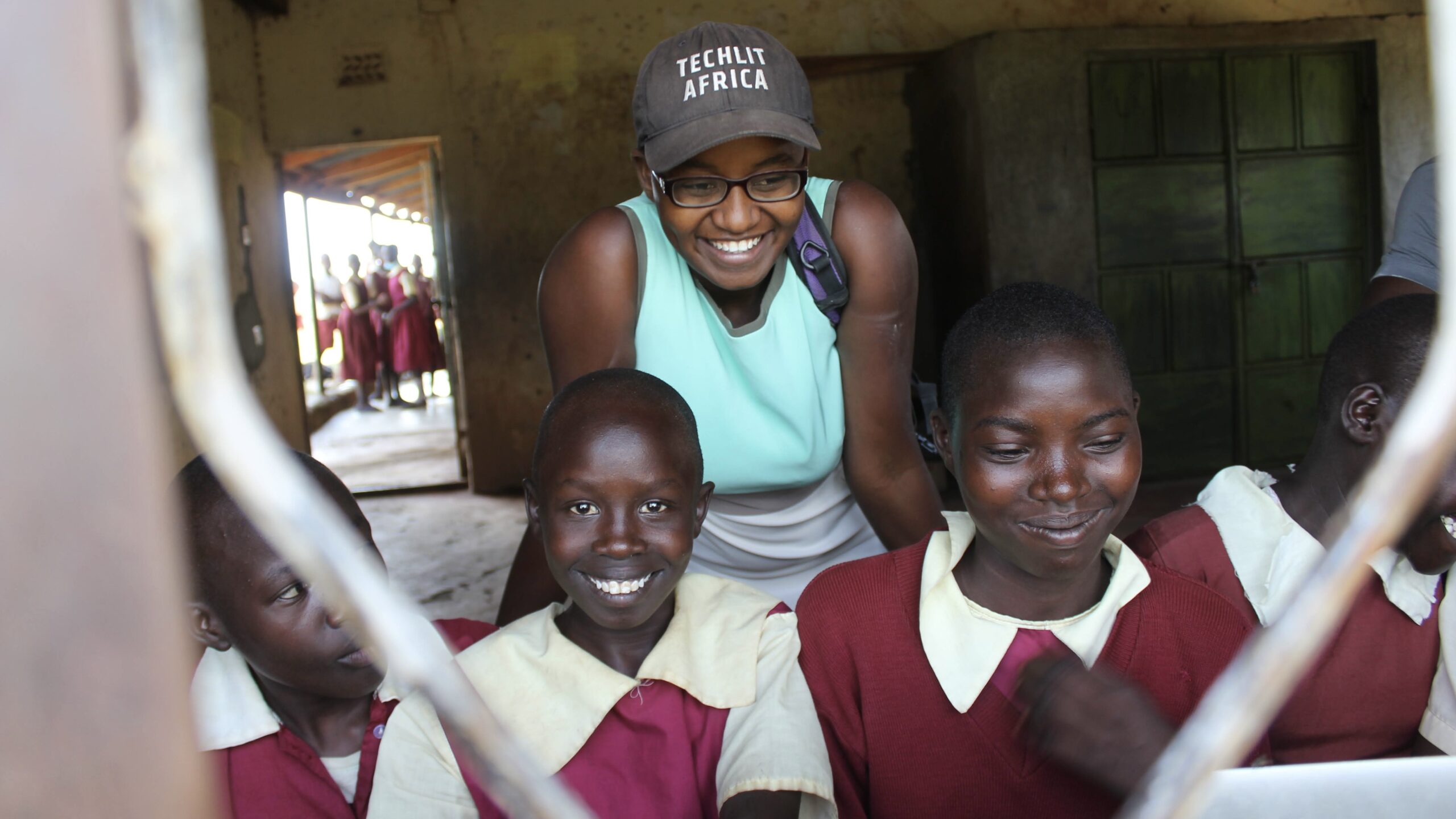
Former student from Kenya brought computer literacy to her hometown after studying in the US
The small Kenyan town of Mogotio hasn’t typically attracted much attention. Four hours from Nairobi and an hour from the closest city, motorbikes shuttle passengers down a single paved road, as dusty roads carve up in the interior, lined with single-level shops and homes.
But travel down one of these rough roads, and inside an unsuspecting four-story school, change is underway.
A pair of teenagers crowd around a MacBook as the school’s founder, Nelly Cheboi, teaches them about responsive design on their websites.
Her idea is to turn rural Africa into the next outsourcing hub.
“We have this youth graduating, facing massive unemployment, but they don’t have the skills to tap into this gold mine, the digital economy,” Cheboi said. “We start with them even as young as five years, and they just do Minecraft. And we teach them about everything under the sun. We teach them about code, about 3D modeling. And they’re doing this every single day of their schooling.”
“We are changing what it means to grow up in rural Kenya,” she added.

Growing up
As a child, all Cheboi’s single mother could afford was a small tin-roofed home in Mogotio. Cheboi was often in and out of school when she could not afford school fees.
“I saw poverty up close. Like seeing it through the lens of my mom: she’d wake up at 5 a.m. and go to the roadside and try to sell things, get home at 10 p.m. sometimes, and we don’t even have food to eat,” Cheboi said. “So education, for me, seemed like the only opportunity I had because I just knew that I needed to take care of her. I needed to get us out of poverty.”

Nelly studied hard, graduating as one of Kenya’s top students. She was accepted into Zawadi Africa, a year-long prep course for US colleges. Despite applying to 24 schools, she was rejected by every single one of them. With debts from her high school fees preventing her from enrolling in Kenyan universities, she was forced to go back to selling food on the roadside with her mother.
“I was the one waking up at 5 a.m. now and baking chapatis and sitting there trying to sell it,” she said. “So, I’ll just sit there for hours, and there’s no one there. And I remember I just kept, like, writing resumes on a piece of paper, writing my resume, and it just felt so unfair.”
Then, weeks before the fall semester, a breakthrough: Cheboi was accepted to Augustana College in Illinois.
Abundance: “Everything seemed in reach”
University was heaven for a serious student like Cheboi, where she said teachers made learning easy.
“It’s like, you’re not only given the notes, you have textbooks, you know what is coming in an exam. Sometimes they even do, like open-book exams. Like this is so easy! I ended up doing three majors, chemistry, math and computer science,” Cheboi said “Then, the professor, like, at open hours, you could ask them questions. They’re not like, strict and mean, it was fantastic.”
More than anything, Nelly was struck by the abundance she experienced in America. She wasn’t referring to things, although they would come in handy later; it was the mindset that came with abundance.
“Everything seemed in reach,” she said. “And, that only happens in a world of abundance.”
Bringing digital skills and technology to rural Africa
Cheboi’s biggest challenge during her American education was basic digital skills, like typing — even Googling. Initially, it would take her half an hour to write a single line of code.
“I just kept saying, ‘Nelly, you made it all the way from rural Kenya to America,’” she said. “‘The reason you’re struggling with this is simply because you grew up in Mogotio,’ and that was supposed to give me solace. But what it did was, what about kids growing up in Mogotio?”
Cheboi returned to her hometown, using money she earned from her work-study job as a janitor to fund the beginnings of her school.

“Then I can make sure the kids in Mogotio are having what I see the kids in America have,” she said.
Nine years later, Cheboi is building a garden for the students with fruit trees and a quad for them to lounge in between classes. Students have had Zoom calls with NASA, and a visit by an astronaut and a chess master.
Along with the mindset of abundance, Cheboi is also bringing physical abundance from America.
In a room at the end of the school’s long, open-air hallway, shelves are stacked with about 3,000 laptops, desktop computers and monitors, donated from corporations and universities.
Cheboi lifts up a laptop from a pile of computers. “This one is about 4 years old, so we might actually get another 10 years because any broken part we find, we fix it. So we haven’t really thrown anything away so far.”
TechLit Africa currently works in 25 schools and aims to expand, although recent funding cuts forced them to limit their programming. Cheboi is expanding her school, Zawadi Yetu, into a high school, hoping to connect students with remote internships, and if available to them, scholarships for studying in America.
“I often think about what would have happened if I didn’t leave,” Cheboi said. “I would have done maybe something remarkable, but I don’t think it would have been at this scale. It was being able to see the two worlds, scarcity here and abundance there, being able to see it even helped me understand and love my country more.”
All photos courtesy of Nelly Cheboi/TechLit Africa.