

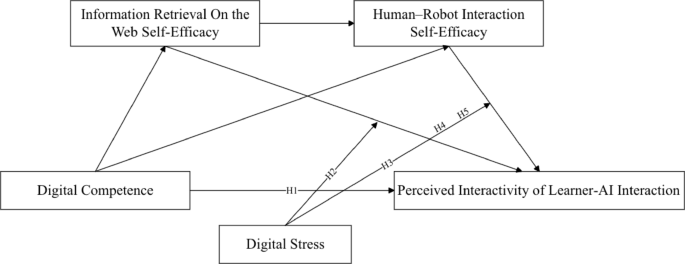
Linking digital competence, self-efficacy, and digital stress to perceived interactivity in AI-supported learning contexts
Ipinnaiye, O. & Risquez, A. Exploring adaptive learning, learner-content interaction and student performance in undergraduate economics classes. Comput. Educ. 215, 105047 (2024).
Google Scholar
Ifenthaler, D. & Schumacher, C. Reciprocal issues of artificial and human intelligence in education. Ournal Res. Technol. Educ. 55, 1–6 (2023).
Google Scholar
Kasneci, E. et al. ChatGPT for good? On opportunities and challenges of large Language models for education. Learn. Individ Differ. 103, 102274 (2023).
Google Scholar
Bhullar, P. S., Joshi, M. & Chugh, R. ChatGPT in higher education-a synthesis of the literature and a future research agenda. Educ. Inf. Technol. 29, 21501–21522 (2024).
Google Scholar
Shao, Z. & Chen, K. Understanding individuals’ engagement and continuance intention of moocs: the effect of interactivity and the role of gender. Internet Res. 31, 1262–1289 (2021).
Google Scholar
Wang, K. Y., Chih, W. H. & Hsu, L. C. Building brand community relationships on Facebook fan pages: the role of perceived interactivity. Int. J. Electron. Commer. 24, 211–231 (2020).
Google Scholar
Walter, Y. Embracing the future of artificial intelligence in the classroom: the relevance of AI literacy, prompt engineering, and critical thinking in modern education. Int. J. Educ. Technol. High. Educ. 21, 15 (2024).
Google Scholar
Haroud, S. & Saqri, N. Generative AI in higher education: teachers’ and students’ perspectives on support, replacement, and digital literacy. Educ. Sci. 15, 396 (2025).
Google Scholar
Wang, X., Li, Z., Ouyang, Z. & Xu, Y. The Achilles heel of technology: how does technostress affect university students’ wellbeing and technology-enhanced learning. Int J. Environ. Res. Public. Health 18, 12322 (2021).
Rodon, C. & Chevalier, A. Toward more comprehensive Chinese internet users’ studies: translation and validation of the Chinese–Mandarin version of the 8-Item information retrieval on the web Self-Efficacy scale (Ch-IROWSE). Int. J. Human–Computer Interact. 33, 846–855 (2017).
Google Scholar
Gao, H. et al. Validity and reliability of the Chinese version of human–robot interaction self-efficacy scale in Chinese adults. Psicol. Reflex E Crítica. 37, 40 (2024).
Google Scholar
Kim, B. J. & Lee, J. The mental health implications of artificial intelligence adoption: the crucial role of self-efficacy. Humanit. Soc. Sci. Commun. 11, 1561 (2024).
Google Scholar
Spain, R. et al. A reinforcement learning approach to adaptive remediation in online training. J. Def. Model. Simul. 19, 173–193 (2022).
Google Scholar
Tram, N. H. M., Nguyen, T. T. & Tran, C. D. ChatGPT as a tool for self-learning english among EFL learners: A multi-methods study. System 103528 (2024).
Liu, G. L., Zou, M. M., Soyoof, A. & Chiu, M. M. Untangling the relationship between AI-Mediated informal digital learning of english (AI-IDLE), foreign Language enjoyment and the ideal L2 self: evidence from Chinese university EFL students. Eur. J. Educ. 60, e12846 (2025).
Google Scholar
McGivney, E. Interactivity and identity impact learners’ sense of agency in virtual reality field trips. Br. J. Educ. Technol. 56, 410–434 (2025).
Google Scholar
Kim, T. & Im, I. Understanding users’ AI manipulation intention: an empirical investigation of the antecedents in the context of AI recommendation algorithms. Inf. Manage. 62, 104061 (2025).
Wang, C., Zou, B., Du, Y. & Wang, Z. The impact of different conversational generative AI chatbots on EFL learners: an analysis of willingness to communicate, foreign Language speaking anxiety, and self-perceived communicative competence. System 127, 103533 (2024).
Google Scholar
Chen, L. Unlocking the beat: how AI tools drive music students’ motivation, engagement, creativity and learning success. Eur. J. Educ. 60, e12823 (2025).
Google Scholar
Leroy, A., Romero, M. & Cassone, L. Interactivity and materiality matter in creativity: educational robotics for the assessment of divergent thinking. Interact. Learn. Environ. 31, 2194–2205 (2023).
Google Scholar
Martín-Núñez, J. L., Ar, A. Y., Fernández, R. P., Abbas, A. & Radovanović, D. Does intrinsic motivation mediate perceived artificial intelligence (AI) learning and computational thinking of students during the COVID-19 pandemic? Comput. Educ. Artif. Intell. 4, 100128 (2023).
Google Scholar
Afanasyeva, Y., Bratkova, M., Galoyan, D., Rzanova, S. & Bombieri, L. The impact of interactive touchscreen images on the well-being of schoolchildren in the context of inclusive education. Educ. Inf. Technol., 1–20. https://doi.org/10.1007/s10639-024-12608-z (2024).
Mills, N., Hok, H., Dressen, A. & Veillas, Q. The design and evaluation of an interactive AI companion for foreign Language writing. Foreign Lang. Ann 58, 40–69 (2025).
Wambsganss, T., Benke, I., Maedche, A., Koedinger, K. & Käser, T. Evaluating the impact of learner control and interactivity in conversational tutoring systems for persuasive writing. Int. J. Artif. Intell. Educ. 1–32. https://doi.org/10.1007/s40593-024-00409-x (2024).
Budai, B. B., Csuhai, S. & Tózsa, I. Digital competence development in public administration higher education. Sustainability 15, 12462 (2023).
Google Scholar
Martzoukou, K., Kostagiolas, P., Lavranos, C., Lauterbach, T. & Fulton, C. A study of university law students’ self-perceived digital competences. J. Librariansh. Inf. Sci. 54, 751–769 (2022).
Google Scholar
Bauer, E., Greiff, S., Graesser, A. C., Scheiter, K. & Sailer, M. Looking beyond the hype: Understanding the effects of AI on learning. Educ. Psychol. Rev. 37, 45 (2025).
Google Scholar
Bećirović, S., Polz, E. & Tinkel, I. Exploring students’ AI literacy and its effects on their AI output quality, self-efficacy, and academic performance. Smart Learn. Environ. 12, 29 (2025).
Google Scholar
Golz, C. et al. Technostress and digital competence among health professionals in Swiss psychiatric hospitals: cross-sectional study. JMIR Ment Health. 8, e31408 (2021).
Google Scholar
Gerlich, M. AI tools in society: impacts on cognitive offloading and the future of critical thinking. Societies 15, 6 (2025).
Google Scholar
Schunk, D. H. & DiBenedetto, M. K. Motivation and social cognitive theory. Contemp. Educ. Psychol. 60, 101832 (2020).
Google Scholar
Carpenter, S. K., Endres, T. & Hui, L. Students’ use of retrieval in self-regulated learning: implications for monitoring and regulating effortful learning experiences. Educ. Psychol. Rev. 32, 1029–1054 (2020).
Google Scholar
Oliff, H., Liu, Y., Kumar, M. & Williams, M. Improving human–robot interaction utilizing learning and intelligence: A human factors-based approach. IEEE Trans. Autom. Sci. Eng. 17, 1597–1610 (2020).
Campagna, G. et al. Promoting trust in industrial Human-Robot collaboration through Preference-Based optimization. IEEE Robot Autom. Lett. https://doi.org/10.1109/LRA.2024.3455792 (2024).
Google Scholar
Chou, C. M., Shen, T. C., Shen, T. C. & Shen, C. H. Influencing factors on students’ learning effectiveness of AI-based technology application: mediation variable of the human-computer interaction experience. Educ. Inf. Technol. 27, 8723–8750 (2022).
Google Scholar
Latikka, R., Turja, T. & Oksanen, A. Self-efficacy and acceptance of robots. Comput. Hum. Behav. 93, 157–163 (2019).
Google Scholar
Steele, R. G., Hall, J. A. & Christofferson, J. L. Conceptualizing digital stress in adolescents and young adults: toward the development of an empirically based model. Clin. Child. Fam Psychol. Rev. 23, 15–26 (2020).
Google Scholar
Zhang, C., Dai, B. & Lin, L. Validation of a Chinese version of the digital stress scale and development of a short form based on item response theory among Chinese college students. Psychol. Res. Behav. Manag. 16, 2897–2911 (2023).
Google Scholar
Feng, L. Investigating the effects of artificial intelligence-assisted Language learning strategies on cognitive load and learning outcomes: A comparative study. J. Educ. Comput. Res. 62, 1961–1994 (2025).
Google Scholar
Daud, N. M. From innovation to stress: analyzing hybrid technology adoption and its role in technostress among students. Int. J. Educ. Technol. High. Educ. 22, 31 (2025).
Google Scholar
Zhai, C., Wibowo, S. & Li, L. D. The effects of over-reliance on AI dialogue systems on students’ cognitive abilities: a systematic review. Smart Learn. Environ. 11, 28 (2024).
Google Scholar
Ng, D. T. K., Leung, J. K. L., Su, J., Ng, R. C. W. & Chu, S. K. W. Teachers’ AI digital competencies and twenty-first century skills in the post-pandemic world. Educ. Technol. Res. Dev. 71, 137–161 (2023).
Google Scholar
Marougkas, A., Troussas, C., Krouska, A. & Sgouropoulou, C. Virtual reality in education: a review of learning theories, approaches and methodologies for the last decade. Electronics 12, 2832 (2023).
Google Scholar
Vygotsky, L. S. Mind in Society: the Development of Higher Psychological Processesvol. 86 (Harvard University Press, 1978).
Kugele, S. Constructivist procedural learning for grounded cognitive agents. Cogn. Syst. Res. 90, 101321 (2025).
Google Scholar
Lee, D. & Palmer, E. Prompt engineering in higher education: a systematic review to help inform curricula. Int. J. Educ. Technol. High. Educ. 22, 7 (2025).
Google Scholar
Bauer, E. et al. Effects of AI-generated adaptive feedback on statistical skills and interest in statistics: A field experiment in higher education. Br. J. Educ. Technol. https://doi.org/10.1111/bjet.13609 (2025).
Google Scholar
Steiss, J. et al. Comparing the quality of human and ChatGPT feedback of students’ writing. Learn. Instr. 91, 101894 (2024).
Google Scholar
Bai, Y. & Wang, S. Impact of generative AI interaction and output quality on university students’ learning outcomes: a technology-mediated and motivation-driven approach. Sci. Rep. 15, 24054 (2025).
Google Scholar
Baig, M. I. & Yadegaridehkordi, E. Factors influencing academic staff satisfaction and continuous usage of generative artificial intelligence (GenAI) in higher education. Int. J. Educ. Technol. High. Educ. 22, 5 (2025).
Google Scholar
Wang, L. & Li, W. The impact of AI usage on university students’ willingness for autonomous learning. Behav. Sci. 14, 956 (2024).
Google Scholar
Markus, A., Pfister, J., Carolus, A., Hotho, A. & Wienrich, C. Effects of AI understanding-training on AI literacy, usage, self-determined interactions, and anthropomorphization with voice assistants. Comput. Educ. Open. 6, 100176 (2024).
Google Scholar
Wang, F., Cheung, A. C. K., Chai, C. S. & Liu, J. Development and validation of the perceived interactivity of learner-AI interaction scale. Educ. Inf. Technol. 30, 4607–4638 (2024).
Google Scholar
Davis, F. D. & Perceived Usefulness Perceived ease of use, and user acceptance of information technology. MIS Q. 13, 319–340 (1989).
Google Scholar
Al-Adwan, A. S. et al. Extending the technology acceptance model (TAM) to predict university students’ intentions to use metaverse-based learning platforms. Educ. Inf. Technol. 28, 15381–15413 (2023).
Google Scholar
Aldraiweesh, A. A. & Alturki, U. The influence of social support theory on AI acceptance: examining educational support and perceived usefulness using SEM analysis. IEEE Access. https://doi.org/10.1109/ACCESS.2025.3534099 (2025).
Google Scholar
Zhou, N., Wang, J., Liu, X., Yang, L. & Jin, X. The digital competence of Chinese higher education students and the linkage with their career adaptability. Educ. Train. 65, 939–954 (2023).
Google Scholar
Mustofa, R. H., Kuncoro, T. G., Atmono, D., Hermawan, H. D. & others. Extending the technology acceptance model: the role of subjective norms, ethics, and trust in AI tool adoption among students. Comput. Educ. Artif. Intell. 100379 https://doi.org/10.1016/j.caeai.2025.100379 (2025).
Boubker, O. From chatting to self-educating: can AI tools boost student learning outcomes? Expert Syst. Appl. 238, 121820 (2024).
Google Scholar
Guo, J., Talib, M. A., Guo, B. & Ren, J. Smartphone addiction as a moderator of undergraduates’ sense of coherence, social support, and satisfaction with life. Soc Behav. Personal 53, 1–13 (2025).
Teng, L., Liu, D. & Luo, J. Explicating user negative behavior toward social media: an exploratory examination based on stressor–strain–outcome model. Cogn. Technol. Work. 24, 183–194 (2022).
Google Scholar
Evans, P., Vansteenkiste, M., Parker, P., Kingsford-Smith, A. & Zhou, S. Cognitive load theory and its relationships with motivation: A self-determination theory perspective. Educ. Psychol. Rev. 36, 7 (2024).
Google Scholar
Skulmowski, A. & Xu, K. M. Understanding cognitive load in digital and online learning: A new perspective on extraneous cognitive load. Educ. Psychol. Rev. 34, 171–196 (2022).
Google Scholar
Kim, S. Y., Park, H., Kim, H., Kim, J. & Seo, K. Technostress causes cognitive overload in high-stress people: eye tracking analysis in a virtual kiosk test. Inf. Process. Manag. 59, 103093 (2022).
Google Scholar
Lademann, J., Henze, J. & Becker-Genschow, S. Augmenting learning environments using AI custom chatbots: effects on learning performance, cognitive load, and affective variables. Phys. Rev. Phys. Educ. Res. 21, 010147 (2025).
Google Scholar
Öztürk, İ., Merat, N., Rowe, R. & Fotios, S. The effect of cognitive load on Detection-Response task (DRT) performance during day- and night-time driving: A driving simulator study with young and older drivers. Transp. Res. Part. F Traffic Psychol. Behav. 97, 155–169 (2023).
Google Scholar
Zhu, B., Chau, K. T. & Mokmin, N. A. M. Optimizing cognitive load and learning adaptability with adaptive microlearning for in-service personnel. Sci. Rep. 14, 25960 (2024).
Google Scholar
Semilarski, H., Soobard, R., Holbrook, J. & Rannikmäe, M. Expanding disciplinary and interdisciplinary core Idea maps by students to promote perceived self-efficacy in learning science. Int. J. STEM Educ. 9, 57 (2022).
Google Scholar
Fryer, L. K., Thompson, A., Nakao, K., Howarth, M. & Gallacher, A. Supporting self-efficacy beliefs and interest as educational inputs and outcomes: framing AI and human partnered task experiences. Learn. Individ Differ. 80, 101850 (2020).
Google Scholar
Fu, W. et al. An empirical study of adaptive feedback to enhance cognitive ability in programming learning among college students: A perspective based on multimodal data analysis. J. Educ. Comput. Res. 63, 532–564 (2025).
Google Scholar
Weber, F., Wambsganss, T. & Söllner, M. Enhancing legal writing skills: the impact of formative feedback in a hybrid intelligence learning environment. Br. J. Educ. Technol. 56, 650–677 (2025).
Google Scholar
Yaseen, H. et al. The impact of adaptive learning technologies, personalized feedback, and interactive AI tools on student engagement: the moderating role of digital literacy. Sustainability 17, 1133 (2025).
Google Scholar
Cronin-Golomb, L. M. & Bauer, P. J. Self-motivated and directed learning across the lifespan. Acta Psychol. (Amst). 232, 103816 (2023).
Google Scholar
Shao, S. The role of AI tools on EFL students’ motivation, self-efficacy, and anxiety: through the lens of control-value theory. Learn. Motiv. 91, 102154 (2025).
Google Scholar
Lucas, M., Zhang, Y., Bem-haja, P. & Vicente, P. N. The interplay between teachers’ trust in artificial intelligence and digital competence. Educ. Inf. Technol. 29, 22991–23010 (2024).
Google Scholar
Saleem, F., Chikhaoui, E. & Malik, M. I. Technostress in students and quality of online learning: role of instructor and university support. Front. Educ. 9, 1309642 (2024).
Google Scholar
Paas, F., Van Gog, T. & Sweller, J. Cognitive load theory: new conceptualizations, specifications, and integrated research perspectives. Educ. Psychol. Rev. 22, 115–121 (2010).
Google Scholar
Kumpikaitė-Valiūnienė, V., Aslan, I., Duobienė, J., Glińska, E. & Anandkumar, V. Influence of digital competence on perceived stress, burnout and well-being among students studying online during the COVID-19 lockdown: A 4-country perspective. Psychol. Res. Behav. Manag. 1483–1498. https://doi.org/10.2147/PRBM.S325092 (2021).
Opitz, B. & Kubik, V. Far transfer of retrieval-practice benefits: rule-based learning as the underlying mechanism. Cogn. Res. Princ Implic. 9, 65 (2024).
Google Scholar
Pavlik, P. I., Yudelson, M. & Koedinger, K. R. A measurement model of microgenetic transfer for improving instructional outcomes. Int. J. Artif. Intell. Educ. 25, 346–379 (2015).
Google Scholar
Woodworth, R. S. & Thorndike, E. L. The influence of improvement in one mental function upon the efficiency of other functions. Psychol. Rev. 8, 247–261 (1901).
Google Scholar
Yuan, X., Rehman, S., Altalbe, A., Rehman, E. & Shahiman, M. A. Digital literacy as a catalyst for academic confidence: exploring the interplay between academic self-efficacy and academic procrastination among medical students. BMC Med. Educ. 24, 1317 (2024).
Google Scholar
Peciuliauskiene, P., Tamoliune, G. & Trepule, E. Exploring the roles of information search and information evaluation literacy and pre-service teachers’ ICT self-efficacy in teaching. Int. J. Educ. Technol. High. Educ. 19, 33 (2022).
Google Scholar
Galindo-Domínguez, H. & Bezanilla, M. J. Cognitive reserve and anxiety interactions play a fundamental role in the response to the stress. Contemp. Educ. Technol. 13, ep294 (2021).
Google Scholar
Lovette, A. J. et al. Anxiety as a predictor of emotional and cognitive reactivity both within and between people. Cogn. Ther. Res. 47, 483–493 (2023).
Google Scholar
Pekrun, R. The control-value theory of achievement emotions: assumptions, corollaries, and implications for educational research and practice. Educ. Psychol. Rev. 18, 315–341 (2006).
Google Scholar
Buff, A. Enjoyment of learning and its personal antecedents: testing the change–change assumption of the control-value theory of achievement emotions. Learn. Individ Differ. 31, 21–29 (2014).
Google Scholar
Pekrun, R. Control-value theory: from achievement emotion to a general theory of human emotions. Educ. Psychol. Rev. 36, 83 (2024).
Google Scholar
Martzoukou, K., Fulton, C., Kostagiolas, P. & Lavranos, C. A study of higher education students’ self-perceived digital competences for learning and everyday life online participation. J. Doc. 76, 1413–1458 (2020).
Google Scholar
González-Prida, V. et al. Digital Competencies as Predictors of Academic Self-Efficacy: Correlations and Implications for Educational Development. Societies 14, (2024).
Getenet, S., Cantle, R., Redmond, P. & Albion, P. Students’ digital technology attitude, literacy and self-efficacy and their effect on online learning engagement. Int. J. Educ. Technol. High. Educ. 21, 3 (2024).
Google Scholar
Sun, J., Staab, S. & Kunegis, J. Understanding social networks using transfer learning. Computer 51, 52–60 (2018).
Google Scholar
Gorbunova, A., Lange, C., Savelyev, A., Adamovich, K. & Costley, J. The interplay of Self-Regulated learning, cognitive load, and performance in Learner-Controlled environments. Educ Sci 14, (2024).
Stark, L., Malkmus, E., Stark, R., Brünken, R. & Park, B. Learning-related emotions in multimedia learning: an application of control-value theory. Learn. Instr. 58, 42–52 (2018).
Google Scholar
Faul, F., Erdfelder, E., Buchner, A. & Lang, A. G. Statistical power analyses using G* power 3.1: tests for correlation and regression analyses. Behav. Res. Methods. 41, 1149–1160 (2009).
Google Scholar
Cohen, J. Statistical Power Analysis for the Behavioral Sciences (Academic, 1988).
Wang, X., Wang, Z., Wang, Q., Chen, W. & Pi, Z. Supporting digitally enhanced learning through measurement in higher education: development and validation of a university students’ digital competence scale. J. Comput. Assist. Learn. 37, 1063–1076 (2021).
Google Scholar
Rodon, C. & Meyer, T. Self-efficacy about information retrieval on the web across all domains: a short measure in French and english. Behav. Inf. Technol. 37, 430–444 (2018).
Google Scholar
Pütten, A. R. V. D. & Bock, N. Development and validation of the self-efficacy in human-robot-interaction scale (SE-HRI). ACM Trans. Hum. -Robot Interact. THRI. 7, 1–30 (2018).
Google Scholar
Goretzko, D., Siemund, K. & Sterner, P. Evaluating model fit of measurement models in confirmatory factor analysis. Educ. Psychol. Meas. 84, 123–144 (2024).
Google Scholar
Dahl, J. E. & Mørch, A. A theoretical and empirical analysis of tensions between learning objects and constructivism. Educ. Inf. Technol. https://doi.org/10.1007/s10639-025-13636-z (2025).
Google Scholar
Banihashem, S. K., Farrokhnia, M., Badali, M. & Noroozi, O. The impacts of constructivist learning design and learning analytics on students’ engagement and self-regulation. Innov. Educ. Teach. Int. 59, 442–452 (2022).
Google Scholar
Fodouop Kouam, A. W. The effectiveness of intelligent tutoring systems in supporting students with varying levels of programming experience. Discov Educ. 3, 278 (2024).
Google Scholar
Wu, X. Y. & Chiu, T. K. F. Integrating learner characteristics and generative AI affordances to enhance self-regulated learning: a configurational analysis. J. New. Approaches Educ. Res. 14, 10 (2025).
Google Scholar
Kemp, A., Palmer, E., Strelan, P. & Thompson, H. Testing a novel extended educational technology acceptance model using student attitudes towards virtual classrooms. Br. J. Educ. Technol. 55, 2110–2131 (2024).
Google Scholar
Younas, M., El-Dakhs, D. A. S. & Jiang, Y. A comprehensive systematic review of ai-driven approaches to self-directed learning. IEEE Access. https://doi.org/10.1109/ACCESS.2025.3546319 (2025).
Google Scholar
Khlaif, Z. N., Sanmugam, M. & Ayyoub, A. Impact of technostress on continuance intentions to use mobile technology. Asia-Pac Educ. Res. 32, 151–162 (2023).
Google Scholar
Gauselmann, P. et al. A relief from mental overload in a digitalized world: how Context-Sensitive user interfaces can enhance cognitive performance. Int. J. Human–Computer Interact. 39, 140–150 (2023).
Google Scholar
Makowska-Tłomak, E., Bedyńska, S., Skorupska, K. & Paluch, J. Blended online intervention to reduce digital transformation stress by enhancing employees’ resources in COVID-19. Front. Psychol. 13, 732301 (2022).
Google Scholar
Blanc, S., Conchado, A., Benlloch-Dualde, J. V., Monteiro, A. & Grindei, L. Digital competence development in schools: a study on the association of problem-solving with autonomy and digital attitudes. Int. J. STEM Educ. 12, 13 (2025).
Google Scholar
Sun, L. Transforming business interpretation education with AI: perspectives from instructors and learners. Educ. Inf. Technol. 30, 11827–11861 (2025).
Google Scholar
Su, B. et al. Exploring the impact of human-robot interaction on workers’ mental stress in collaborative assembly tasks. Appl. Ergon. 116, 104224 (2024).
Google Scholar
Rummel, J., Wöstenfeld, F. O., Steindorf, L. & Röer, J. P. Effects of cognitive load on perceived internal and external distraction and their relationship with attentional control. J. Cogn. Psychol. 36, 165–181 (2024).
Google Scholar
Sadeghi-Bahmani, D. et al. Emotional competencies in multiple sclerosis. Mult Scler. Relat. Disord. 78, 104896 (2023).
Google Scholar
Simonton, K. L. & Garn, A. C. Control–value theory of achievement emotions: A closer look at student value appraisals and enjoyment. Learn. Individ Differ. 81, 101910 (2020).
Google Scholar
Zhang, S. & Liu, Q. Investigating the relationships among teachers’ motivational beliefs, motivational regulation, and their learning engagement in online professional learning communities. Comput. Educ. 134, 145–155 (2019).
Google Scholar
Ekatushabe, M., Kwarikunda, D., Muwonge, C. M., Ssenyonga, J. & Schiefele, U. Relations between perceived teacher’s autonomy support, cognitive appraisals and boredom in physics learning among lower secondary school students. Int. J. STEM Educ. 8, 8 (2021).
Google Scholar
Jia, X. H. & Tu, J. C. Towards a New Conceptual Model of AI-Enhanced Learning for College Students: The Roles of Artificial Intelligence Capabilities, General Self-Efficacy, Learning Motivation, and Critical Thinking Awareness. Systems 12, (2024).