

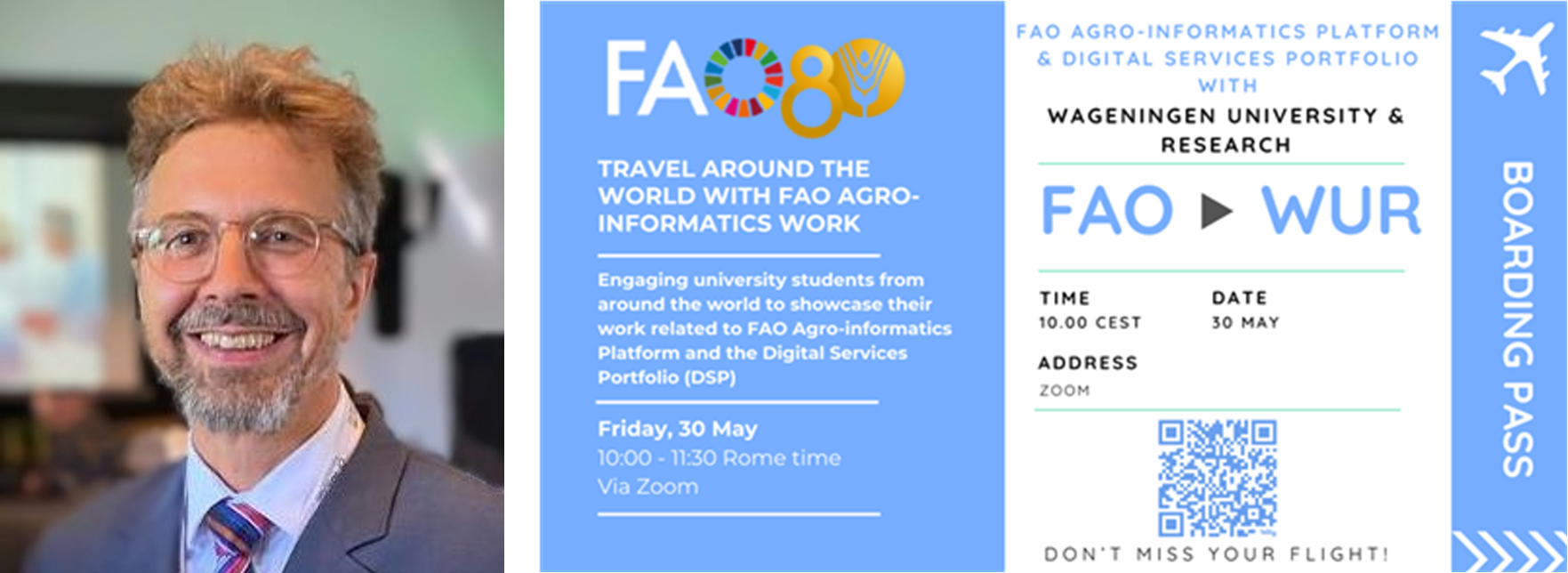
Connecting Students, Academia and the Future of Food
How can data and technology help drive the transformation of agrifood systems? Karl Morteo, FAO Senior Information Technology Officer, shares insights from FAO’s “global tour” for university students, which spotlights real examples where data and tech are driving inclusive, sustainable agrifood systems – and the partnerships with academia and research institutions that are powering this change.
“Travel Around the World with Digital FAO and Agro-informatics” brings together academia, youth and FAO experts around a shared goal: make digital tools in agriculture more accessible, inclusive and effective.
What role do universities and students play in developing and implementing digital solutions for agrifood systems?
Academia is a driving force for creativity, innovation and engagement with real-world challenges. Through partnerships with universities, FAO bridges cutting-edge research with its mission to apply digital tools in agriculture more sustainability and inclusively.
Students bring enthusiasm, analytical skills and a readiness to think differently. This helps FAO uncover fresh approaches that strengthen our ongoing digital work – including using artificial intelligence, data visualization and geospatial analyses to improve the way we understand and manage agrifood systems.
Through the Travel the World with Digital FAO and Agro-informatics initiative, students work directly with FAO’s open digital tools, such as the FAO Agro-Informatics Platform and the Digital Services Portfolio (DSP), helping them develop practical skills and an understanding of how technology can be a force for change in the daily lives of rural communities.
But it is genuinely a two-way exchange. FAO benefits from the ideas and contributions of these young researchers, who often identify new methods or approaches that help refine our ongoing work, while students and universities have the opportunity to interact directly with FAO experts.
How does the initiative help young people better understand the role of digital solutions in transforming agriculture?
This initiative connects what students learn in the classroom with real challenges faced by farmers, policymakers, and communities – helping them to understand how digital tools can help shape the future of agrifood systems.
Students get to see firsthand that digital tools are not just technical resources, they are instruments that enable smarter, faster and more inclusive responses to food security and rural development needs.
What we often observe is that students leave the sessions with a new sense of purpose. They see how their skills in data science, software development and analysis can directly contribute to better production, better nutrition, a better environment and a better life for all.
Could this initiative be extended to new regions or disciplines? How can universities get involved?
The initiative was designed to grow and evolve. We are already working with universities in Africa, Europe, Asia and Latin America, and are now connecting with institutions in the Near East and Pacific.
We are also encouraging broader engagement from diverse academic disciplines. Digital tools in agriculture thrive on a wide range of expertise beyond agronomy – such as computer science, data management, economics, geography and social sciences. Bringing these perspectives together leads to more practical, people-centered solutions.
Universities can engage by co-hosting sessions, integrating FAO’s open datasets into their teaching, or joining the Agro-informatics community of practice, which connects institutions that are interested in applying digital methods to agricultural and environmental challenges.
Universities can contact Jana Stankova to explore opportunities to participate in this initiative. The goal is to create a global learning community where students and professors contribute directly to digital tools for sustainable and inclusive agrifood systems.
How does the initiative help smallholders and marginalized communities access digital tools and data?
This is one of our core principles. Many smallholders and rural communities still lack access to the data, digital tools and training they need to participate fully in the digital transformation of agriculture, and we are helping address those gaps by connecting academic learning with community needs.
Students and universities are encouraged to develop and test solutions that can work in low-connectivity areas or be adapted to local languages and practices. These can be built on FAO’s Digital Services Portfolio (DSP), which provides countries with adaptable and open-access digital platforms. By linking student projects to FAO’s global systems, we help ensure their work reaches farmers and communities on the ground.
This not only strengthens local capacity but also helps bridge the digital divide. Students get to see how their efforts can make agriculture more inclusive and resilient, while giving smallholders and marginalized groups a voice in shaping the digital future.
How can the data generated through this initiative influence FAO Members’ decision making or policy setting?
University teams can contribute to projects that enhance FAO’s understanding of agricultural and environmental trends, and these findings can be used in dialogues with Member countries.
For example, students can use the Agro-informatics Platform to study land degradation, assess climate risks, or monitor the impacts of droughts and floods on agricultural production. Their outputs can inform discussions on land planning, sustainable practices, and adaptation strategies.
Research developed through the initiative has also helped improve tools within FAO’s DSP, particularly those supporting early warning, market access and farm management. These contributions, while educational for students, also strengthen the analytical capacity of FAO and its partners.
Any final thoughts you would like to share?
I would like to sincerely thank all the universities, professors and students that have joined this journey. Your enthusiasm and commitment are helping FAO showcase the power of digital tools in agriculture to build more efficient, equitable and sustainable food systems.
A special word of thanks goes to our participating institutions: the University of Nairobi, Wageningen University, Zewail City, the University of Sydney, Cornell University, Mississippi State University, Stellenbosch University, and the Asian Institute of Technology.
We are very excited about what’s to come in 2026. We are planning new, more interactive activities to deepen engagement, foster exchange across regions and showcase how digital tools can advance sustainable agrifood systems. Stay tuned – and join our Community of Practice for updates, learning materials and opportunities to contribute.