

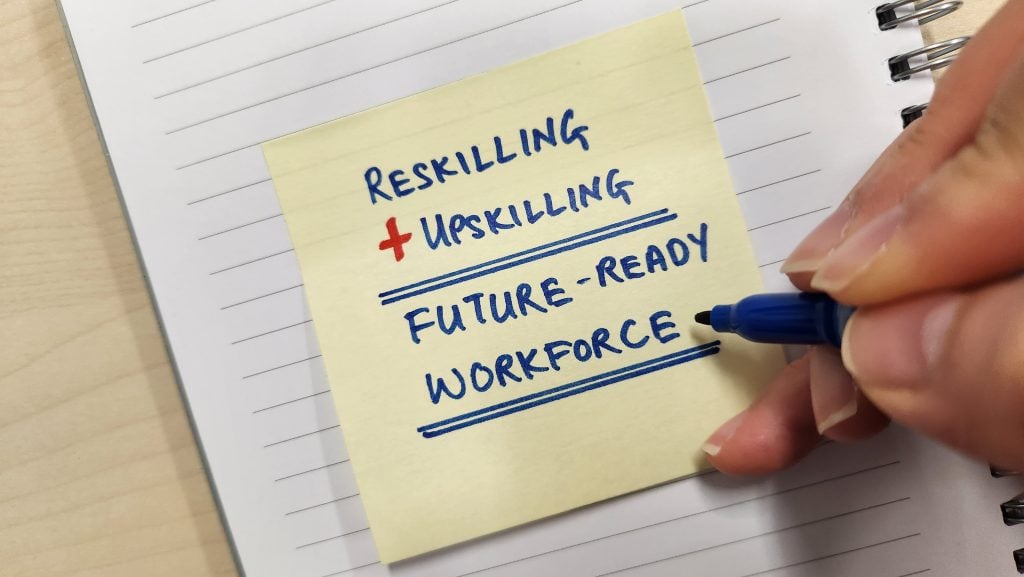
Upskilling and Reskilling for a Future-Ready Workforce
As talent shortages deepen and roles evolve faster than hiring markets can respond, organizations are turning inward to build the skills they need for the future. Kestria’s latest research highlights how upskilling and reskilling are becoming core strategies for strengthening internal capability, resilience, and retention. The insights that follow show why this shift is accelerating globally and how leaders are putting it into practice across regions and industries.

December 9, 2025 – With talent shortages continuing to intensify, organizations around the world are increasingly recognizing the need to upskill and reskill their current workforce. This growing focus on internal capability development is driven by the pace of technological change, evolving business models and shifting employee expectations, a recent report from Kestria explained.
According to the Kestria Global Leadership Barometer 2025, over 70 percent of leaders in the Asia Pacific region view internal talent development as the most effective strategy to address these challenges—more than double the emphasis placed on competitive compensation or global recruitment efforts. This perspective underscores a significant shift towards long-term capability building over reactive hiring practices. Kestria interviewed professionals from across various regions to further illuminate this trend, highlighting diverse approaches and programs that are successfully fostering internal growth and adaptability.

Andreas Meier, vice president of guarantees and documentary instruments at Siemens Energy, Germany, notes that attracting and retaining talent is increasingly challenging, with skilled candidates in short supply. “Identifying individuals who possess both the right educational background and strong character also requires significant time and effort,” he said. “My approach to interviews focuses more on personality than on technical expertise, as I believe company-specific skills can be taught to those who demonstrate the right attitude, integrity and willingness to learn. Consequently, given the evolving demands of our markets, demands our workforce must also embody, the most effective path forward is to upskill or reskill existing, reliable employees.”
Alfredo List, CEO at Planeta Listo, Mexico, emphasizes that the country faces a significant skills gap, as much of the workforce lacks the capabilities required by modern industries. “Upskilling and reskilling address this challenge by equipping employees with the competencies needed, reducing reliance on an already scarce and costly pool of skilled talent,” he explained. “At the same time, Mexico’s economy is undergoing rapid technological transformation, with industries adopting automation, AI and digital technologies at an accelerated pace. Targeted upskilling and reskilling programs can provide workers with the digital literacy and specialized expertise necessary to thrive in this evolving landscape; helping to prevent job displacement while fostering innovation.”
Nga Phan, general manager at Cargo-partner Logistics Co., Ltd., Vietnam, observes that with technology, automation and AI reshaping every industry, roles are evolving faster than hiring markets can keep pace. “Upskilling and reskilling enable organizations to adapt existing talent to new demands rather than relying solely on external recruitment,” she said. “Retention and engagement are critical for supporting employees’ career growth. Investing in learning builds loyalty, reduces turnover and enhances the organization’s attractiveness to future hires. While external recruitment is costly, developing internal talent leverages existing cultural alignment, shortens ramp-up time and creates a more versatile workforce capable of filling multiple roles.”
Fabian Ringwald, chief information officer at SWICA, Switzerland, stresses that the company seeks individuals who consciously choose to stay despite having other opportunities in the market. “As talent remains scarce, particularly those who align well with our company culture, we see it as our responsibility to ensure our people can grow and develop their skills within the organization,” he said. “Moreover, it makes clear economic sense to invest in employees with whom we have already built strong relationships, rather than simply replacing them.”
Building Skills Internally
For Mr. Ringwald, there is no ‘one-size-fits-all’ approach. “It is essential to provide orientation through a clear goal and corresponding development paths and to align these with an individual plan for each employee, taking into account their experience, background and motivation,” he said.
 Transferable Skills That Are in Demand
When embarking on a job search or considering a career shift, your transferable skills—those versatile capabilities gained across various roles and industries—can serve as your most powerful advantage. These skills demonstrate your adaptability and potential to thrive in new environments, even if your experience doesn’t align perfectly with a specific job description. But what exactly are they? These are abilities and expertise that you’ve gained in one role, industry, or life experience that can be applied to a new position or workplace, according to a just-released report from NPAworldwide. “Whether you’re shifting industries or advancing in your field, having a strong set of transferable skills ensures that you remain competitive and adaptable,” the report said.
As per Mr. Meier, everyone learns differently, yet on-the-job training remains a key cornerstone. “Reskilling can be highly effective when it begins by sparking interest,” he noted. “For example, through job shadowing or initial exposure to another field. From there, learning continues in practice: assigning responsibilities that go beyond current skills, encouraging employees to take initiative, while ensuring they are supported by colleagues who can guide them, as well as by interim learning programs that serve as reference points.”
Related: Why Soft Skills and Continuous Learning Are Key to Thriving in a Changing Workplace
Ms. Phan explained that they build expertise by training teams on specific trade lanes, helping sales and operations understand both commercial opportunities and compliance nuances. “Cross-functional rotation gives staff insight into the full operational journey,” she said. “We invest in digital tools training to ensure all employees are tech-enabled. Mentorship from senior experts preserves hard-won experience in-house. Customer-centric workshops use real cases, while global knowledge exchange strengthens collaboration. Leadership and foreign language courses, including English and Chinese, are also provided.”
“‘In our company, we recognize that employees have varying skill levels and learning needs, and we have developed customized learning paths that allow individuals to focus on areas requiring the most improvement,” said Mr. List. “Microlearning has proven particularly effective for busy employees who may not have time for extended training sessions. Additionally, less experienced employees are paired with senior colleagues for guidance and support. Mentorship programs provide valuable practical experience while fostering strong relationships within the organization.”
Tackling the Gap When Organizations Lack a Clear Talent Strategy
“The starting point is to ask which capabilities will be required to achieve growth over the next three to five years,” said Ms. Phan. “Our talent strategy is aligned with the business strategy. Rather than attempting to address everything simultaneously, we focus on a few critical skill areas, such as digital operations, customer solutions and compliance expertise. We also assess our current workforce to identify strengths, gaps and succession risks, targeting reskilling and upskilling initiatives in high-impact areas. Results are measured, lessons are learned and successful practices are then scaled across the organization.”
“The initiative must originate from the board or C-suite,” said Mr. List. “Once an initial gap analysis has been completed, the organization’s key talent priorities should be identified. Establishing specific, measurable, achievable, relevant and time-bound (SMART) goals and objectives is essential for an effective talent strategy.”
 The Select Guide to America’s Top 250 Executive Search Firms
Hunt Scanlon Media proudly presents the Select Guide to America’s Top 250 Executive Search Firms.
This comprehensive online directory is your definitive resource for finding the best executive search firms to serve your talent needs.
Our guide is meticulously curated to connect you with leading firms that specialize in various industries and functions, ensuring you find the perfect match for your executive recruitment needs.
Not having a clear talent strategy is not an option, according to Mr. Ringwald. “If one does not exist, it must be created,” he said. “As a leader, you owe this to every individual who is willing to invest their time working with you. Begin by evaluating your existing talent base and defining how you envision your future talent base. Next, identify areas requiring further development, explore the available opportunities and determine where external talent may need to be brought in. Finally, develop an individual plan for each employee, secure their commitment, align motivations and begin executing the plan.”
“It is difficult to answer, as my organization has never lacked a clear strategy—if anything, it was occasionally too rigid,” said Mr. Meier. “Today, I am pleased to be in an organization that has learned to be flexible in developing talent: allowing people room to learn and grow and providing individual programs in which diverse talents can flourish, whether 21-year-olds with no experience or 45-year-olds with extensive experience.”
Upskilling and reskilling are critical strategies for addressing global talent challenges. The Kestria Global Leadership Barometer 2025 shows that internal talent development is increasingly prioritized over reactive hiring. “Organizations implementing tailored programs, such as on-the-job training, mentorship, cross-functional rotations and digital skills development, enhance adaptability, retention, engagement and organizational resilience,” the report concluded. “Aligning talent strategies with business priorities and investing in employee growth enables companies to navigate evolving markets while fostering a versatile and motivated workforce.”
Related: What Skills Do CEOs Need Today to Succeed
Contributed by Scott A. Scanlon, Editor-in-Chief and Dale M. Zupsansky, Executive Editor – Hunt Scanlon Media