

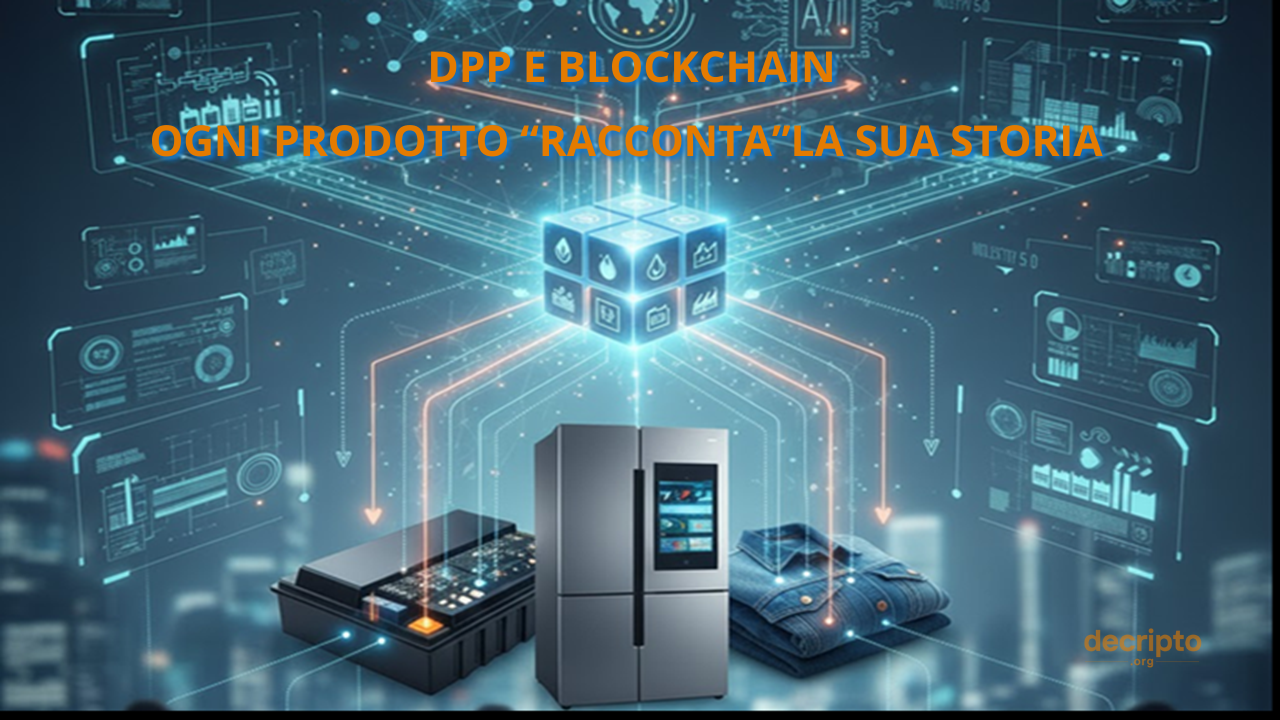
how to make products truly transparent
Blockchain makes possible a revolution in the production and sales processes of products. For years, the value of a product focused on what was immediately visible: the price, the brand, the appearance. Today, this logic is beginning to show its limits. Behind an object lies an increasing amount of information concerning its origin, the resources used to make it and the consequences of its use over time. Data that, until recently, remained confined to manufacturers’ systems or along opaque passages in the supply chain.

A garment is a concrete example of this. It is no longer just the end result displayed in the shop, but the outcome of a sequence of choices: raw materials, industrial processes, water and energy consumption, working conditions. When these elements become accessible, the product ceases to be a neutral object and takes on a broader meaning that goes beyond the function for which it was purchased. The same approach extends to technological goods.

Electric vehicle batteries can be monitored throughout their life cycle, accumulating information on performance, lifetime and technical interventions. Household appliances can make their energy impact measurable, transforming abstract data into comprehensible indicators. Even common appliances found in every home thus enter a dimension of traceability that was previously reserved for highly specialised industries.
This change is linked to the introduction of the Digital Product Passport (DPP), provided for by the European Ecodesign for Sustainable Products (ESPR) regulation. The digital passport was created to accompany the product along the entire supply chain, collecting structured and verifiable information. The use of blockchain helps to guarantee data integrity, reducing the risk of manipulation and making the relationship of trust between producers, consumers and authorities more solid.
In this context, transparency is no longer an accessory element, but becomes an integral part of the value of the product itself.
Blockchain: the heart of the digital passport
At the heart of the PLR mechanism is blockchain technology, which records every piece of data in an immutable and verifiable manner. Once entered, a piece of information cannot be changed without leaving a trace. For consumers, this means being able to verify the history of a product at every stage. For companies, letting people know in detail how a product was made, avoiding misleading or cosmetic claims, turns transparency into an important strategic lever. By showing real data on materials, processes and environmental impacts, companies can distinguish themselves in the market, build customer loyalty and win new business.
Most people associate blockchain technology with cryptocurrencies and financial speculation. In reality, its use can offer great opportunities to the industry that were difficult to imagine until a few years ago: product traceability, automated contracting, asset tokenization and intelligent data management.

Smart products thanks to IoT and AI
The Digital Product Passport integrates with Industry 5.0, IoT and artificial intelligence, ensuring up-to-date and reliable data. For companies, this means new business opportunities through predictive maintenance, more organised submarkets and greater logistical and design efficiency. The main challenge is cultural and organisational, as it requires close coordination between international suppliers and significant investment in digital skills.
Sensors along the supply chain can update data automatically, while artificial intelligence algorithms can analyse it to optimise processes and sustainability. In this way, each product becomes a small information hub, useful to both producer and consumer: a household appliance can indicate the right time for maintenance, a battery quantify the time remaining before losing capacity. The result is a reduction in waste, fewer breakdowns and longer product life.
Concrete benefits for businesses
Reliable data recorded on blockchain help companies reduce reputational risks, improve supply chain management and access regulated markets with greater security. At the same time, demonstrating concrete environmental and social commitments becomes a competitive advantage, especially in Europe, where sustainability is increasingly central to consumer choices.
Small and medium-sized enterprises must adapt, otherwise they risk being excluded from these dynamics. One possible solution is shared digital platforms or consortia, which reduce costs and complexity, making the benefits of PLR accessible to all. Those who know how to exploit these tools will turn transparency into a real competitive advantage: more sustainable products, evolved after-sales services and more organised secondary markets feed a virtuous circle of trust and sustainability.
The value of product history
The DPP is not just blockchain technology, but the symbol of a cultural revolution and the tool with which Europe redefines the relationship between businesses, supply chains and consumers. Trust is built on verifiable data, shared along the entire value chain. Those who know how to exploit this information can count on a concrete advantage in international markets, offering more sustainable, transparent and safe products.