

Inside OpenAI’s Plan To Make Money
Happy new year! After a short hiatus, The Prompt is back!
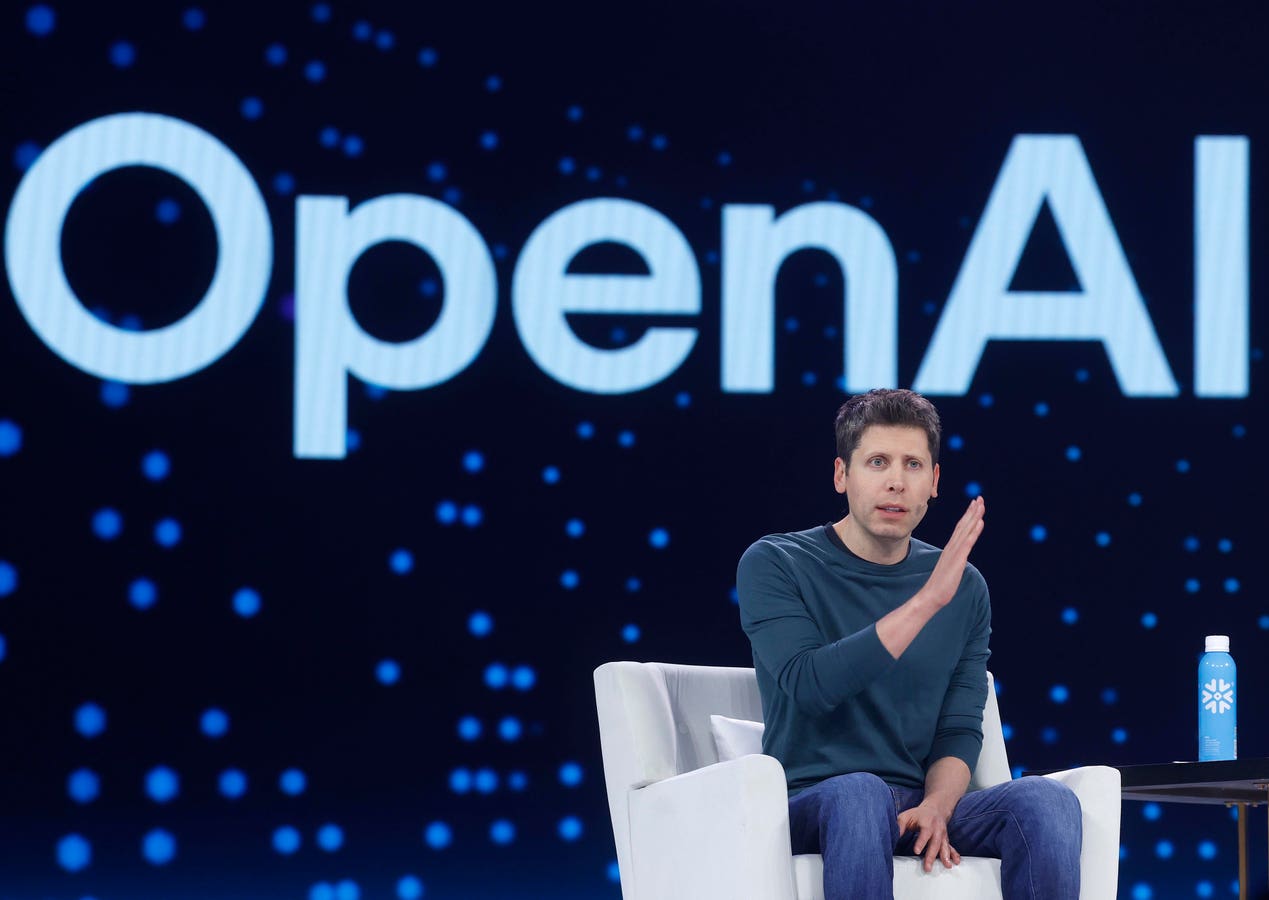
OpenAI CEO Sam Altman
Getty Images
OpenAI’s goal for 2026 is focusing on the “practical adoption” of artificial intelligence, Chief Financial Officer Sarah Friar wrote in a blog post over the weekend. In other words, getting the chatbot into more hands and ensuring people get the most out of it. Doing so will also help scale the business, creating the cash to spend on more compute to power further research breakthroughs and better products, Friar wrote. “Adoption drives revenue, and revenue funds the next wave of innovation. The cycle compounds.”
OpenAI ended 2025 with back-to-back massive infrastructure deals with the likes of Oracle, AMD and Broadcom that tallied up to $1.4 trillion of committed spend on compute over the next eight years— much, much larger than its revenue of $20 billion in 2025. Defending the company’s spending on compute, Friar added that OpenAI’s revenue has grown at the same rate as compute consumption: both tripled year over year.
OpenAI already charges different tiers of subscriptions for individual and enterprise users and its API platform business helps other developers build on top of its models. And most recently, it finally launched ads, revenue from which could amount to about $25 billion annually by 2030, according to some analysts— which could help cover the exorbitant costs of training and running AI models. But she’s thinking big about other possible revenue sources. “As intelligence moves into scientific research, drug discovery, energy systems, and financial modeling, new economic models will emerge,” Friar wrote. That includes things like licensing, IP-based agreements and outcomes-based pricing, where customers pay only for measurable results delivered by a product.
OpenAI is currently in talks to raise as much as $100 billion in additional capital to fund its growth plans. The investment could value the startup at as much as $830 billion, the Wall Street Journal reported last month.
Now let’s get into the headlines.
BIG PLAYS
Elon Musk, CEO of xAI
Hans Lucas/AFP via Getty Images
California’s attorney general Rob Bonta sent a cease and desist letter to Elon Musk’s xAI, demanding the company to stop the creation and distribution of AI-generated sexualized images. Lawmakers have raised concerns about people using the company’s AI chatbot to create nonconsensual sexually explicit images of women and children. Bonta also opened an investigation into xAI to determine if these images broke the law.
TALENT RESHUFFLE
Mira Murati, CEO of Thinking Machines Lab
Getty Images for WIRED
In a surprising move, a string of researchers and cofounders announced their departure from $12 billion-valued AI startup Thinking Machines Lab. OpenAI executive Fidji Simo announced that the company had hired three of Thinking Machines’ researchers including its CTO and cofounder Barret Zoph, Luke Metz and Sam Schoenholz, all of whom previously worked at OpenAI. Sequentially, two other researchers announced they’re leaving the startup. The exodus rattled investors as the startup seeks funding at a $50 billion valuation with little revenue and only one product, The Information reported.
AI DEAL OF THE WEEK
Humans&, a startup that aims to build AI products that help people collaborate with one another, has raised $480 million in seed funding at a $4.48 billion valuation, The New York Times reported. Founded just three months ago by researchers from top AI labs like Google, Anthropic, xAI and Meta, the startup is backed by Nvidia, billionaire Jeff Bezos and VC firms like SV Angel and Google Ventures. Forbes first reported that the startup was raising funding.
DEEP DIVE
The AI Data Center Gold Rush Is Leaving The Landlords Behind
Swollen with seemingly insatiable demand for computing power, the AI boom has birthed hundreds of unicorns out of thin air, minted dozens of billionaires and alchemized more than a trillion dollars in market value for big public tech companies like Nvidia, Broadcom, Google and Meta. It’s also inspired an infrastructure land grab perhaps unprecedented in financial breadth. Earlier this week, Meta CEO Mark Zuckerberg announced plans to build out tens of gigawatts of AI infrastructure this decade, and “hundreds of gigawatts or more over time.” At $50 billion per gigawatt, that’ll likely cost trillions.
Boom times for AI infrastructure should mean banner years for the companies that have historically provided it: data center real estate investment trusts, or REITs. Yet three of the biggest, Equinix ($78 billion market cap), Digital Realty ($55 billion market cap) and Iron Mountain ($27 billion market cap), aren’t seeing them. Their share prices are down 13%, 11% and 16% over the last year, respectively, compared to the S&P 500’s 17% increase.
These companies are the landlords for the internet; they buy real estate, build data center shells with supporting infrastructure, and lease the property to tech company tenants. They should be killing it. They’re not, and it’s likely because of a few things: lower appetite for risk, power constraints and lack of access to more—and more speculative capital.
Read the full story on Forbes.
MODEL BEHAVIOR
A number of monkeys are on the loose in the city of St. Louis and AI-generated images are making it harder to find them, the Associated Press reported. Many people falsely claimed that they had captured the monkeys, sharing fake images online as evidence even though the monkeys remained at large.