

Rwanda’s Skills Training Delivers Jobs and Opportunity for Youth
Results and Outcomes
Between 2017 and 2024, the program achieved the following results:
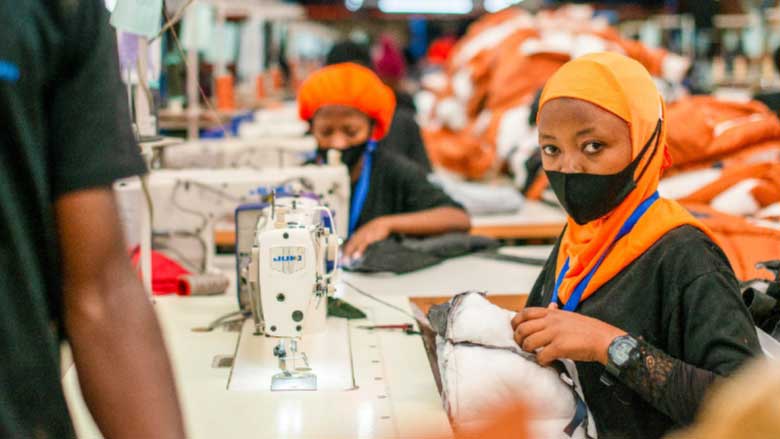
- Expanded equitable access to skills development opportunities: The SDF reached nearly 24,000 NEET youths (47.8 percent young female) and existing workers through industry led short term training and certification in priority sectors and introduced new flexible training opportunities for apprenticeships and upskilling of existing workers.
- Increased access to industry-led training: Over 5,900 new students enrolled in 46 new or updated industry-aligned, employer-led programs (44.3 percent women).
- Stronger employment and entrepreneurship outcomes:
- 82 percent of the nearly 24,000 graduates from short-term training and upskilling programs were employed or self- employed within nine months (41 percent female).
- 39 percent of self-employed graduates created at least one additional job.
- 83 percent of employers reported high satisfaction with PSG’s impact on the productivity of their workforce.
- Built a sustainable student financing system through data collection and analysis, improving the tracking of outstanding student loans since the 1980’s, which boosted repayment rates from 16 percent to 45 percent, enabling more access to students financing for long-term training opportunities at TVET and degree levels.
- Improved loan recoveries prioritized Science, Technology, Engineering, and Mathematics (STEM)-focused student loans, enabling almost 30,000 students (38 percent female) to pursue long-term TVET and degree programs in STEM fields, in line with the Government’s vision towards industrialization.
- Institutionalized the mandatory co‑creation of training curricula between industry and academia, thereby ensuring that programs evolve with the changes in the labor market.
- Strengthened institutional capacity. Established a new digital Graduate Tracking System, streamlining data collection of the employment status of graduates, cutting costs with the shifts from manual tracer studies, and strengthening evidence-based decision-making for skills development programs and curriculum.
- Contribution to WBG Targets and Jobs
The program advanced the World Bank Group’s jobs agenda by enabling nearly 22,000 SDF graduates to secure employment or become self-employed, with nearly 40 percent of the self-employed graduates each creating at least one additional job in priority sectors.
Lessons Learned
- Employer or industry-led training improves employment outcomes. Structured partnerships with industry or employers in skills development is a must to boost trainees’ employment outcomes.
- Balance short‑term training with longer‑term TVET, diploma, and degree‑level programs to build a workforce that can meet the demands and ambitions of rapidly growing economies. Relying solely on short courses may not be sustainable and cannot support the deeper industry growth that depends on both basic and advanced skills. Sectors such as energy, health, and pharmaceuticals illustrate this clearly—they require medium‑ and high‑level skills alongside entry‑level competencies.
- Expand pathways for skills acquisition for diverse groups across formal and informal labor market segments. Because target groups have different needs, they require differentiated skills and tailored training packages. The SDF introduced an innovative approach by creating multiple “windows” that offer flexible entry points for NEET youth and workers to gain employable skills, e.g., skills upgrading for Small and Medium Enterprises (SMEs) and selected foreign investors; out-of-school youth; apprenticeships, internships, informal sector training; Recognition of Prior Learning.
- A strong foundation in basic education—at least through junior secondary—is essential for effective skills development. When learners lack foundational literacy and numeracy, late‑stage upskilling becomes far less effective, particularly for NEET youth. These core skills are most efficiently built early on, making gaps in basic education a major constraint for later training initiatives.
- Strengthening the governance of the skills development system is crucial. A well‑organized skills landscape enables shared goals and coordinated targets across ministries and agencies, and supports evidence‑based strategies. Effective governance should prioritize labor‑market forecasting to guide skills development pathways, and improve system‑level planning, budgeting, and monitoring. Stronger, formalized coordination mechanisms with industry and relevant line ministries are essential to ensure that skills interventions are coherent, efficient, and responsive to labor‑market needs.
Next Steps
Rwanda Priority Skills for Growth Program directly contributes to stronger human capital and improved conditions for private sector development—fully aligned with Rwanda’s and the World Bank’s 2023 Country Economic Memorandum priority of boosting productivity and competitiveness. It also advances the World Bank’s “Investing in People” agenda by expanding access to education, skills acquisition, and employment opportunities for vulnerable populations.
Building on this strategic direction and to deepen support for a market responsive and inclusive skills ecosystem, the Government of Rwanda and the World Bank launched a subsequent $200 million operation. The Priority Skills for Growth and Youth Empowerment (PSGYE) Program builds on the strong foundation of PSG and will:
- Scale up employer aligned training for more than 200,000 youth and workers in micro and small enterprises
- Expand opportunities for vulnerable and NEET youth to acquire market relevant skills
- Improve the labor market relevance of TVET and degree programs in priority sectors
- Further strengthen skills system governance, including improved student loan recoveries and greater access to laptops to support blended and hybrid learning in tertiary education
Through results-based financing, PSGYE aims to embed these reforms at national and institutional levels—helping translate skills investments into lasting jobs and productivity gains.