

NAO boss calls for ‘step change’ in financial management across UK public sector

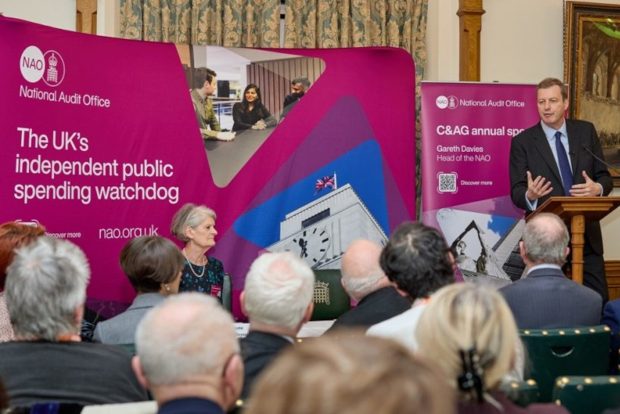
“Government systems are set up to control spending within budgets, not to help managers manage”: Gareth Davies speaking to a largely parliamentary audience on 10 February | Credit: Justine Desmond Photography
The head of the UK’s National Audit Office (NAO) has called for a “step change” in the standing attached to the “often underplayed” role of financial management in enabling the public sector to hit cost-saving targets and ultimately deliver better services to citizens.
Gareth Davies, the NAO’s comptroller and auditor general, spoke of four “fundamentals” of financial management that can “unlock the improvements in value for money we all seek” during a keynote address to a largely parliamentary audience in the Palace of Westminster on 10 February.
These fundamentals are: “timely and accurate” financial reporting; the “right” financial management information; “skills and capability” needed to inform decision-making; and leadership and culture to “drive” better financial management.
Davies was speaking just a couple of weeks after the NAO – which exists to scrutinise public spending for Parliament, assessing about 400 annual reports and accounts (ARAs) each year – highlighted that some central government departments are suffering from ‘weaknesses in getting the basics of financial data and reporting right’ in a first-of-its-kind report collating and presenting insights into their annual book-keeping.
As part of the government’s 2025 Spending Review, all UK departments are to deliver at least 5% savings and efficiencies by 2028-29. The target was described by Davies during a Q&A session after his speech as “more thoroughly thought through and more soundly based than previous efficiency plans – although that is a low bar” before he added that – by improving business processes and applying technology – “we ought to do a lot more.”
Read more: NAO identifies ‘weaknesses in getting basics right’ in UK government annual accounts
Local government’s ‘cautionary tale’
Davies highlighted during his speech that that too often basic requirements are not being met, as proven by the Whole of Government Accounts being disclaimed for a second year in a row.
The Whole of Government Accounts for 2023-24 were disclaimed by Davies in July 2025. As with the 2022-23 accounts, the cause was the lack of audited accounts for English local authorities.
“Not all departments and public bodies yet match the best for timely and high-quality accounts,” said Davies. “If you are in any doubt that timely and robust accounting matters in the public sector, the situation in English local government remains a cautionary tale, where backlogs of unaudited accounts… mean that a material part of the Whole of Government Accounts is not assured, but also that local taxpayers are not getting the most basic form of financial accountability.”
Arguing for a more proportionate reporting regime for small public bodies, he urged that “reporting requirements [should] serve their purpose of clear accountability and not become an end in their own right”.
“Managers often do not have access to the activity cost information they need to drive efficiency and performance. Government systems are set up to control spending within budgets, not to help managers manage,” he said, on wanting fit-for-purpose financial management information.
“If the unit cost of delivery, and the components making it up, are not well understood, it’s difficult to make sound operational decisions: how do you know where the biggest ‘bang for the buck’ is?”, he asked, rhetorically.
Read more: HM Treasury picks HSBC to provide platform for UK government’s first blockchain bond issuance
‘Clear tone for the top’ needed
On skills and capability, Davies said that the “challenge of transforming services and business processes and delivering real efficiency improvements requires more rather than less of these high-level financial management skills”.
“It’s not a question of headcount, but of expertise,” he said in the speech. “We see significant scope for better integrating expert financial advice into the decision-making process. There are great examples of departments getting this right. The result is better planning and forecasting and better operational decisions.”
On leadership and culture, he called for “a clear tone from the top and a credible narrative on the achievements made possible by a better grip on the money,” adding that “financial management is not just about compliance – it’s how better results are delivered”.
He later focused specifically on the hot topic areas of defence and artificial intelligence, as well as “system-wide improvement, including devolution”.
On defence, he highlighted that NAO ‘defence value-for-money reports’ had shown “painfully clearly that without robust financial management, additional funding will not deliver the capability we [the UK] need”.
On AI, he highlighted that the NAO “will update [its] previous work on government’s progress in identifying use cases for AI and whether the expected benefits in efficiency and service quality are being realised”.
On devolution, he said that government’s “shifting resources from the centre to regions and localities… adds urgency to work on local audit improvement”.
Read the public financial management topic section of our sister title, Global Government Finance.
‘Continues to be much to do’
Davies was speaking a year since a NAO five-year strategy (2025-2030) set out a plan to “contribute to two distinct outcomes – helping to improve the productivity and resilience of public services and supporting better financial management and reporting in government”.
“Trust and value have been central to the NAO’s remit for its whole existence. But our strategy sets a new level of ambition for our impact. We want our work to help improve the productivity and resilience in public services and support better financial management and reporting in government,” Davies said.
Just over two years previously, in a speech delivered in Parliament, he highlighted “five ways in which government could improve productivity and resilience”: major infrastructure projects; asset management; procurement; digital transformation; and reducing fraud and error.
“While our work shows that there continues to be much to do on each of these challenges, I want to acknowledge first that government has taken some positive steps,” he said, going on to specify elements of progress.
But he recognised “how much there is to do to convert all this activity into better results for taxpayers and service users”.

NAO ‘in foothills’ on AI
Dame Meg Hillier MP, who chairs the Commons Treasury select committee and the Commons liaison committee, asked during the Q&A about the extent to which the NAO was using AI and the risks of AI use.
“The audit industry is one of the sectors where it’s going to make the biggest impact, I suspect, because our job is looking at large amounts of data and assuring the accuracy of the data [and] also drawing insights from that for value-for-money purposes,” Davies responded. “I would say we’re in the foothills as an organisation of applying it to our work – although we have started. We are using machine-learning tools, which are accelerating key bits of the audit: at the moment this is essentially taking out some of the routine work that the junior members of the audit team will be doing (comparing an invoice to a ledger entry, matching them up and moving on to the next one). That is many times faster now using these tools than it was when that was a purely human process.”
“Of course, where this is heading, I think – particularly as government is moving on to new financial systems through its ‘shared services’ approach [ongoing central government strategy to cut costs through the sharing of back-office functions between departments] – is the end of old-fashioned audit sampling towards analysis of the entire population on the ledger, and all sorts of questions about how we assure that. So there’s a lot of automation coming in the audit process,” he said.
On the second part of Hillier’s question, Davies described audit as “really about trust”, explaining that “there is a new ‘trust question’ that AI presents, which is: ‘can I trust the way this technology is being applied?’ Can I trust the algorithms that are making decisions about service provision, benefit claims…?’.”
Here to ‘win the match’
Davies, continuing his answer to Hillier, referred to an HM Revenue & Customs (HMRC) ‘data-matching’ initiative – currently being investigated by the NAO – to combat child benefit fraud.
“HMRC have – quite rightly, I think – experimented with data-matching techniques to try and drive down fraud and error in child benefit. It’s a really important thing that they were innovating but there are clearly lessons to be learned from what happened in that case where lots of innocent people were dragged into the net unnecessarily. And I know HMRC is busily learning lessons on that, too,” he said, saying that the NAO’s report would be published in the “late spring”.
“There is no such thing as risk-free application of this technology,” he continued. “But how do we minimise the severe effects on the public? How do we minimise unfairness and inequity in its application? HMRC is a great example but I would say that mustn’t discourage the innovation and use of new techniques. We just have to get better at doing it.”
Later during the Q&A Davies was asked by Jon Watts, who is chair of the audit and risk assurance committees of both the Foreign, Commonwealth & Development Office (FCDO) and Environment Agency, whether the Government Finance Profession is “generally undervalued”.
“In a way that was the whole purpose of my speech, [which was] to say: ‘I think that there’s a lot of talk, quite rightly, about digital skills, because there’s a long way to go on that, but we mustn’t take for granted the kind of financial skills we’re going to need for those level of achievements,” Davies responded.
“The finance profession in the civil service a few years ago had a slogan that was, essentially, ‘we’re not here just to keep the score, but to win the match’,” he continued. “And I think that that is actually spot on for what government needs from its finance specialists, and that’s why we are really behind the strategy that the [Government] Finance Function has for making those improvements.”
The Government Finance Function’s latest strategy (‘GFF Strategy 2030’) was published in July 2025.
This article was originally posted on the website of our sister title, Global Government Finance. Sign up to the Global Government Finance newsletter.