

Making it real: how Gen Z turns online energy into IRL community
When Jesse Perlmutter, 23, moved to New York in July after graduating from college near Chicago, she wanted to expand her circle and meet people with similar passions. Roughly six months later, she has attended a scavenger hunt, morning run clubs, and happy hours that she discovered through social media.
Perlmutter, who runs the marketing efforts at an online financial company, said the run club has become a staple in her Thursday morning routine.
“I left the first run club with three new contacts in my phone and was added to a busy group chat,” she said. “After the run, everyone walks over to a coffee shop to talk and hang out more. It’s such a great community, and I can’t believe I found it from Instagram.”
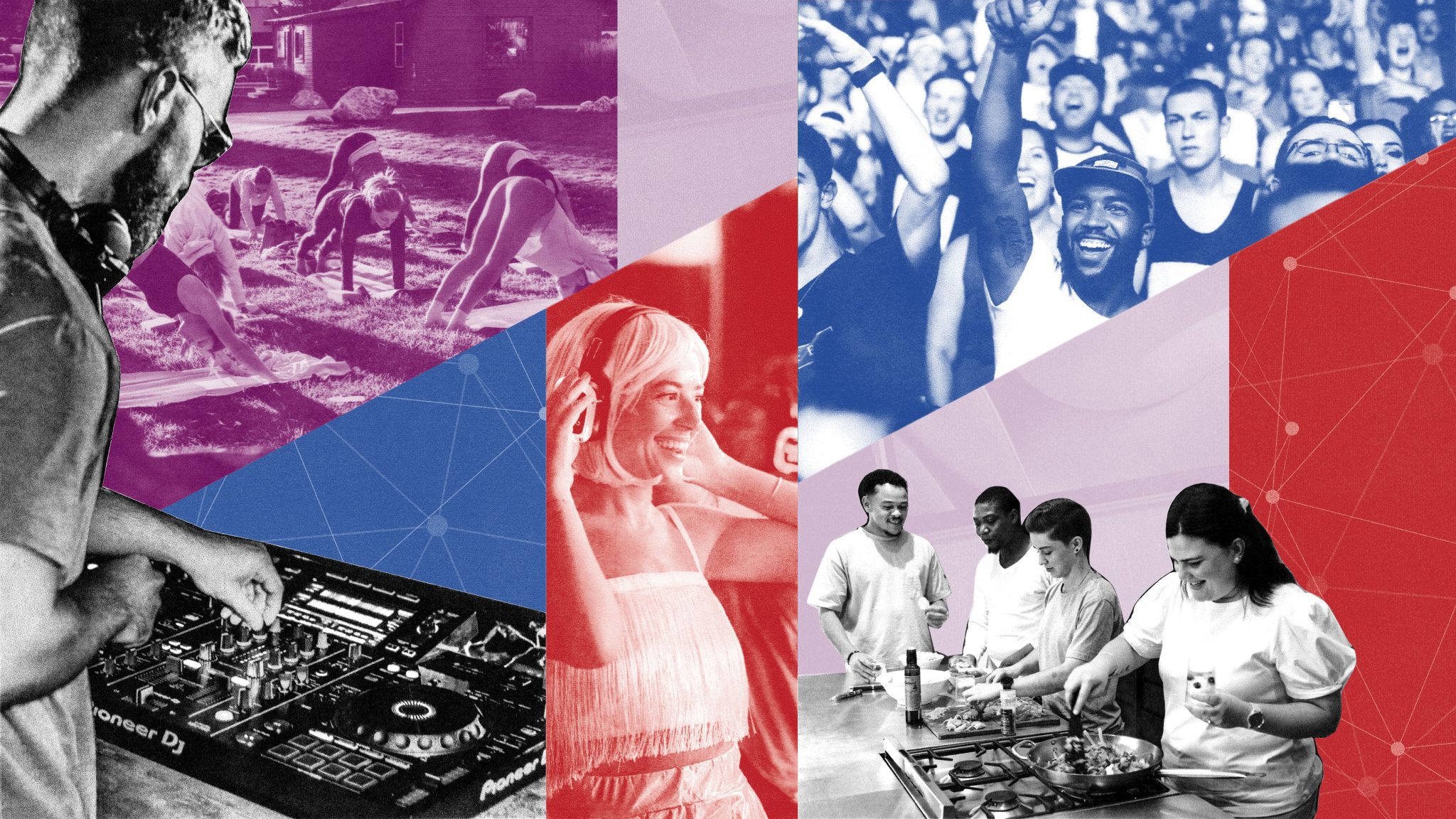
Gen Z’s years spent on screens fostered fluency in online communication and creativity, but it also reinforced the illusion that connection was happening elsewhere. Now there’s an intense craving for in-person connection and Gen Z is reclaiming real life moments. Young people are using their online communities to create, host and attend in-person gatherings, as well as forge memories at places like sporting events and music festivals. They’re using tech to organize pop-ups, panels, and community gatherings, actively engineering face-to-face connections in a generation that’s been conditioned to opt out. In an era of constant connectivity, IRL has become a counterweight to a digital reality that feels infinite and sometimes exhausting. The need for this has only increased since the pandemic; while remote and hybrid working has boomed, spending time in third spaces – like movie theaters, cafes and libraries – doesn’t fit into a busy day.
In-person moments matter now because they can’t be optimized, sped up or endlessly replicated. “Real life events are a way to re-anchor into something real,” says Milo Speranzo, Chief Marketing Officer for Lenovo North America, whose team created Make Space, a platform aimed at bringing the creative community together to discover new opportunities, possibilities, and forms of expression, all powered by Lenovo AI. “Physical space has become one of the few places where trust forms naturally and creative identity feels grounded, not performed.”
Live and in-person events growing in popularity
According to a 2025 report by event management platform Eventbrite, 73 percent of 2000 survey respondents in the U.S. aged 18 to 35 years old plan to attend live events in the next six months. In 2022, that number was barely over 50 percent (according to Civic Science). Eventbrite calls these events “gatherings that transform online interests into meaningful real-world connections and self-discovery opportunities.”
In fact, nearly 20 percent of Gen Z adults attend live sports two to four times a year, the highest rate of game attendance. They also went to the movies more than any other age group in 2025, with members watching together on the big screen 6.1 times on average. Overall, the global live events industry is projected to surpass $1.3 trillion by 2032, when the youngest Gen Zer will be 20 years old.
Julia Hartz, Eventbrite cofounder, CEO, and executive chair, said in a report that the data reflects a pivotal moment in the way that younger generations form connections, showing a demonstrated ability to turn online passions into genuine communities.
And the events seem to be having a significant positive impact. The report found that 84 percent of people who attended events based on their interests developed close friendships.
Perlmutter said she’s now close friends with a girl she met during her first run club meeting.
“We stayed side by side for the full three miles and didn’t stop talking the entire time,” Perlmutter said. “I couldn’t tell if I was out of breath from the run or our non-stop conversation. It was clear we had clicked, and now we have a built-in weekly run and coffee date together.”
The push to facilitate in-person connections
For Gen Z creatives in particular who live and work online there’s a burgeoning shift from performance to presence, and from broadcasting to belonging. Many are exhausted by the pressure to constantly produce, optimize and brand themselves. Live events aren’t just experiences. For Gen Z creative communities, they’re one of the positive ways to feel grounded in something real. But even with the plethora of tools on hand, taking the leap to reach out and meet up with people is no small feat.
Author and Stanford psychologist Jamil Zaki conducted extensive research into the barriers standing between young people and in-person meetups. According to Zaki, a leading issue is that this cohort doesn’t realize how much their peers want to connect in real life, too, and the best way to break that barrier is to take a chance.
Scientific research shows the brain boosting effects of in-person connections and social gatherings. When we are face-to-face, we are in a shared environment, not a divided one, so our brains are in sync, from body language to eye contact. Our brains and bodies are hardwired for this “social glue,” and the results can be immensely positive. And, at a time when attention is constantly being captured for the algorithm, it’s even radical. Last year, social media influencer, podcaster, and author Christina Najjar took one such leap of faith and hosted No Phones in Soho in New York, a tech-free party that attracted a line around the outside the club, full of young people ready to ditch their devices and connect. Known as Tinx, she’s often called ‘TikTok’s older sister’ to her audience of over 1.5 million followers who are primarily millennial and Gen Z women. Najjar’s SiriusXM podcast, It’s Me, Tinx, is defined by her advice to callers about dating, mental health and the loneliness epidemic. She dubbed the months of June to August ‘summer of outside,’ urging them to get off their screens, out of the house, and into social situations.
“I looked out and I saw people talking, and it was just my dream,” she said on the show about her “no phone” party. “People kept saying to me, ‘I feel so free without my phone. I feel so free.’ And it was awesome.”
Creative spaces push in-person
María José Gutierrez Chavez, 25, said she regularly pushes herself to attend in-person PR events as a reporter at Inc. magazine.
“As fun as they look on paper, it can be hard to force yourself to attend a space where you most likely don’t know anyone — especially after a full day at work,” she said.
“But by going, I’ve met people who I end up grabbing coffee with outside of work, made friends who invite each other to our birthdays, and many who actually hit me up and send me job opportunities.”
Gen Z is craving experiences where they can actively build connections. “They’re looking for spaces that offer genuine community, room to experiment, and the chance to express themselves without pressure to perform,” says Speranzo from Lenovo, which has done extensive research on young consumer habits. “That shows up as a preference for experiences where they can participate, learn by doing, and connect across disciplines, not just watch or consume.”
Savvy tech brands recognize the need to tap into this craving for human experiences, even when engaging with next gen tech is the goal of an event. Lenovo’s Make Space is an initiative that builds in-person experiences and environments that aim to empower creatives by demonstrating how they can confidently use modern technology like AI in their artistic endeavors. The technology is embedded into the experience of touch screens that affect the room, tools people can play with together, DJs and their visual team using our devices, and AI that supports exploration.
Lenovo hosted Make Space NYFW X DAZED to launch the series in Brooklyn last February. The event featured DJ sets, artist installations by various artists, and an AI-driven runway experience powered by Lenovo’s Yoga Aura Edition AI PCs. Taking place during fashion week, the event pulled in a mix of attendees from different disciplines, like fashion director and stylist Nicola Formichetti who used Lenovo’s Yoga Aura Edition, AI and Smart Modes to build a digital fashion show, and Osean, an artist and creator, used the tools to create a virtual walk-through of a neon city. The entry line snaked down the block.
Gamers are doing it live
Even communities built entirely online are craving connection and community, and there’s a corresponding shift in how Gen Z interacts with online content. That has influenced how Lenovo’s gaming hub has designed experiences, says Volker Düring, VP & GM of PC Gaming at Lenovo. “We blend offline events with online storytelling so gamers can participate before, during, and after” he said. During Epic’s Unrealfest 2025, Lenovo gave Legion 9i laptops to Indie Game Developers @Loftia.gg and @Swammy who taught classes on site on how to build games on a gaming PC. Then they created digital content and how-to guides on Legion’s social handles.
Lenovo was also the official technology partner of both the FIFAe and the Esports World Cup 2025 (EWC), providing Legion Towers & Ecosystem devices to power the 2000-plus teams for the competition and experience zones.
In a culture shaped by feeds and filters, the most radical act might be simply showing up. In-person events offer credibility and shared energy that digital spaces can’t manufacture. “Helping people find each other, co-create across disciplines, and feel welcome without scale or spectacle is the goal,” says Speranzo. “At its best, technology acts as connective tissue rather than the main event, enabling pop-up creative spaces and moments of collective making that feel local and human.”
For a generation raised online, creating spaces for a real social life and meaningful connections is not just a bonus, but a human necessity.