

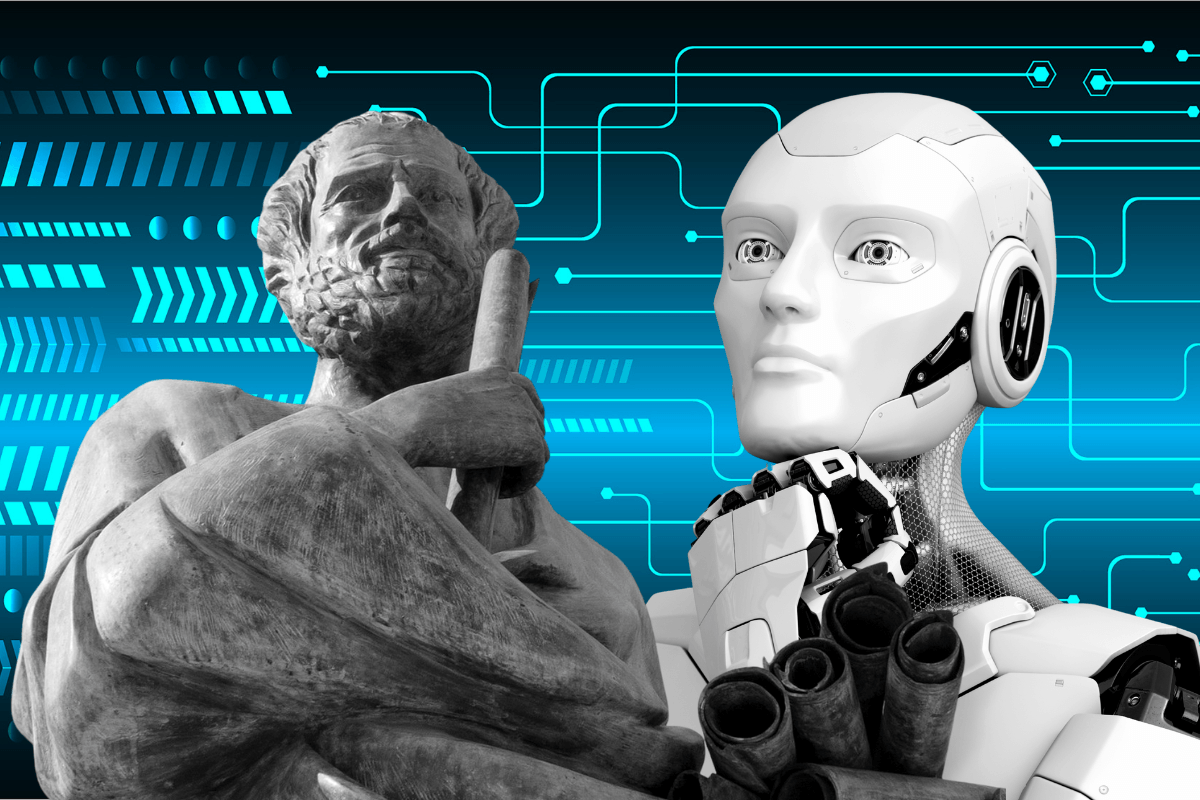
To revive its competitiveness, the EU must double down on brain skills
If Europe is to leapfrog economically, it must complement its competitiveness agenda with a stronger focus on human ingenuity alongside technological development. Several important initiatives are already underway. The Savings and Investment Union aims to revolutionise funding for innovation, while the EU-INC proposal would create a single digital register for companies. EU leaders will discuss progress on the entire competitiveness revival at this week’s Summit in Brussels.
As these initiatives take shape, a new source of dynamism must be activated, placing humans on the offensive in their relationship with technology.
In Power and Progress: Our Thousand-Year Struggle Over Technology and Prosperity, Daron Acemoglu and Simon Johnson argue that the Industrial Revolution was ultimately driven not by cheaper energy or labour, but by the entrepreneurial drive of a new class of businesspeople. Today, this insight translates into a renewed focus on the “human advantage” in an increasingly democratised economy. This means doubling down on brain skills, including foundational cognitive, interpersonal and technological literacy. These capabilities underpin our ability to adapt and build purpose, the foundations of a successful socio-economic model.
Combining human and machine strengths will not happen automatically. It requires deliberate corporate and national strategies. The challenge lies between two extremes: total AI adoption, which leaves little space for human agency and outright resistance, which assumes AI will fail to deliver on its promise. As Erik Brynjolfsson recently observed, there are signs of an emerging AI-driven productivity surge. His calculations suggest US productivity increased by 2.7% in 2025, compared with an average of 1.4% over the past decade. Research from the Stanford Digital Economy Lab confirms that the largest productivity gains emerge when technology augments human capabilities rather than replaces them. The greatest economic value therefore lies in redesigning work so that machines and humans focus on what they do best.
Brain skills are key because they support adaptability, creativity and performance. Their development starts early in life, at the height of neuroplasticity when children and young people benefit from safe and enriching environments. Investment in brain skills generates substantial returns and translate into better-equipped workforces. According to the World Economic Forum, 59% of employees will need additional training to meet evolving skill demands by 2030. As Professor Rym Ayadi puts it: “In the age of artificial intelligence, resilience will not be determined by the power of our algorithms, but by the strength of our brains”.
Brain skills develop only within a supportive environment of positive brain health. For this reason, the two have been combined in the concept of brain capital. Brain health refers to the ability to maintain positive brain functioning and achieve one’s full potential throughout life. Focusing on the brain is not about siloing public health to the detriment of other organs. Rather, it reflects an understanding that the brain regulates core life functions and complex decision-making, and is the seat of human intelligence.
The brain therefore plays a decisive role in achieving productivity gains, the Holy Grail of economic progress. Human-machine complementarity means doubling down on the importance of judgement, creativity, empathy and problem-solving. But productivity gains only materialise when organisations redesign work processes. This requires new business models, workforce training and reskilling, and institutional adaptation across labour market rules, education systems, corporate governance and regulatory frameworks.
At the height of the COVID-19 pandemic, the EU launched the SURE programme – Support to Mitigate Unemployment Risks in an Emergency. With a budget of €100 billion, the programme financed short-time work schemes and similar measures designed to keep workers formally employed even as economic activity slowed. European Commission data shows that SURE supported 31 million workers and 2.5 million companies across 19 member states, acting as the EU’s first large-scale social stabilisation instrument.
Today’s labour markets require a different type of protection. Employment security will depend less on emergency measures and more on helping companies adopt AI responsibly, upskill workers and design technologies that complement human capabilities. The European Commission should therefore propose a new programme modelled on SURE, focused on enhancing human-AI collaboration. Such an initiative would created hybrid workforces in which humans and AI agents operate as collaborators. Rather than adopting technology for its own sake, companies would be incentivised to deploy it in ways that increase the contribution of individual employees.
Such a programme – perhaps called BRAIN-SURE – would be an innovative social policy intervention, embracing technology as a force for human-centred economic growth rather than viewed as a perpetual threat.
Harris Eyre is Lead and Senior Fellow for Neuro-Policy at Rice University’s Baker Institute for Public Policy and Executive Director of the Brain Capital Alliance and the Brain Economy Hub.
Elizabeth Kuiper is Associate Director at the European Policy Centre.
Paweł Świeboda is Senior Visiting Fellow at the European Policy Centre and Co-Founder of the Brain Capital Alliance.
The support the European Policy Centre receives for its ongoing operations, or specifically for its publications, does not constitute an endorsement of their contents, which reflect the views of the authors only. Supporters and partners cannot be held responsible for any use that may be made of the information contained therein.