

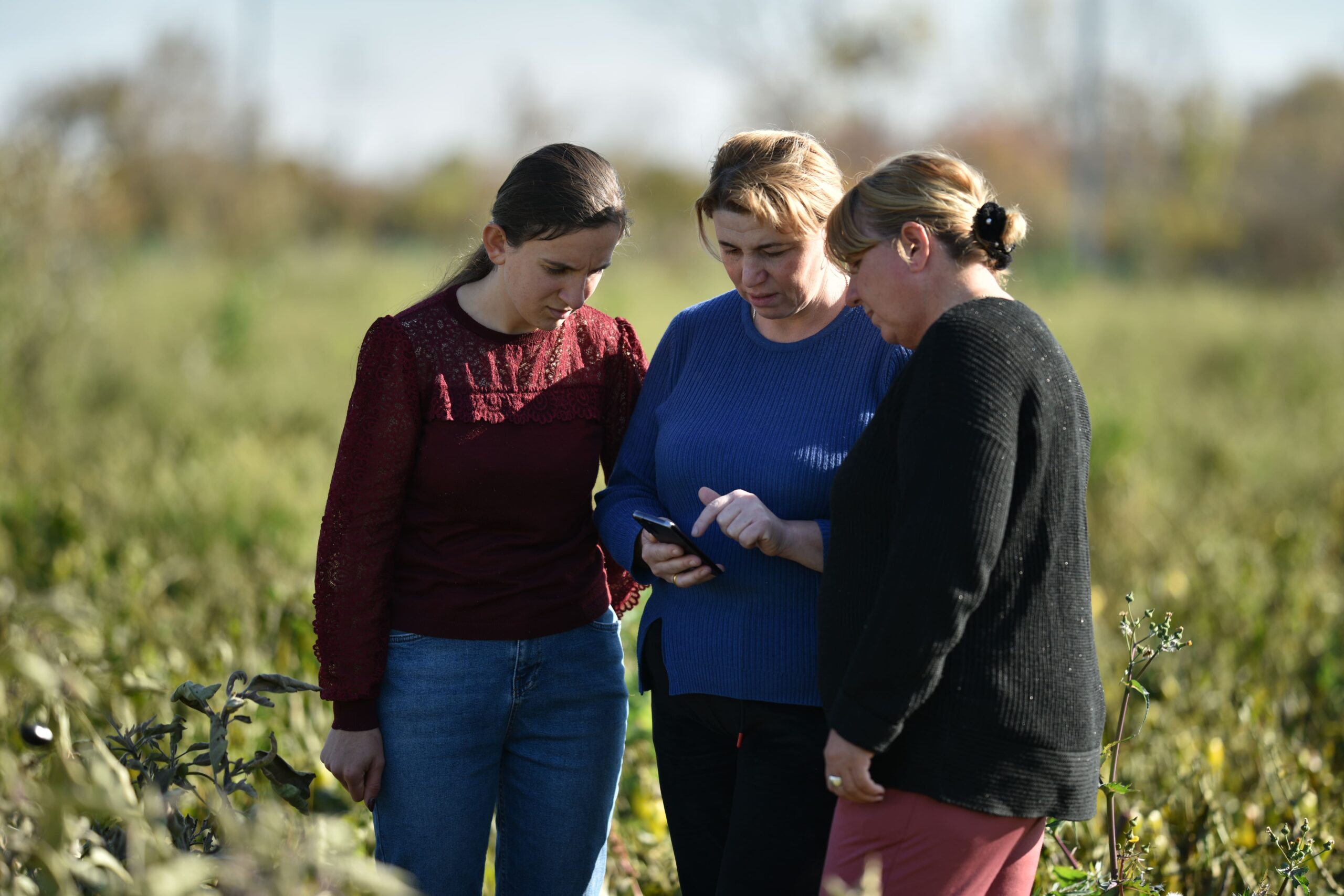
How farmers learn in the digital age – International Day special
In celebration of the International Day for Digital Learning (19 March 2026), this first issue of AgriTech Observer examines how digital learning has reshaped – and will continue to reshape – the way farmers learn in Europe and Central Asia.
Drawing on a review of more than 55 digital learning solutions and practices documented in the FAO AgriTech Observatory, this edition examines both the informal and structured digital learning ecosystem. It also analyses their transformation across two principal stages – digitization, characterized by the expansion of informal online learning, and platformization, marked by the emergence of organized communities, digital libraries and formal e-learning environments. The article concludes by exploring the transformative potential of artificial intelligence (AI) and the enabling conditions required for its effective and inclusive deployment in agricultural learning contexts.
The informal digital learning ecosystem for agriculture
The first wave of digital learning in agriculture began with connectivity. As broadband infrastructure access expanded across rural Europe and Central Asia during the 2000s and 2010s, farmers increasingly accessed online search engines and specialized websites to access agricultural knowledge, progressively complementing traditional public extension systems.
The diffusion of smartphones marked a second inflection point. Mobile devices effectively placed digital learning tools in farmers’ pockets, enabling real-time access to multimedia content and peer networks. Platforms such as YouTube and Facebook, alongside messaging applications including Telegram, Viber and WhatsApp, emerged as major channels for informal agricultural knowledge exchange. More recently, Instagram and TikTok have gained relevance, particularly among younger farmers.
Survey data confirm the relevance of online sources for agricultural information and practices in Europe and Central Asia, though adoption remains uneven. In the European Union (EU), around 80 percent of farmers browse the internet for information about improving farm practices[1]. Outside the EU, surveys conducted by FAO show that respectively approximately 50 percent of farmers in Uzbekistan[2] and 40 percent of smallholder farmers in Belarus[3] use YouTube, other social media, websites and mobile apps as sources of information and advice for agricultural practices. Adoption rates, however, vary significantly across the region. In Albania, only 26.5 percent of farmers report going online for agricultural guidance[4], while in Tajikistan the figure drops to just 8 percent[5], highlighting persistent disparities in digital access and usage. Within this informal learning ecosystem, messaging applications have evolved beyond communication tools into functional knowledge networks. Telegram is used especially across the Central Asia, while Viber plays a more prominent role in many countries in Eastern Europe and the Western Balkans.
|
|
At the same time, digital “agri-influencers” are emerging as new intermediaries in agricultural knowledge systems. Often experienced farmers themselves, they disseminate technical demonstrations and cultivation advice through short-form video content. Abdukadyr Abdushukurov in Kyrgyzstan, for example, shares practical content on orchards, vineyards, poultry and horticulture with more than 500 000 followers on Instagram. In Türkiye, Emine Kaya — a young farmer and agricultural technology student — combines farm management with digital outreach, engaging tens of thousands of followers across Instagram and TikTok.

©FAO/Danil Dolidze
Platformization of agricultural knowledge: websites, digital libraries and online communities
Beyond social media and messaging applications, specialized agricultural websites remain a foundational layer of the informal digital learning ecosystem. Evidence from the AgriTech Observatory highlights several recurring models:
|
|

© FAO/ Sanja Knežević
Structured digital learning in agriculture: online courses, certificates and skills development
Beyond informal channels, we can observe more formal and structured digital learning platforms dedicated specifically to agriculture. These platforms offer modular coursework, structured curricula, assessments and certifications, sometimes with blended online and in-person training, formalizing digital learning into recognized skills development pathways.
Structured digital learning platforms offer several distinctive advantages over their informal counterparts. They enable standardization: learning outcomes can be clearly defined, aligned with national agricultural priorities, and linked to broader policy objectives such as climate adaptation or food safety compliance. They also offer considerable scalability, making it possible to train large numbers of learners without a proportional expansion of advisory personnel or physical training infrastructure.
A defining feature of structured digital learning platforms in agriculture is the provision of certification, which frequently serves as a key incentive for participation. Proof-of-completion certificates can either document acquired knowledge and competencies per se, or serve as qualifying credentials for accessing finance, subsidies, value chain participation, or regulatory compliance.
Platforms that provide proof-of-completion certificates primarily position certification as evidence of acquired knowledge and competencies. Notable examples documented in the AgriTech Observatory include:
|
|
A more instrumental form of certification connects course completion directly to financial schemes. Two examples from Türkiye are illustrative:
|
|
Despite the demonstrated potential of structured digital learning, significant challenges remain. Course completion rates frequently remain low, particularly in contexts characterised by wide variation in digital literacy. Connectivity constraints and limited digital skills continue to restrict participation in rural and remote areas. Sustainability is a recurring concern: many platforms remain heavily dependent on project-based or donor funding, creating uncertainty around long-term viability.
Most importantly, despite their scale, the majority of structured programmes continue to deliver standardised content to highly heterogeneous learner populations whose farm sizes, production systems, and agroecological contexts differ substantially. Bridging this tension between standardisation and contextual relevance represents a central challenge for the next phase of agricultural digital learning — one to which artificial intelligence may offer partial, though by no means straightforward, solutions.

©FAO
Toward AI-driven digital learning
Advances in artificial intelligence, particularly in generative AI, are beginning to reshape how people learn across sectors, and agriculture is no exception. Instead of navigating static courses or searching across multiple websites, farmers can interact with conversational systems that respond instantly to specific, practical questions.
AI can make learning “just-in-time”. When a farmer encounters a problem — an unidentified pest, an unfamiliar disease symptom, or uncertainty about fertilizer application — a well-trained AI system could provide immediate, context-sensitive guidance. Such interactions could take place in multiple languages and formats, reducing the time between problem and response. In this sense, learning would begin to merge with extension services rather than remaining separate from them, with AI acting as a kind of digital agronomist.
Recent developments in generative AI point to an even more transformative frontier for digital learning. New models are capable of converting textbooks, PDF documents and other source materials into multiple personalized formats — such as narrated audio lessons, simplified summaries, quizzes or interactive explanations adapted to the learner’s interests and level. Instead of consuming fixed modules, farmers could engage with dynamically generated content shaped around their immediate needs: short micro-lessons linked to current field conditions, voice-based interfaces that enable participation by low-literacy users, and adaptive explanations that respond to follow-up questions in real time.
Beyond personalization of format, AI holds potential for contextual personalization of content. Knowledge and advisory outputs could vary depending on farm size, crop type, growth stage and local weather or pest risks. Systems might incorporate past learning behavior and farm-level data to refine advice over time. Gender-sensitive design could allow women farmers, who often face time and mobility constraints, to access learning in formats and at moments that align with their responsibilities. In principle, this could make agricultural learning more relevant, inclusive, and effective than ever before.
However, the realization of this vision depends on structural preconditions that remain uneven across Europe and Central Asia. Rural connectivity gaps continue to affect parts of Europe and Central Asia, limiting farmers’ ability to access AI-enabled services. Language coverage remains uneven, particularly for minority and local languages. Training data are not sufficiently localized, and critical data gaps remain. High-quality, hyper-local, interoperable datasets are essential for accurate and reliable recommendations, yet such data are frequently incomplete, fragmented or inaccessible. Without them, the risk of generalized, inappropriate or even misleading advice increases.
Governance and equity considerations are therefore central. Key policy questions include whether AI-driven learning will reduce or exacerbate digital divides; whether algorithmic systems can meaningfully adapt to highly heterogeneous agroecological conditions; and whether design processes adequately account for marginalized groups, including smallholders and women farmers. Transparency, data stewardship, and human oversight will be critical determinants of trust and adoption.

©FAO/David Khelashvili
On this International Day for Digital Learning, it is timely to reflect on how digital transformation is reshaping the way farmers learn across Europe and Central Asia. What began as simple online access to information has evolved into digital platforms and is now entering a new phase where artificial intelligence could embed adaptive learning directly into farm operations.
Yet progress remains uneven. Connectivity gaps, limited digital skills and weak data systems still constrain impact. Ensuring that digital learning strengthens resilience, productivity and equity will require inclusive design, strong data infrastructure and sustained policy commitment.
About the AgriTech Observer series
The AgriTech Observer is a new knowledge series that translates the data and evidence generated by the FAO AgriTech Observatory into actionable insights for policy and practice. It provides concise analyses of both the current state of digitalization in agrifood systems and emerging trends shaping their future, combining Observatory data with complementary evidence and expert analysis. Moving from observation to insight, the series supports decision-makers, practitioners and partners in understanding where the digitalization of agrifood systems stands today, anticipating change and shaping more inclusive, resilient and sustainable digital agriculture pathways.
Learn more
AgriTech Observatory