

Is Bitcoin Money? – All Otsego

The Myth Busting Economist by Larry Malone
Is Bitcoin Money?
Bitcoin is perplexing, but this column tries to describe it in simple terms and expose its myths. The world’s pioneering digital currency, Bitcoin is a throwback to ancient times when money was not created by governments to be circulated through financial institutions.
Bitcoin challenges our common sense because you can’t touch it, smell it or see it. Some folks think that means it can’t be money, but for most of human history items such as salt, cattle, shells and pelts have served as money. Remember the grade-school lesson where the Dutch buy Manhattan for $24.00 worth of wampum? That’s a myth, as some of our original American ancestors received 60 guilders ($24.00 worth) of goods in 1626 for their island. That trade came about because the Dutch and local Indians recognized that money could be guilders, wampum or goods.
Bitcoin arrived during the global financial crisis of 2008. A white paper titled “Bitcoin: A Peer to Peer Electronic Cash System” was authored and circulated online in October 2008 by Satoshi Nakamoto, a pseudonym for an individual or group that has never revealed their identity. The paper proposed Bitcoin as a cryptocurrency that would circulate online, without central management, on a blockchain network.
The blockchain was Nakamoto’s true innovation—a fully secure digital ledger that records transactions without the need for a record keeper. And instead of relying on governments and banks, Bitcoin would be created, “mined” in Nakamoto’s words, by computers solving extremely difficult mathematical problems.
In January 2009, Nakamoto released the software that mined the first Bitcoin. Early users were mostly programmers experimenting with the blockchain technology. But a year and half later, in May 2020, a programmer used 10,000 bitcoins to pay for two pizzas, demonstrating that Bitcoin could be a form of money.
In his book “Sapiens: A Brief History of Humankind” (2015), Yuval Harari describes money as the most successful system of mutual trust ever devised by humans. He suggests that money is a shared fiction, since the only thing needed to make money function as money is our belief that money is money.
Why is this important? Because after the first transaction involving pizzas, millions of people and some banks, financial institutions, and governments came to believe that Bitcoin is money.
Cryptocurrency exchanges like Coinbase sprung up and allowed owners of Bitcoin to keep it in online wallets, where it could be stored safely and exchanged for global currencies. This led to two developments: volatility in its price, as expressed in other currencies, and an astounding increase in the value of a single Bitcoin. Those two pizzas purchased with 10,000 Bitcoins in 2011 would be valued at over $600 million today.
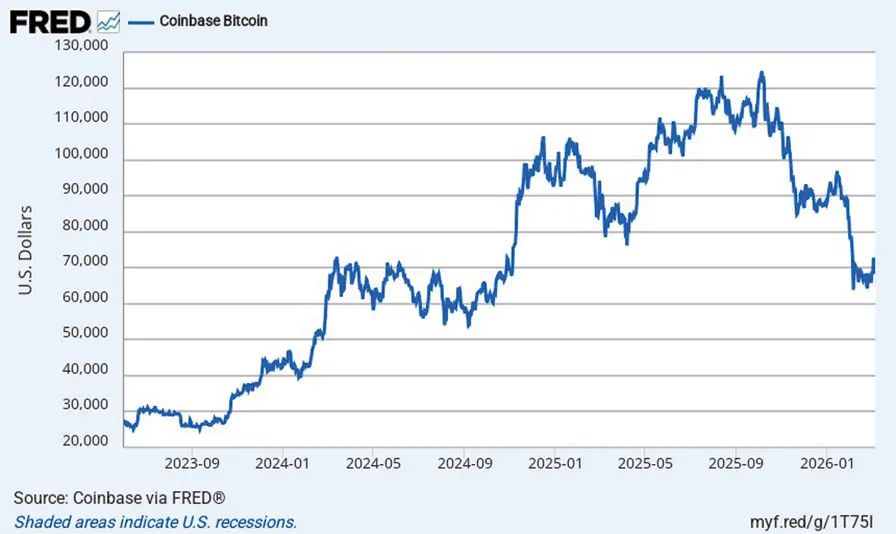
So why has the price of a single Bitcoin risen to almost $125,000.00 in recent years? Because a meaningful number of our friends, neighbors and global citizens believe that Bitcoin is money, and that a single Bitcoin is worth that many dollars. Since that high in 2025, Bitcoin’s dollar price has fallen more than $50,000.00, as shown in the chart from the Federal Reserve above.
Bitcoin was also devised to be scarce, with a fully mined supply of just 21 million Bitcoins. As of now, over 20 million Bitcoins have been mined, or about 95 percent of the total supply. It’s troubling that Nakamoto kept 5 percent of the total supply of Bitcoin, which means they have tremendous power over its market. Strangely, Nakamoto hasn’t been heard from since 2011. Nor has Nakamoto ever exchanged a single Bitcoin for another currency or purchased an item using Bitcoin.
Bitcoin can only be accessed by owners online by using a key consisting of a lengthy sequence of random numbers, letters and characters. These keys are easy to forget or lose, and if that happens there is no way to reset or recover the keys to access your Bitcoins. That’s why upwards of 4 million Bitcoins (20 percent of the total supply) are inaccessible because their owners lost their keys!
In 2011, Stefan Thomas, a software developer, lost his password to an account that holds his key to 7,002 Bitcoins (~ $420 million). He gets just two more tries to open the account before it locks him out permanently. James Howell accidentally threw away a hard drive with the key to his 8,000 Bitcoins (~ $480 million) and has spent over a decade trying to get permission to excavate the landfill in Wales where it was dumped.
While Bitcoin is acknowledged by many individuals and institutions as money, the extreme volatility in its price means that it is rarely used as money to facilitate transactions between individuals and groups. That means Bitcoin is basically equivalent to holding gold for the sake of owning an asset.
The idea of a true cryptocurrency remains intriguing, especially if it would facilitate transactions across borders and outside of the intervention of governments, banks and financial institutions. Because Bitcoin was the first of its kind, it’s possible other cryptocurrencies will emerge, be stable in value, and facilitate exchanges among interested parties who believe they are money.
Larry Malone is professor emeritus of economics at Hartwick College.