

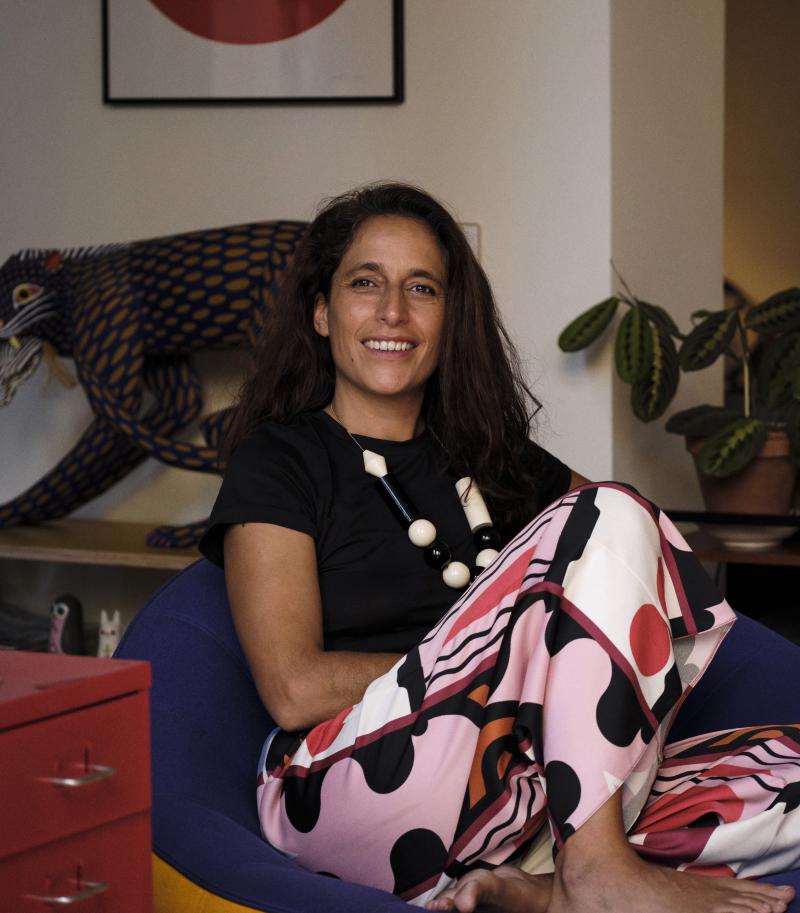
Malika Favre on the trap every illustrator falls into (and how to escape it)
There’s a moment when the well-known illustrator Malika Favre describes how she came to hire her second studio assistant. She’d bought a piano on eBay, couldn’t get her two hands to do different things, and so had gone online to find a teacher. Tom was classically trained, had no background in illustration whatsoever, and at the end of one of their lessons, he asked whether he could apply for the job.
“I thought long and hard about it,” Malika recalls, “and then I realised it kind of makes sense. If this guy can play a really complicated Schubert piece, he can definitely roll a print.” Three weeks after he started, an email arrived from the Montreux Jazz Festival, just a short train ride from where he’d grown up, commissioning Malika to design their poster. Tom came along for the whole trip.
Funny story. But it’s also something more than that. It’s a demonstration of the principle that quietly underpins Malika’s entire career: that the most transformative things that happen to you rarely arrive through conventional channels. They arrive through people.
Malika was telling this story during a Studio Session, a live talk hosted inside The Studio, Creative Boom’s private community for professionals. Her talk—titled ‘You and Me, and Everyone We Know’ after a Miranda July film she loves—traced her career not through projects or awards, but through the individuals who shaped it.
The trap every illustrator falls into
Malika is French, trained originally as a graphic designer, and built her illustration voice over five years at Airside, a small London studio unusual for having illustrators working alongside designers. It was there she first started exploring her personal aesthetic, pitching ideas to an internal shop that let designers produce and sell their own work. Her first pitch was a minimal, cheeky erotic alphabet that sold out in a week and spread across the design blogs.
Wallpaper* magazine then commissioned the studio to produce another alphabet for its sex and art issue. It was a landmark moment: “The first time I was literally paid to do what I was doing for myself,” she says. “I had so much fun doing this.”
Yet success has a habit of narrowing things down. After she left Airside at 28 to go it alone, she noticed something that should be required reading for any emerging illustrator. “You’ll only get commissioned for things you’ve already drawn,” she notes. Having drawn erotic alphabets, she was being asked for more of them. Having drawn women with hats, she was asked for more. The one-trick pony trap was looming large.
Her solution? The same one Airside had accidentally taught her. Keep doing personal work, constantly and without commercial expectation, so that your portfolio keeps evolving in directions nobody asked for. “Every time I experimented with something new, eventually it would end up in my portfolio, and I would get commissioned for it later on,” she recalls.
A part-time agent and a dream commission
The same logic applies to business relationships. When Malika was looking for an agent, she nearly went with someone more established. Then she met John Pearce, one of the founders of Handsome Frank. That’s now one of the UK’s most respected illustration agencies, but at the time it was just a side project he was running in his spare time while working at Creative Review. He answered her email in 10 minutes. They met at a coffee shop and hit it off immediately. “I like the idea of growing with him,” she says, “and just being in a small boutique agency.” Fifteen years later, they’re still together.
The New Yorker followed a similar pattern, built on years of small yeses. Malika had been contributing pieces to the magazine for a long time, operating by a private rule: if they asked, she said yes, no matter the deadline.
One morning, an email arrived from Françoise Mouly, the magazine’s art director and one of the most influential figures in American editorial illustration. “She was saying, ‘I really like your work, maybe we could explore the possibility of doing a cover,'” Malika recalls. “I jumped around. That was like the best day of my life, I think. Just getting that first email.” She took three weeks off all other work, sent 38 ideas, and received an immediate response: ‘There’s a cover in there’. She’s since produced around 20 for the New Yorker.
One in particular stands out, not for the design itself but for what it triggered. Drawn from Malika’s childhood memory of being operated on for strabismus, a common eye misalignment, an April 2017 cover depicted a female surgeon. The image, designed from the patient’s perspective, depicts four female surgeons looking down, capturing the sensation of fading under anaesthesia.
Dr Susan Pitt, an endocrine surgeon at the University of Wisconsin, saw the cover and reflected on the scarcity of female representation in surgical media. Later, at a conference in Orlando, she organised a recreation of the cover with colleagues, then launched a social media challenge, asking other female surgeons to do the same. The challenge went viral under the hashtags #NYerORCoverChallenge and #ILookLikeASurgeon, with hundreds of surgeons from countries as widespread as Brazil, Mexico and Turkey recreating the pose.
“Seeing my cover being reenacted in that way was so humbling,” she says. It was also the moment she understood something about the work she’d been making for years. “I was doing a lot of illustrations that were talking about female empowerment, depicting strong women, because this is who I am and how I was raised,” she explains. “But that’s when I also realised: okay, I need to take it seriously and really understand the meaning that an illustration can have, and not just do it on an instinctive level.”
Spend money to make money
If there’s a thread running through all of this, it traces back to an unlikely source. Malika’s late grandfather was a businessman who loved Excel spreadsheets and used to annotate his own inheritance documents with little cartoon figures captioned “I’m completely crazy.” He had two rules he repeated throughout her childhood, and both of them stuck.
The first: to make money, you have to first learn how to spend it. For Malika, that’s meant investing in quality paper for prints, in travel that feeds her work and expands her colour palette, and in other people’s art and craft, and in time: specifically, the time she’s given to projects with no obvious commercial return.
Her Instagram curation account, run with filmmaker friend George Wu, grew to over 320,000 followers without ever taking a paid post or brand deal, evolved into a newsletter, and has since launched as a carefully assembled online bazaar of design objects. “Not only did I not earn anything,” she says cheerfully, “I also spent way too much.” The account exists purely because she and George were having fun and trusted that it mattered.
The second rule is perhaps the more powerful of the two: to make money, you have to make friends. It’s the logic that explains almost everything in Malika’s career, from signing with a part-time agent she liked over a bigger one she didn’t know, to hiring a pianist as her studio manager, to building something joyful with a best friend during a pandemic.
“We’re all shaped by the people around us,” she reflects. “No two journeys are the same because we all meet different people. But for me it’s always: cherish the ones you have, and you never know where it might lead.”
It’s easy advice to nod at; harder to actually live by, especially when the pressure to be strategic, visible and commercially productive is relentless. But Malika’s career, built one unexpected human connection at a time, makes a fairly persuasive case that her grandfather, with his Excel spreadsheets and his little cartoon self-portraits, was onto something.