

UAB Libraries share AI resources, skills with Alabama’s K-12 educators
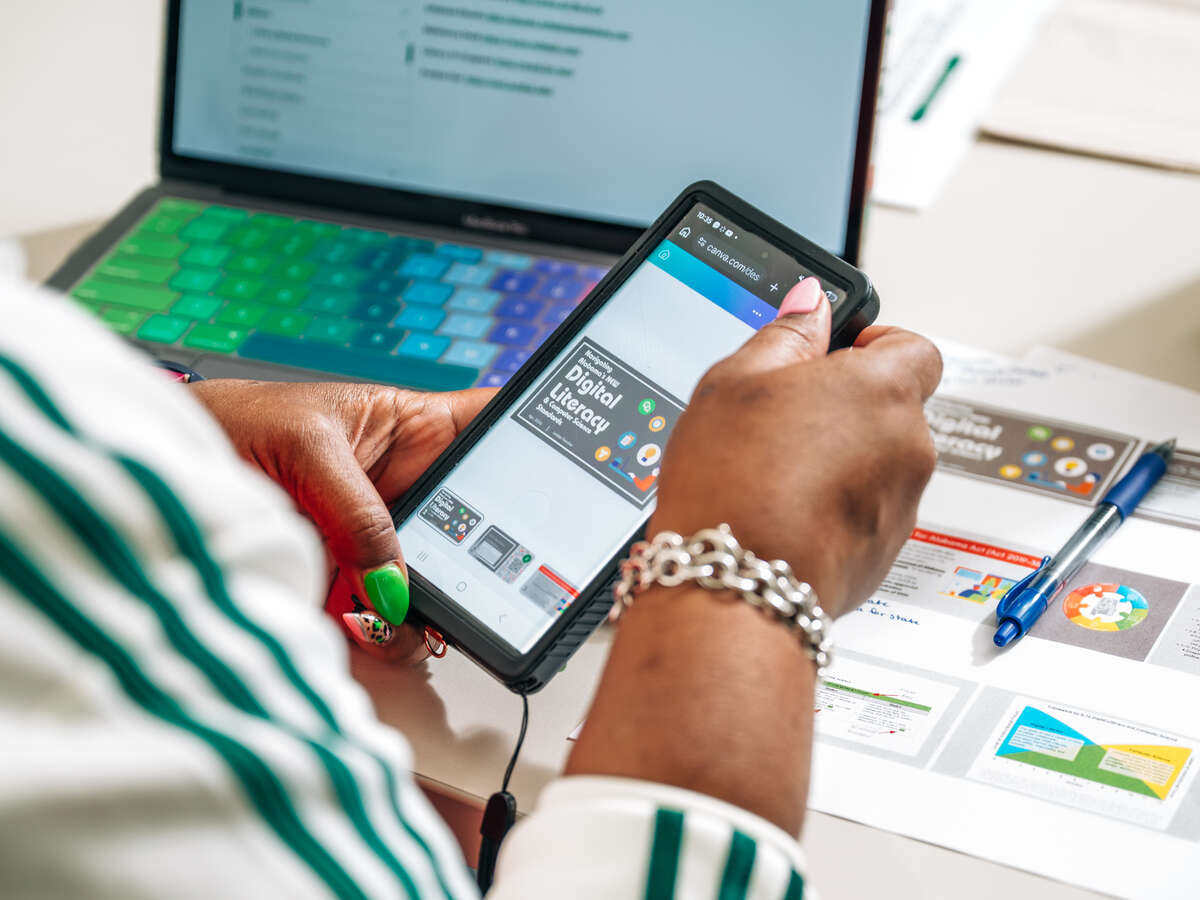
A participant looks at the workshop digital literacy materials and tools on her phone and laptop.As artificial intelligence tools become more available, teachers need to know when it is appropriate and how to use them.
That is why faculty from the University of Alabama at Birmingham Libraries are working to enhance media and AI literacy in the community.
In late April, UAB Libraries hosted teachers and librarians for a no-cost workshop, Partnering for Progress. The goals were to share knowledge about AI applications and implications for the classroom and to form relationships between those educators and expert librarians at UAB. It was created in response to educators’ wanting guidance on this topic.
The workshop is part of a continuing effort by UAB Libraries to collaborate with area teachers to foster research skills, promote information literacy and provide access to unique resources. It is a great example of UAB experts’ working to meet a direct need in the community.
Educators attended from Alabama school districts including Birmingham, Haleyville, Homewood, Huntsville, Leeds, Opelika, Pelham, Trussville, Tuscaloosa and Vestavia Hills, plus Jefferson, Blount, Escambia, Etowah, Shelby, St. Clair and Walker counties. The curriculum was designed by Associate Professor and Media Literacy Librarian Brooke Becker and Reference Librarian for Education and Educational Technology Summer Upton, who led the workshop.
 Teachers raise their hands in response to a question during the morning session.The group talked about AI and generative AI, a type of artificial intelligence that creates original content by learning patterns from existing data. They discussed skills students and educators will need to use AI in schools, plus freely available online resources for teachers and students, and characteristics of AI policies for schools and school districts. Guest speaker Jordan Fancher discussed the new Alabama Digital Literacy and Computer Science Standards, which establish K-12 standards designed to foster computational thinking, digital citizenship and technical skills starting in the 2026-2027 school year.
“As a member of the committee that created and is now working on unpacking the standards, Fancher gave great insight and practical tips about how educators can incorporate them into their schools, especially with regard to the standards related to AI,” Upton said.
After lunch, the group worked on implementing what they learned and discussed in the morning. Some chose to work on AI policies to propose to their administrators. Upton taught interested attendees the Google tool NotebookLM as a sample AI tool they can use in their own schools.
“We had a question-and-answer, whole-group discussion about concerns and implementation of the information they gained during the workshop,” Upton said. “Some of the most popular questions were related to differences among the most popular GenAI tools like ChatGPT and Claude, as well as ethical considerations related to privacy and accuracy.”
Button Smith, librarian at Pizitz Middle School, says she was pleased to find there are resources available on how to create an AI policy and tools available to teach students how and when to use AI appropriately. April Wallace, library media specialist for Pelham Park Middle School, says she came to the workshop worried about the negative consequences of AI, including environmental concerns, loss of creativity and curiosity, and privacy issues. The workshop did help alleviate some of the apprehension she had, she says.
Teachers and librarians participated in a free workshop hosted by UAB Libraries to help them learn skills students and educators will need to use AI in schools. “The facilitators presented useful information, and shared resources to help schools shape their own AI policies, including how to teach students to use AI responsibly and to cite AI if they use it,” Wallace said. “I can further investigate those shared tools and resources and use them myself and share with my district.”
Hannah Holladay is chair of the English Department at Opelika High School. She says she has already shared resources and websites with her administration and fellow teachers, and they are considering the best ways to implement them to help students navigate the world of AI ethically.
“One idea that was shared with us from Summer Upton was the concept that AI should be viewed as a skill, not a tool,” Holladay said. “When both teachers and students can understand how to add this skill of ethically using AI within our existing practices, it can be beneficial.”
Despite fear that people will become reliant on AI because of all it can do, the encouragement from UAB and from other teachers and librarians has her feeling confident she can help guide students toward appropriate usage.
“These services and conversations about them were incredibly helpful,” Holladay said. “Hearing how UAB Library faculty are working so carefully to protect people, information and processes is encouraging, and if they can do so at such a large scale of influence, we can as well.”