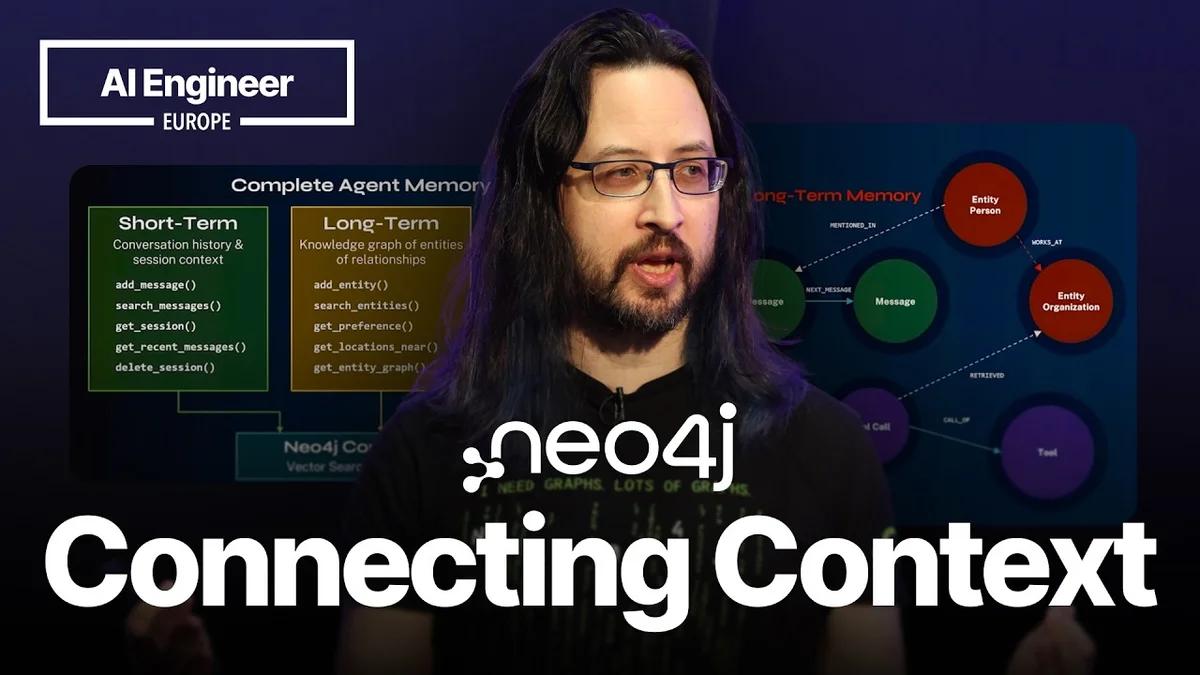
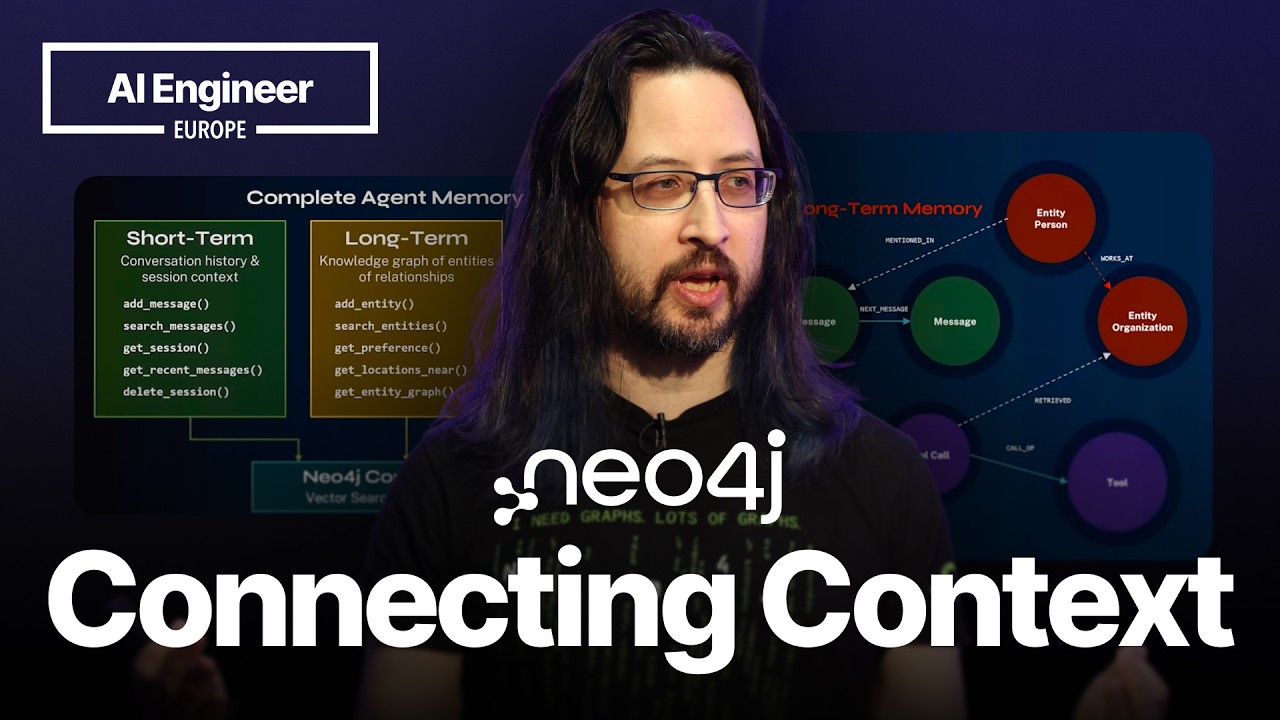
Stephen Chin, VP of Developer Relations at Neo4j, presented on the power of context graphs for AI at an AI Engineer Europe event. Chin highlighted the current struggle of AI engineers who feel overwhelmed by the rapid advancements in AI, leading to a sense of being controlled by the technology rather than controlling it. He proposed context graphs as a solution to bring order and understanding to the complex AI landscape.
Neo4j’s Stephen Chin on Context Graphs for AI — from AI Engineer
Visual TL;DR. AI Overwhelm leads to Context Graphs. Scattered Data addressed by Context Graphs. Context Graphs enables Agent Memory Pillars. Context Graphs enables Actionable Insights. Context Graphs enables Explainable AI. Context Graphs enables Context-Aware AI. Actionable Insights results in Future with Graphs. Explainable AI results in Future with Graphs. Context-Aware AI results in Future with Graphs.
AI Overwhelm: AI engineers feel controlled by rapid advancements, not in control
Context Graphs: Neo4j’s solution using knowledge graph technology for AI
Agent Memory Pillars: Three core components for robust AI agent memory
Actionable Insights: Transforming scattered data into understandable and usable information
Explainable AI: AI systems that are understandable and transparent in their reasoning
Context-Aware AI: AI agents that understand and utilize relevant contextual information
Future with Graphs: Embracing connected data for a more controlled AI future
Visual TL;DR
Escaping the AI Matrix with Context Graphs
Chin began by drawing a parallel to ‘The Matrix,’ suggesting that without proper context, AI systems can become a bewildering maze. He illustrated the problem with a scenario where scattered and siloed data across various enterprise systems (CRM, Slack, Jira) hinders the ability to make informed decisions. He posed the question: do we want to remain trapped in this complexity, or do we want to embrace a system of reasoning powered by connected data?
Neo4j’s contribution to this challenge is the concept of context graphs, which are knowledge graphs specifically designed to capture decision traces, including the full context, reasoning, and causal relationships behind every significant decision. Chin emphasized that while large language models (LLMs) excel at language, reasoning, and creativity, knowledge graphs provide the crucial structured data and context they need to operate effectively.
The Three Pillars of Agent Memory
Chin outlined a three-tiered memory architecture for AI agents:
Short-Term Memory: This captures the immediate conversational context, including sessions, messages, and tool results, all persisted as graph nodes with metadata.
Long-Term Memory: This builds a persistent knowledge graph of entities, relationships, and learned preferences, enabling cross-conversation knowledge persistence and temporal relationship tracking.
Reasoning Memory: This layer includes decision traces, tool usage audits, and provenance, which are vital for making AI explainable and auditable. It allows for learning from experience and understanding why specific decisions were made.
He showcased how this architecture can be implemented using Neo4j, highlighting the ability to store, visualize, and analyze data to improve agent performance and provide more relevant insights.
From Scattered Data to Actionable Insights
A demonstration of ‘Lenny’s Memory,’ an open-source project leveraging Neo4j, illustrated the practical application of context graphs. Chin showed how the system could ingest podcast data, extract entities, and build a knowledge graph. Users can then query this graph to find specific information, such as locations mentioned in episodes or the relationships between people and topics discussed. For instance, a query about locations mentioned in a specific podcast episode resulted in a map visualization pinpointing those places, demonstrating the power of graph-based retrieval.
Chin emphasized the contrast between a traditional audit log, which only records actions, and a context graph, which captures the full ‘why’ behind decisions. He highlighted how context graphs enable the understanding of policies applied, risk factors, and employee reasoning, leading to more transparent and justifiable AI-driven decisions, particularly in sensitive domains like financial services.
The Future with Context Graphs
Chin concluded by encouraging attendees to explore Neo4j’s Graph Academy and its new context graph course. He pointed out the availability of free resources, including a hosted Neo4j instance, to help developers experiment with these techniques. The ultimate goal, he stated, is to empower AI agents to move beyond simply providing answers and instead offer reasoned, context-aware, and explainable recommendations, thereby helping organizations and developers alike to truly understand and control their AI systems.