

Big Check Presentation highlights OSU Extension’s rural broadband work
Nearly one decade ago, Brian Whitacre, Oklahoma State University Extension specialist for rural economic development, set out to help connect rural Oklahomans with a stable internet connection.
The design was simple: Extension partners with several rural libraries each year. Through AARP Oklahoma funding, libraries receive small, portable internet hotspots that are loaned to residents, allowing them to connect to cellular data.
The devices can connect to 5-10 devices in a user’s home, with devices loaned out for 1-2 weeks at a time.
After one year, the cost shifts to the libraries, who can choose whether to continue offering the devices. To date, more than 90% of libraries that participated in the program continue to operate the program themselves.
“People know how important broadband and connectivity are,” Whitacre said. “I’m a little overwhelmed by how many libraries are able to keep it running and see the benefit of it, especially considering the shoestring budgets that many rural libraries face.”
Almost 10 years later, OSU’s Rural Hotspot Lending Program has exceeded his expectations.
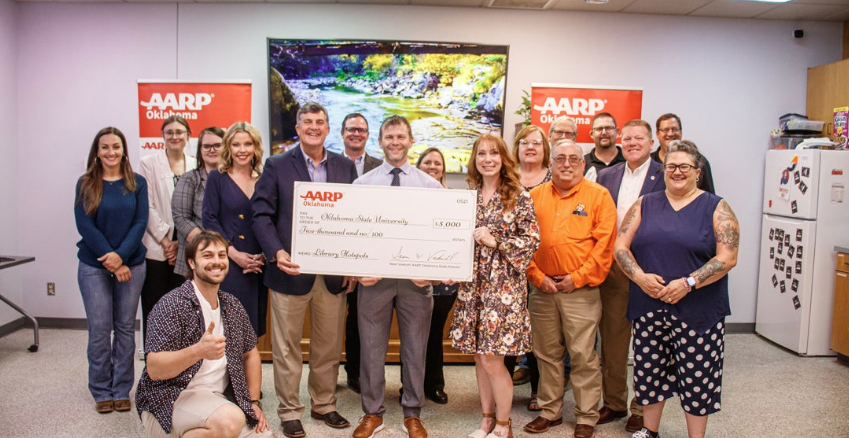
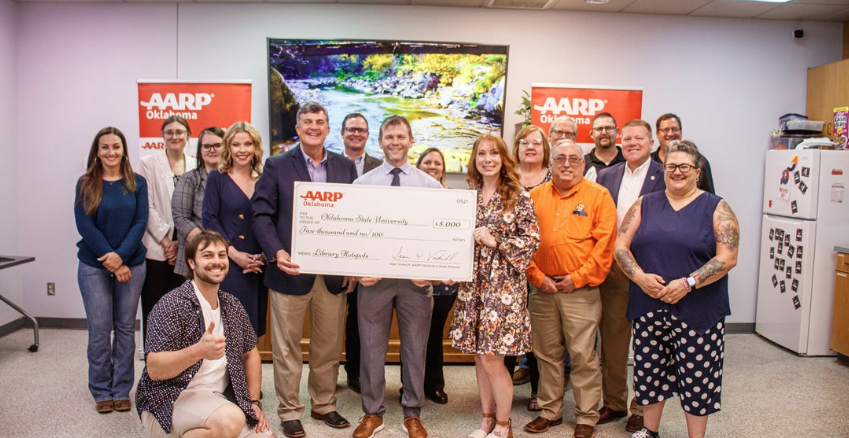
On May 1, OSU Extension celebrated the program. Named the Big Check Presentation, this year’s event was held at Fairview Public Library, in conjunction with AARP Oklahoma. An oversized check–representing AARP’s contribution to expand the program over the past year—was presented, and leaders like Whitacre spoke about the program’s impact.
“Providing hotspots has been a win-win situation for the patrons and the library,” said Crystal Privette, Fairview’s library director. “Our library has been happy to provide another surprising, yet beneficial service to the community. We look forward to continuing the program for as long as the service is needed.”
OSU Extension isn’t embarking on this program alone. After the inaugural year, Whitacre has partnered with AARP, which has funded the program every year since, donating $5,000 each year to purchase the devices, buy the data and distribute them to libraries.
“Oklahomans and their families deserve reliable internet access. Unfortunately, many rural areas still lack connectivity in their homes,” said Sean Voskuhl, AARP Oklahoma state director. “Through our continued partnership with Oklahoma State University’s Division of Agricultural Sciences and Natural Resources and the Oklahoma Cooperative Extension Service, we are making a difference and bringing digital connectivity to rural communities. This access connects them to essential resources like healthcare, entertainment, and job and education opportunities, while enhancing their social connections.”
In Oklahoma, recent data shows that only 68% of households have a steady, wired internet connection, which ranks below the national average. Oklahomans are also more likely to be reliant on cellular data plans only, which are typically limited and require constant usage monitoring. The hotspots that are part of this program come with unlimited data, allowing patrons to connect without worrying about “overuse” charges. To date, OSU Extension has partnered with 36 rural libraries, with an estimated 4,200 Oklahomans using the hotspots annually.
The devices have had a wide array of uses. Students have used it to complete homework. Others have used it as an opportunity to go back to school. People have connected with family across the country. Whitacre said others have made extra income online, selling items on reselling platforms or starting a new business.
“I’ve worked on a lot of different programs here at OSU,” Whitacre said. “Some of my most rewarding moments are reading the survey responses from hotspot patrons. We hear lots of cool stories. I love the Extension part of my job because it really does relay that real-world impact our programming has.”
His favorite response to see in survey results: Students who can work on homework.
“You think about K-12 education nowadays, and a lot of it has moved online,” Whitacre said. “My own kids typically have some type of assignment outside of school each night. Some kids don’t have a regular connection at home. So, helping kids with schoolwork or projects is great to hear. That’s the next generation of Oklahoma.”
Moving forward, the program will continue evolving with the ever-changing technology landscape. Whitacre alluded to artificial intelligence and its potential role in the hotspot lending program moving forward.
“I really would like to see a digital skills component to this, helping people with questions they have about how to productively use the internet,” Whitacre said.
Whitacre is still taking applications from rural libraries wanting to participate in the program through the end of summer 2026. Any libraries interested in joining can reach out to Whitacre via email at brian.whitacre@okstate.edu.
“There’s solid data out there on how many people in your local community have a good connection to the Internet,” Whitacre said. “If it’s low, if you have a lot of people only dependent on cell phones, this program can really help.”
OSU Extension uses research-based information to help all Oklahomans solve local issues and concerns, promote leadership and manage resources wisely throughout the state’s 77 counties. Most information is available at little to no cost.