

Amazon’s grocery delivery play doesn’t erase key challenges
When Amazon announced on Wednesday that it will make fresh grocery delivery available to thousands of communities through its sprawling same-day service, the news quickly sparked declines in the stock prices of some of its key rivals in the e-commerce and food retailing sectors.
Instacart shares plummeted more than 11% on unusually high trading volume as investors reacted to Amazon’s sharp expansion of a program that lets shoppers buy perishables alongside other goods like batteries and laundry detergent in the same virtual carts on its core delivery platform. The stock prices of DoorDash and Kroger each slumped by about 4%, and Walmart shares lost more than 2.5%.
Through the program, Amazon is offering free grocery delivery to Prime customers on orders of more than $25. The service costs $2.99 for orders below that amount for members of Prime, and other shoppers can place an order for $12.99, with no minimum. Amazon has rolled out the service to about 1,000 cities and towns across the U.S. and plans to bring it to more than 2,300 areas by Dec. 31.
But while Amazon’s aggressive move in the online grocery space is certainly a testament to the company’s vast prowess as an online retailer, the project is also a reminder that the retailer has a relatively small brick-and-mortar presence in a sector where physical stores play an essential role in connecting with customers, industry analysts said.
“Amazon has chased the grocery market for many years. But without a big store base, it’s hard to win, as most shoppers still buy in person, and proximity is key to delivering perishables efficiently to customers,” Arun Sundaram, senior vice president of equity research at CFRA Research, wrote in an email. “As a result, we think today’s market reaction seems a bit overdone.”
Sundaram said in a research note that Amazon has had only limited success in making inroads as a grocery and perishables retailer and “has yet to clearly differentiate itself from conventional grocery rivals.”
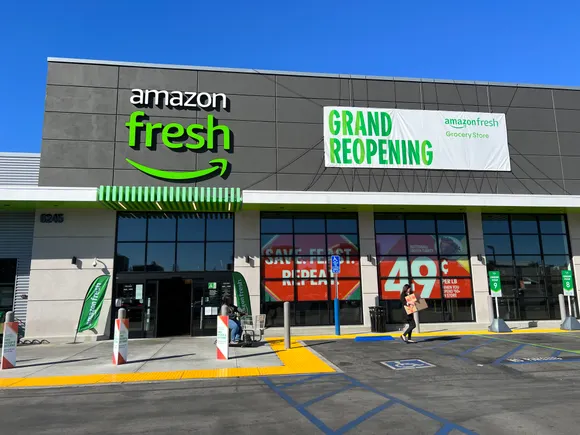
He added that although Whole Foods Market has performed well since Amazon bought it in 2017, the chain focuses on the natural and organic segment. Meanwhile, Amazon still runs only a few dozen supermarkets under the Amazon Fresh banner it launched in 2020 even as competitors like Kroger and Walmart run thousands of stores apiece, Sundaram pointed out.
A Walmart spokesperson noted in an email that its grocery delivery service already reaches 93% of U.S. households, adding that the company, which runs more than 4,600 stores, is able to fulfill orders in as little as half an hour.
John Clear, a partner at AlixPartners who formerly worked as a buyer for Lidl US, said Amazon’s expertise in online fulfillment doesn’t address shortcomings in its grocery assortment and pricing strategy that he said the company needs to overcome.
Assuming “that customers are going to actively make the decision based on delivery fees alone … doesn’t get [to] the core of why people choose their grocery stores — primarily customers want good value and consistent quality,” Clear wrote in an email, noting that he thinks Amazon has “failed to convince on either front, so far.”
Clear said he believes Amazon’s program will stand out in metropolitan areas but have less of an impact in suburban communities. “Urban is focused more on convenience [and] top-up, which is still a big market but ultimately could be difficult for Amazon to really crack,” he said.
Meanwhile, Amazon is up against several competitors in the grocery delivery space that are ahead in building their reputations with consumers.
“Instacart, Walmart, Kroger and more have proven that while fast delivery is a bonus for customers it’s not the core presenting problem or primary decision factor for customers — traditional pillars remain key: price, quality, experience and value,” Clear added.
Still, while Amazon might have hurdles to overcome in its efforts to build its presence across the grocery industry, the company’s extensive fulfillment facilities give it a distinct advantage in e-commerce over other food retailers, which have struggled to make money through their online operations, Neil Saunders, managing director of GlobalData Retail, said by email.
“As Amazon already has a lot of the logistical infrastructure in place, it should be able to grow profitably — which is something other online grocers have struggled to do. This is a wake-up call to all online grocers,” Saunders wrote.
Amazon’s decision to amp up its presence in the grocery business in conjunction with its highly popular Prime membership program could be problematic for regional supermarket chains that have sought to build a base of delivery customers, said David Bishop, partner at grocery e-commerce consultancy Brick Meets Click, which tracks grocery e-commerce sales.
“If Amazon is able to show how they can help a customer save money and get what they want, when they want it, how they want it, then those other grocery programs are going to be at risk, because that question then falls, what role or value are you providing?” Bishop said in an interview.
Bishop noted that Brick Meets Click considers Amazon’s grocery delivery service, which it has been testing in selected markets for a number of months, as a ship-to-home service instead of as a traditional grocery delivery platform. He said shopper interest in buying groceries through Amazon could be a reason why the ship-to-home channel has recently grown.
“The question is, how do regionals respond? Because [Amazon is] effectively now introducing another free version of home delivery, even though technically we call it ship-to-home, and that’s the bigger issue,” said Bishop.
Tom Furphy, CEO and managing director of investment firm Consumer Equity Partners and former vice president of consumables and Amazon Fresh for Amazon, agreed that Amazon’s expertise and reach in delivery will put pressure on other food retailers.
“Make no mistake, this will take share from incumbent retailers,” Furphy wrote in an email. “Long-term, I’m bullish on Amazon’s ability to keep gaining grocery share well beyond the $100 billion in packaged goods and Whole Foods volume they already sell today.”
However, Amazon might face challenges in getting customers to associate Amazon with keeping their homes stocked with food, Furphy noted.
“I’m not convinced about the everyday appeal of mixing fresh groceries with electronics or hardware in the same basket, but minimally it can be an effective way to introduce grocery delivery to a broader set of Amazon’s customers,” Furphy said.