

Bridging the digital divide: development and validation of a digital literacy scale for older adults in China
The concept of digital literacy has evolved significantly alongside the rapid advancement of digital technology. Initially, digital literacy referred to an individual’s ability to access network information or operate computer equipment (Gilster, 1997). However, as technology has progressed, the definition has been broadened to encompass a wide range of skills. Eshet (2004) identified five key components of digital literacy: photo-visual skills, reproduction skills, branching skills, information skills, and socio-emotional skills. Meanwhile, UNESCO (2018) defined digital literacy as the ability to access, manage, understand, integrate, communicate, evaluate, and create information through digital technologies, with a focus on safe and appropriate use for employment, decent jobs, and entrepreneurship. Building upon this foundation, Reddy et al. (2020) empirically validated a comprehensive six-dimensional framework that integrates media, information, visual, communication, computer, and technology literacies. Although contextualized for the South Pacific, this framework provides a robust structure for measuring digital competencies across various educational settings. Recent scholarship highlights the multifaceted nature of digital literacy, conceptualizing core competencies as essential “talismans”, critical capabilities required to navigate 21st-century digital environments effectively (Reddy et al., 2022). By reframing digital literacy beyond technical proficiency, contemporary research emphasizes its role as a dynamic integration of cognitive, social, and ethical competencies necessary for meaningful participation in technologically evolving societies (Mbandje et al., 2023).
One of the most widely recognized frameworks for digital literacy is the European Commission’s Digital Competence (DigComp) Framework (Ferrari et al., 2013). This framework outlines five dimensions: (1) information and data literacy, (2) communication and collaboration, (3) digital content creation, (4) safety, and (5) problem-solving. Despite its influence, definitions and components of digital literacy vary among different studies. For example, Rodríguez-de-Dios et al. (2016) developed a digital literacy scale for teenagers with six components: technical skills, communication skills, information skills, critical skills, and security skills. Carretero et al. (2017) further refined DigComp into five key areas, with sub-competences detailing specific skills and abilities. Another approach by Chetty et al. (2018) includes six core dimensions: information literacy, computer literacy, media literacy, communication literacy, and technology literacy. In this study, our selection of the DigComp framework was guided by its unique suitability for studying digital literacy among older Chinese adults. First, the framework’s multidimensional structure, integrating knowledge, skills, and attitudes, offers a robust, globally validated foundation for instrument development. Second, DigComp’s emphasis on safety and problem-solving aligns with China’s sociocultural context, where collective welfare and pragmatic technology use are prevalent. This alignment manifests in family-centric security practices, such as preventing mobile payment fraud, and survival-oriented applications, including navigating health QR code systems. Third, the framework’s adaptability further permitted contextualization. We deliberately integrated China-specific technological ecosystems (e.g., embedding WeChat and Alipay functionalities into communication and security dimensions) while deprioritizing digital content creation, based on focus groups indicating limited relevance to older adults’ daily necessities.
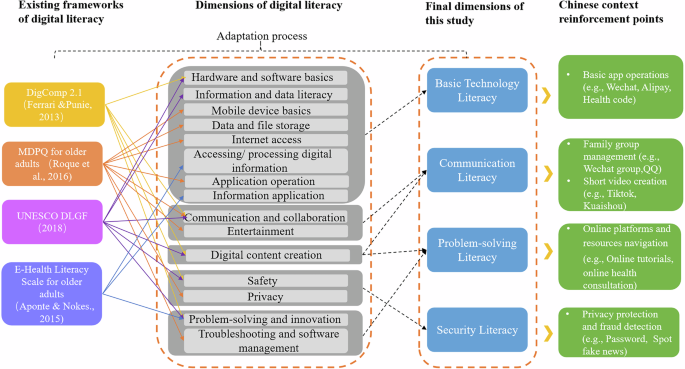
Building on existing research and considering the specific needs of older adults, this study defines digital literacy for older adults as the methods, abilities, and attitudes that enable active engagement with digital technology in various aspects of life, including learning, entertainment, and daily activities. The proposed dimensions of older adults’ digital literacy include digital basic technology literacy, digital communication literacy, digital problem-solving literacy, and digital security literacy. Digital basic technology literacy encompasses fundamental skills, including operating mobile devices and connecting to the internet (Chetty et al., 2018; Reddy et al., 2023). Digital communication literacy refers to the ability to maintain or expand personal relationships through online platforms, which is vital for reducing social isolation (Carretero et al., 2017; Reddy et al., 2023). Digital problem-solving literacy is crucial for transitioning from merely “surviving” to “thriving” in the digital society, encompassing skills such as online learning, health management, and financial management (Ferrari et al., 2013). Lastly, digital security literacy includes safeguarding digital devices from threats and protecting personal information from cyber risks (Carretero et al., 2017). Figure 1 presents the conceptual mapping of the existing framework to our proposed four-dimensional framework. As illustrated in Fig. 1, the left panel presents this study’s primary reference frameworks (e.g., DigComp, as well as frameworks designed for older adults, such as MDPQ and Digital Health Literacy). These established instruments encompass a spectrum of dimensions, including hardware and software fundamentals, accessing and processing digital information, information application, application operation (e.g., calendars), communication and collaboration, digital content creation, safety, privacy, and problem-solving with innovation. Collectively, these dimensions provide the theoretical scaffolding for the subsequent adaptation processs, illustrating the adaptation of existing frameworks (e.g., DigComp, MDPQ) into four core dimensions.

Conceptual framework for the development of digital literacy among older adults in China.
This adaptation process entailed three key methodological adjustments: First, dimension consolidation streamlined existing digital literacy frameworks into four core competencies. This synthesis classified core elements of established frameworks while integrating adaptive priorities of Chinese older adults in digital environments. Specifically, their heightened need for internet information verification, payment security awareness, and daily mobility software proficiency, in contrast to lower requirements for digital content creation and information organization. Second, cultural embedding incorporated China-specific digital practices (e.g., WeChat Mini Programs, health QR code usage, and payment scam identification) into dimension definitions. Third, cognitive simplification reconceptualizes technically complex competencies (e.g., digital content creation) as applied problem-solving tasks, such as troubleshooting hospital e-registration systems or resolving errors in transportation apps.
Despite the growing recognition of digital literacy’s importance, existing assessment tools predominantly target younger populations (Reddy et al., 2023), leaving a notable gap for instruments specifically designed for older adults (Choi and DiNitto, 2013). While numerous scales have been developed to evaluate digital literacy across various age cohorts, such as teenagers (Rodríguez-de-Dios et al., 2016), school children (Li and Hu, 2022; Zhu et al., 2019), high school students (Li et al., 2024; Ma et al., 2024), college students (Alexander et al., 2017; Amin et al., 2021), and pre-service teachers (Liza and Andriyanti, 2020; Yu et al., 2022), gaps remain. Other scales like the eHealth Literacy Scale (eHEALS) focus on finding, evaluating, and applying electronic health information to health problems (Chesser et al., 2016; Lee et al., 2020; Shi et al., 2023) but fail to cover all components of the DigComp Framework, particularly content creation, safety, and problem-solving (Oh et al., 2021). Similarly, the Mobile Device Proficiency Questionnaire (MDPQ) assesses skills related to mobile device use (Kang et al., 2023; Roque and Boot, 2018) but overlooks critical areas such as digital communication, digital content creation, and data privacy and protection, which are essential components of digital literacy (Ferrari and Punie, 2013; Boot et al., 2015). Instruments like the Attitudes Toward Technologies Questionnaire and Technology Acceptance Model measure attitudes rather than aptitude, which limits their usefulness in assessing actual digital literacy levels among older adults (Álvarez-Dardet et al., 2020; Ma et al., 2015).
Overall, while significant progress has been made in understanding aspects of digital literacy among older adults—such as e-health literacy and smartphone utilization—there remains a critical need for a comprehensive and tailored scale that considers the unique physical and psychological attributes of this demographic. Developing such a tool is essential for accurately assessing and addressing the digital literacy needs of older adults, ensuring their meaningful participation in an increasingly digital society.