

Digital literacy’s impact on digital village participation in rural left-behind women through serial mediation of political trust and self-efficacy
This section presents the empirical findings derived from our multi-faceted methodological approach, designed to provide a comprehensive understanding of rural left-behind women’s participation in digital village initiatives. We first address potential common method bias and confirm the reliability and validity of our measures. Subsequently, we present the baseline regression results utilizing Tobit and IV-Tobit models, which establish the average effects of digital literacy while addressing endogeneity. Following this, the heterogeneous impacts of digital literacy across different participation levels are explored through quantile regression. Finally, we delve into the underlying sequential mechanisms by presenting the results of our chain mediation analysis. This structured presentation of results aims to clearly delineate how digital literacy influences participation, the conditions under which these impacts vary, and the psychological pathways involved, thereby offering robust and nuanced evidence for our hypotheses.
Common method bias test
Common method bias (CMB) represents a critical methodological concern in social science research, as it can introduce systematic measurement errors that may distort the observed relationships between variables. To rigorously evaluate potential CMB, this study primarily employed Harman’s single-factor test, a widely recognized diagnostic approach.
An exploratory factor analysis (EFA) was conducted on all key self-reported variables included in the study. The EFA revealed three factors with eigenvalues exceeding the standard cutoff of 1. Crucially, the first unrotated factor explained 34.74% of the total variance. This percentage is substantially below the conventional 50% threshold, a guideline often cited in methodological literature93, suggesting that a single factor does not account for the majority of the covariance between the measures. Therefore, these results indicate that common method bias is unlikely to be a significant concern that would compromise the validity of our research findings. The presence of a multifactor structure further supports this, indicating substantive variance attributable to the distinct constructs rather than a single methodological artifact, thereby enhancing the credibility of our empirical analysis. Beyond this diagnostic check, proactive measures to minimize potential CMB were embedded in the study’s design. Specifically, significant effort was invested in ensuring item clarity, utilizing appropriate and validated scaling techniques, and conducting thorough pilot testing to confirm respondent comprehension and the cultural appropriateness of the survey instrument for rural left-behind women.
Reliability and validity testing
This study employed SPSS 26.0 software to conduct preliminary reliability analysis and validity suitability tests on 29 measurement items across three variables: political trust (PT), self-efficacy (SE), and digital village participation (DP). The reliability analysis showed that the Cronbach’s Alpha coefficients of all variables exceeded 0.7, indicating good internal consistency of the scales94. Regarding validity suitability, the Kaiser-Meyer-Olkin (KMO) values were all above 0.6, and Bartlett’s test of sphericity was significant at the 0.01 level, confirming the appropriateness of the data for factor analysis.
Based on these results, confirmatory factor analysis was further performed using structural equation modeling software (AMOS). The measurement model demonstrated good overall fit to the data, with the following fit indices: χ²/df = 2.45, CFI = 0.95, TLI = 0.94, RMSEA = 0.058, and SRMR = 0.04595. Furthermore, the findings indicated that all factor loadings exceeded 0.5, demonstrating good construct validity. Composite reliability (CR) values of the latent variables were all above 0.7, and average variance extracted (AVE) values exceeded 0.5, confirming the reliability and convergent validity of the measurement model96. Detailed statistics are presented in Table 3.
Baseline regression: the pivotal role of digital literacy
Table 4 presents the baseline regression estimates, primarily utilizing the Tobit model to accurately capture the average impact of digital literacy on multifaceted aspects of rural left-behind women’s engagement in digital village initiatives, while accounting for the censored nature of the dependent variable. To further ensure the robustness of these average effects against potential endogeneity issues, we also present results from an Instrumental Variable (IV)-Tobit model. Columns (1) and (2) detail its effect on overall digital village participation, columns (3) and (4) on digital economy involvement, columns (5) and (6) on rural digital governance participation, and columns (7) and (8) on engagement in digital benefit services.
The results consistently highlight digital literacy as a statistically significant and positive determinant of rural left-behind women’s participation in digital villages, the digital economy, and digital governance across various significance levels (Table 4, columns (1), (3), (5), and (7)). While the direct effect on digital benefit services did not reach statistical significance in this baseline model (a point elaborated in Sect. 4.3.2), the overarching positive influence across other key domains is notable. Crucially, the congruence between estimates from the standard Tobit model and the IV-Tobit model—the latter specifically designed to mitigate potential endogeneity biases inherent in observational studies—lends considerable credence to the robustness of this core finding. This consistency suggests that the observed positive relationship between digital literacy and digital village participation is less likely to be an artifact of unobserved confounders or reverse causality, thereby strengthening the empirical support for Hypothesis 1: higher digital literacy is indeed associated with greater participation of rural left-behind women in digital villages.
Interpreted broadly, these findings underscore that digital literacy acts as a critical enabler. It empowers rural left-behind women, a demographic often facing unique socio-economic constraints, to more effectively integrate digital elements into agricultural production, rural governance, and daily life. This enhanced capacity to leverage digital tools and resources appears to partially offset traditional limitations related to factors such as land, capital, or information access, thereby fostering their broader engagement in the ongoing digital transformation of rural areas. This initial insight suggests that digital literacy is not merely a technical skill but a transformative capability for this specific group.
Control variables and digital participation: an overview of individual and household factors
Beyond the primary influence of digital literacy, the baseline regression models (detailed in Table 4) incorporated a suite of individual and household-level control variables to account for confounding factors. These controls provide valuable context regarding the socio-demographic and familial landscapes shaping digital engagement among rural left-behind women.
Influence of Individual Characteristics:
Consistent with established literature on the digital divide, several individual attributes demonstrated significant associations with digital participation. Educational attainment emerged as a robust positive correlate across all examined domains (digital village initiatives, digital economy, digital governance, and digital benefit services)97. This underscores education’s foundational role in fostering cognitive skills, learning agility, and self-efficacy, which are essential for navigating and utilizing digital ecosystems. Conversely, age exhibited a significant negative correlation with participation in the digital economy and digital governance, aligning with prior research attributing this to factors such as escalating life responsibilities, traditional gender roles, and potentially lower technology acceptance among older cohorts98. Women’s monthly income was positively associated with digital economy participation, likely reflecting increased purchasing power for digital access and enhanced economic agency99.
Notably, political affiliation (e.g., party membership) showed a significant positive association with participation in digital village initiatives, the digital economy, and digital governance. This finding is congruent with literature suggesting that political engagement can foster a heightened sense of civic responsibility and mission, while party organizations may serve as crucial conduits for information, resources, and support related to digital projects100. This underscores the potential for organized political structures to act as enablers for digital inclusion within rural contexts, a pathway warranting further nuanced investigation.
Influence of Household Characteristics:
Household-level factors also played a discernible role. The educational level of husbands positively correlated with their wives’ participation across all digital domains, highlighting the profound influence of spousal support, progressive gender attitudes, and potential technical guidance within the household, particularly for women whose husbands might be migrant workers101. Similarly, co-residence with children and the educational level of the eldest child were significantly associated with increased maternal participation in various digital spheres (digital village construction, digital governance, digital benefit services for co-residence; all domains for eldest child’s education). These findings underscore the importance of intergenerational learning, the “digital feedback” effect, and the specific role of more educated children as in-house facilitators and agents of digital skill transmission102.
Intriguingly, certain household economic indicators presented counter-intuitive relationships. The monthly income of husbands negatively correlated with wives’ participation in digital village initiatives and digital governance. This divergence from assumptions of resource-driven participation may reflect complex intra-household power dynamics and the reinforcement of traditional gender roles as spousal income rises, potentially curtailing women’s agency in public-sphere digital activities103. A similar paradoxical negative association was observed between the monthly income of the eldest child and their mothers’ participation in the digital economy. This could be attributed to increased caregiving responsibilities EGFR grandmothers (the study’s subjects) as their economically empowered children start their own families, thereby constraining the time and energy available for digital economic pursuits, a mechanism illuminated by theories of family economics and life-course progression104.
Finally, the number of elderly individuals in the household demonstrated a significant negative correlation with women’s participation in digital village initiatives, the digital economy, and digital governance. This aligns with time allocation theory, indicating that heightened caregiving burdens for the elderly directly impinge upon the time and resources available for other forms of engagement105, representing a substantial structural barrier to digital inclusion for this demographic.
Specificity of factors influencing participation in digital benefit services
A notable divergence in findings emerged concerning participation in digital benefit services. Several factors that significantly influenced other digital domains—namely women’s age, political affiliation, spouse’s monthly income, eldest child’s monthly income (for this specific service), and the number of elderly family members—were not significantly associated with engagement in these agriculturally-focused services (see Table 4, column 8).
These non-significant findings, which in some instances contrast with previous research, offer valuable insights into the specific dynamics influencing this particular form of digital engagement.The absence of an age effect, for instance, might signal a narrowing age-related digital divide specifically for accessible agricultural technologies or reflect unique characteristics of our sample106. Similarly, the non-significance of political affiliation suggests its established role in broader civic or community engagement may be less salient for the utilitarian adoption of specific digital agricultural tools. Regarding household economic indicators (spouse’s and eldest child’s income), their lack of association could imply that many digital benefit services possess relatively low entry barriers, diminishing the impact of direct economic constraints for this particular use case, or that complex intra-household resource allocations neutralize direct income effects107. Furthermore, the non-significant influence of the number of elderly—a factor often linked to time constraints—suggests that either the care burden’s impact is less directly prohibitive for these specific, potentially more flexible, services, or its effects are counterbalanced by other unobserved household-level considerations.
These divergences underscore the highly context-dependent nature of factors influencing digital adoption, which vary considerably with the type of digital service and the specific characteristics of the target population. Future research should thus prioritize exploring the nuanced interplay of socio-cultural factors, service-specific attributes (e.g., perceived utility, ease of use, accessibility), and intra-household dynamics as potential moderators or mediators to refine theoretical models of digital agricultural service adoption.
Heterogeneity Estimation based on quantile regression
While the baseline Tobit regression provided robust estimates of the average effects of digital literacy, it is crucial to understand if and how these impacts vary across different levels of participation. To more comprehensively examine the heterogeneous effects of digital literacy on the digital village participation of rural left-behind women, this study employs a CQR model. In contrast to traditional mean regression methods that estimate average effects, CQR reveals the varying impacts of digital literacy across different quantiles of the conditional distribution of digital village participation, thereby capturing within-group heterogeneity.
Preliminary results from the Tobit regression, presented in Table 5, indicate that higher levels of digital literacy are significantly associated with increased participation in digital villages, the digital economy, and digital governance among rural left-behind women. However, no significant association was observed with participation in digital benefit services. Building upon these preliminary findings and to specifically investigate the heterogeneous associations of digital literacy across the distribution of digital village participation, we subsequently apply the CQR model to analyze its impact on participation in digital villages, the digital economy, and digital governance. The dimension of digital benefit services is excluded from this subsequent analysis due to the lack of a significant relationship in the preliminary analysis.
Quintile regression analysis of digital literacy on digital village participation
As presented in Table 5, the CQR results reveal positive estimated coefficients for digital literacy across all five examined quantiles, all of which are statistically significant at the 1% level. This indicates that higher digital literacy is significantly associated with greater participation of rural left-behind women in digital villages. Importantly, the magnitude of this association exhibits notable heterogeneity across different quantiles of the conditional distribution of participation. Specifically, the coefficient of digital literacy demonstrates an inverted U-shaped pattern, initially increasing and subsequently decreasing as the quantile rises. This suggests that digital literacy may have a stronger positive association with participation among rural left-behind women at moderate levels of involvement in digital villages compared to those with low or high participation levels. The coefficient estimate is highest at the 0.50 quantile, measuring 3.126 and statistically significant at the 1% level. Conversely, at the 0.10 quantile, the coefficient estimate is lowest at 1.132, suggesting a relatively weaker association for women with low levels of participation.
These findings, while confirming a general positive relationship between digital literacy and digital engagement, offer a more granular understanding of this association’s varying strength across participation levels – a nuance often obscured by traditional mean-based analyses. Consistent with a broad body of existing research highlighting the positive role of digital skills in facilitating access to information, resources, and opportunities for participation in various digital contexts108, our results underscore the fundamental importance of digital literacy for engaging with digital village initiatives.
However, the observed inverted U-shaped relationship provides a critical theoretical extension. For rural women at the lower end of digital village participation, the relatively smaller marginal effect of digital literacy suggests that simply possessing basic digital skills, while necessary, may not be sufficient to overcome the multifaceted barriers they face in actively engaging. These barriers could include limited digital infrastructure, lack of relevant content or services, low motivation, or absence of supporting social networks, as highlighted in later-stage Digital Divide literature and discussions around digital inclusion beyond initial access109. Thus, while digital literacy is beneficial, its full empowering potential might not be realized until certain threshold conditions related to motivation, access to relevant platforms, or social support are met.
Conversely, for rural women already highly engaged in digital villages (at the higher quantiles), the diminishing marginal effect of digital literacy could indicate that they have reached a point where basic digital literacy is no longer the primary bottleneck to increased participation. These individuals may have already mastered the fundamental skills required for current digital village activities. Further increases in basic digital literacy might offer limited additional benefits, as their participation levels are likely more determined by other factors such as access to advanced digital technologies or training, the quality and relevance of digital village platforms and content, opportunities for leadership or deeper involvement, or external incentives. This aligns with principles of diminishing returns to basic skills and suggests that promoting participation at higher engagement levels may require different types of interventions focused on advanced skills, platform development, or community building.
The most pronounced positive association at the middle quantiles suggests that these individuals are in a prime position to benefit significantly from improvements in digital literacy. They have likely overcome initial access barriers and possess enough basic skills to actively explore and utilize digital village resources. For this group, enhanced digital literacy directly translates into a greater ability to engage more deeply, efficiently, and broadly with the available digital platforms and services, maximizing their returns on digital skill investment, consistent with aspects of Human Capital Theory110 applied to the digital domain.
In summary, our quantile regression analysis reveals a non-linear, inverted U-shaped relationship between digital literacy and participation in digital villages. While broadly consistent with prior research on the positive role of digital skills, it adds crucial nuance by showing that the empowering effect of digital literacy is strongest for those with moderate engagement levels. This highlights the need for tailored interventions: addressing foundational barriers for the least engaged, enhancing basic skills for the moderately engaged, and potentially focusing on advanced skills or platform/content development for the most engaged.
Quintile regression analysis of digital literacy on participation in digital economy
Table 6 presents the results of the quantile regression analysis, highlighting the significant heterogeneity in the impact of digital literacy on rural left-behind women’s participation in the digital economy across different levels of engagement. Consistent with existing research that generally indicates a positive association between digital skills and economic participation111, our results also demonstrate that the impact effect of digital literacy on digital economic participation is positive and statistically significant across all five quantiles (10th, 25th, 50th, 75th, and 90th percentiles).
However, importantly, as the participation quantile increases, the magnitude of the digital literacy coefficient exhibits a significant non-linear pattern, approximating a U-shaped curve. This suggests that while digital literacy is generally beneficial, its marginal effect is more pronounced among rural left-behind women with very low and very high levels of digital economic participation, compared to those with moderate participation levels. Specifically, the effect peaks at the 90th quantile, with a coefficient of 2.107 (Table 6).
These heterogeneous effects can be further understood by linking them to relevant theoretical frameworks. For rural left-behind women at lower quantiles of digital economic participation, our findings align with the principles articulated by the Capability Approach112 and the core perspectives within the Digital Divide literature113. The Capability Approach theory posits that individuals require certain basic capabilities (e.g., access to resources, skills) to achieve desired socioeconomic functions (e.g., economic participation). Our finding that basic digital literacy has a strong impact at lower participation levels is consistent with this theoretical view, suggesting that digital literacy provides fundamental enabling capabilities that facilitate initial engagement with digital economic opportunities. This also dovetails with the Digital Divide literature’s argument, which emphasizes the crucial role that access to and basic use of digital technologies play in bridging significant gaps in information and opportunity access for marginalized groups.
Conversely, for rural women at higher participation quantiles who are already actively utilizing digital platforms for economic independence, our findings provide empirical support for the theoretical propositions of Human Capital Theory114 and are highly consistent with the dynamics described in the Diffusion of Innovations theory115. Human Capital Theory proposes that investments in skills and knowledge effectively enhance individual productivity and economic returns. Our results indicating a more significant marginal return for highly engaged individuals from higher levels of digital literacy are consistent with the view that advanced digital skills constitute valuable digital human capital, significantly aiding in optimizing existing operations and effectively expanding the scope of digital economic activities. Similarly, these women can be viewed as “early adopters” within the context of digital economic participation, for whom the gains from further digital literacy enhancement are more substantial, which validates the concept within the Diffusion of Innovations theory that early adopters are often better positioned to fully leverage new technologies.
The relatively less significant impact at the middle quantiles (q = 0.25 to q = 0.75) may represent a transitional phase where the initial digital divide effects have partially diminished, but individuals simultaneously encounter other constraints that are difficult to overcome solely through digital literacy, the importance of which then becomes more salient. Consequently, the explanation for phenomena observed in this intermediate stage may not be fully encompassed by the core tenets of the aforementioned theories and warrants further investigation in future research.
In summary, this quantile regression-based analysis offers a more refined perspective compared to traditional mean-based regression methods for understanding the mechanisms of digital literacy’s impact, clearly revealing that the effect of digital literacy is not homogenous but is significantly contingent upon an individual’s current level of participation in the digital economy. By integrating the empirical findings with existing theoretical frameworks, this study is able to conduct a more in-depth analysis of the underlying mechanisms behind these heterogeneous effects.
Quintile regression analysis of digital literacy on participation in digital governance
As presented in Table 7, the CQR results reveal positive and statistically significant coefficients (at the 1% level) for digital literacy across all five examined quantiles of rural left-behind women’s participation in digital governance. This indicates a consistent positive impact of digital literacy on their digital governance engagement. Notably, the estimated coefficient for digital literacy exhibits a declining trend as the quantile increases. At the 0.10 quantile, the marginal effect is largest, with a coefficient of 3.025, suggesting that digital literacy improvements have the most substantial impact on rural women with low participation in digital governance.
These findings, particularly the prominent positive impact at the lower quantiles and the subsequent diminishing marginal effect, offer valuable insights when interpreted through relevant theoretical lenses and compared with existing literature. Consistent with previous research highlighting the positive association between digital skills and civic or political participation116, our results also affirm that digital literacy is a crucial determinant of engagement in digital governance.
However, our quantile regression approach allows for a more nuanced understanding of this relationship’s heterogeneity across different levels of engagement. The strong positive effect observed among rural women at the lower end of digital governance participation aligns well with the principles of the Capability Approach117 and the core tenets of the Digital Divide literature118. For these individuals, who likely face significant barriers to traditional and digital civic engagement, basic digital literacy serves as a fundamental enabling capability, providing the necessary skills to access information, understand online platforms, and undertake initial participatory actions – essentially bridging a critical digital divide.
Conversely, the diminishing marginal effect of digital literacy as participation levels increase suggests that for rural women already highly engaged in digital governance, further incremental improvements in basic digital literacy yield proportionally smaller gains in participation. This pattern can be partially understood through theoretical perspectives such as the Civic Voluntarism Model119 or by considering the concept of diminishing returns to basic skills once a certain level of proficiency and engagement is reached. Highly engaged participants may already possess sufficient basic digital literacy, and their participation levels are likely more influenced by other factors such as motivation, social networks, interest in specific governance issues, or the availability of more advanced digital skills required for deeper forms of participation. Thus, while digital literacy remains beneficial, its foundational “unlocking” power is most pronounced at the initial stages of engagement.
In summary, while confirming the widely accepted positive role of digital literacy in governance participation, our quantile regression analysis underscores the critical heterogeneity of this impact. It reveals that the empowering effect of digital literacy is most potent for those currently least engaged, highlighting its crucial role in overcoming initial barriers to participation and underscoring the need for targeted interventions focusing on basic digital skills for marginalized groups to enhance their civic engagement in the digital realm.
Robustness test
To further ensure the reliability of our research conclusions, we employed a sample size alteration method for robustness testing, with detailed results presented in Table 8. Specifically, 80% of the observations were randomly drawn from the original full sample, constituting a sub-sample of 866 units. Subsequently, this sub-sample was utilized to comprehensively re-estimate both the standard Tobit model and the IV-Tobit model (designed to address endogeneity concerns), which are central to our core analysis.
The re-estimation results clearly indicate the following:
Within the 80% sub-sample, the significant positive impacts of digital literacy on rural left-behind women’s participation in overall digital village initiatives, the digital economy, and digital governance remained statistically significant, perfectly aligning with the findings from the full-sample analysis.
Similarly, the effect of digital literacy on participation in digital benefit services remained non-significant in the sub-sample, thereby corroborating the initial analytical judgment.
Crucially, a high degree of congruence with the full-sample analysis was observed in the sub-sample with respect to the direction and significance levels of the variable effects, as well as the consistency in the relationship between the estimates derived from the Tobit model and the IV-Tobit model.
These findings provide robust evidence that the primary research conclusions of this paper regarding the impact of digital literacy on rural left-behind women’s participation across various dimensions of the digital village are not significantly influenced by specific sample selection and remain stable even with a reduced sample size. Therefore, the conclusions exhibit a high degree of robustness.
Chain mediation effect test
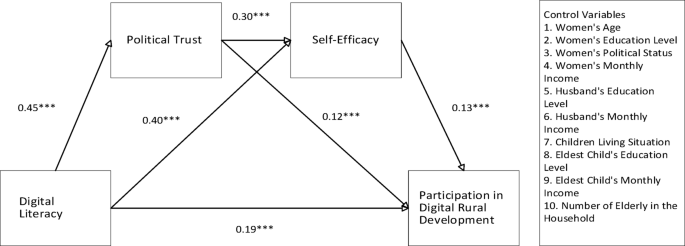
Having established the average effects and explored the heterogeneous impacts of digital literacy, this section delves into the underlying psychological mechanisms through which digital literacy influences digital village participation. To examine the direct and indirect effects, and specifically to test our hypothesized sequential mediating pathway (Di → Pt → Se → Dv), we employed Structural Equation Modeling (SEM). SEM offers a robust and flexible framework for simultaneously estimating multiple regression equations, assessing complex direct and indirect relationships, and evaluating the overall fit of the theoretical model to the observed data.
The analysis was conducted using AMOS 28.0 software. We specified a fully recursive structural model, as illustrated in Fig. 1, with digital literacy (Di) as the exogenous predictor, political trust (Pt) and self-efficacy (Se) as sequential mediators, and digital village participation (Dv) as the endogenous outcome. The maximum likelihood estimation method was utilized, and the robustness of the standard errors and confidence intervals for indirect effects was assessed using the bootstrap method with 5,000 resamples.

Structural Model Path Coefficient Diagram.
Model Fit Assessment:
Prior to interpreting the path coefficients, the overall fit of the hypothesized model was evaluated using a range of standard fit indices. The results indicated a good fit of the model to the observed data: χ²/df = 2.85, CFI = 0.95, TLI = 0.94, RMSEA = 0.062(95% CI = [0.058–0.065]), and SRMR = 0.048. These values generally meet the commonly accepted criteria for good model fit, suggesting that our hypothesized theoretical model adequately represents the relationships among the constructs.
Direct and Indirect Effects Analysis:
As presented in Table 9; Fig. 1, the analysis revealed a significant direct effect of digital literacy on the digital village participation of rural left-behind women (Di → Dv). The estimated standardized direct path coefficient was 0.191 (p < 0.001), indicating statistical significance. This finding provides support for Hypothesis 1, suggesting that digital literacy directly contributes to participation, independent of the proposed mediators. This direct effect accounted for approximately 60.72% (0.191/0.315) of the total observed effect, calculated based on standardized effects.
Furthermore, the analysis indicated a significant total indirect effect of digital literacy on digital village participation through the combined influence of political trust and self-efficacy. The estimated standardized total indirect effect was 0.124 (95% CI = 0.081, 0.138), with the confidence interval not including zero, signifying the presence of significant mediation. This total indirect effect accounted for approximately 39.28% (0.124/0.315) of the total effect of digital literacy on participation, calculated based on standardized effects. Given that both the direct effect and the total indirect effect are statistically significant, these findings collectively indicate that political trust and self-efficacy play a partial mediating role in this relationship.
Breaking down the total indirect effect, several specific mediation pathways were found to be significant.
Indirect effect via Political Trust (Di → Pt → Dv): The estimated standardized indirect effect through political trust was 0.054 (95% CI = 0.023, 0.070), with the confidence interval not including zero. This supports Hypothesis 2 and indicates that political trust acts as a single mediator in this relationship (accounting for approximately 17.17% (0.054/0.315) of the total effect, calculated based on standardized effects).
Indirect effect via Self-Efficacy (Di → Se → Dv): The estimated standardized indirect effect through self-efficacy was 0.052 (95% CI = 0.026, 0.073), with the confidence interval not including zero. This confirms Hypothesis 3 and the mediating role of self-efficacy (accounting for approximately 16.53% (0.052/0.315) of the total effect, calculated based on standardized effects).
Sequential Indirect Effect (Di → Pt → Se → Dv): A significant serial mediation path was identified, with an estimated standardized sequential indirect effect of 0.018 (95% CI = 0.005, 0.023), with the confidence interval also not including zero. This provides strong support for Hypothesis 4, highlighting a sequential mediating process where digital literacy influences political trust, which in turn affects self-efficacy, and subsequently impacts digital village participation (accounting for approximately 5.58% (0.018/0.315) of the total effect, calculated based on standardized effects).
These findings, demonstrating both a significant direct influence and important mediated pathways through psychological and attitudinal factors such as political trust and self-efficacy, are broadly consistent with existing literature on the socio-psychological determinants of digital engagement and participation120. Prior research has highlighted how individual beliefs, confidence in one’s abilities (self-efficacy), and trust in institutions can shape engagement with digital platforms and civic processes121. Our results specifically corroborate these perspectives by empirically confirming that digital literacy not only directly enhances participation but also indirectly fosters it by potentially increasing political trust and bolstering self-efficacy among rural left-behind women in the context of digital villages. This is particularly relevant in the digital village context, where both the perceived trustworthiness of the digital environment (political trust) and an individual’s belief in their capacity to effectively use digital tools (self-efficacy) are crucial for overcoming barriers and actively participating.
Moreover, SEM allows for a more rigorous comparison of effects. By examining the standardized path coefficients and their relative contributions, we observe that the direct effect (standardized coefficient = 0.191) appears numerically larger than the total indirect effect (standardized coefficient = 0.124). While both pathways are significant, this suggests that the direct empowerment gained through digital literacy skills remains the primary driver of participation. However, the substantial and significant indirect effects through political trust and self-efficacy underscore the critical role of these psychological factors as important leverage points for interventions aimed at increasing digital village participation, especially given their sequential nature. Future research could further explore the contextual boundary conditions under which these pathways operate more prominently.