

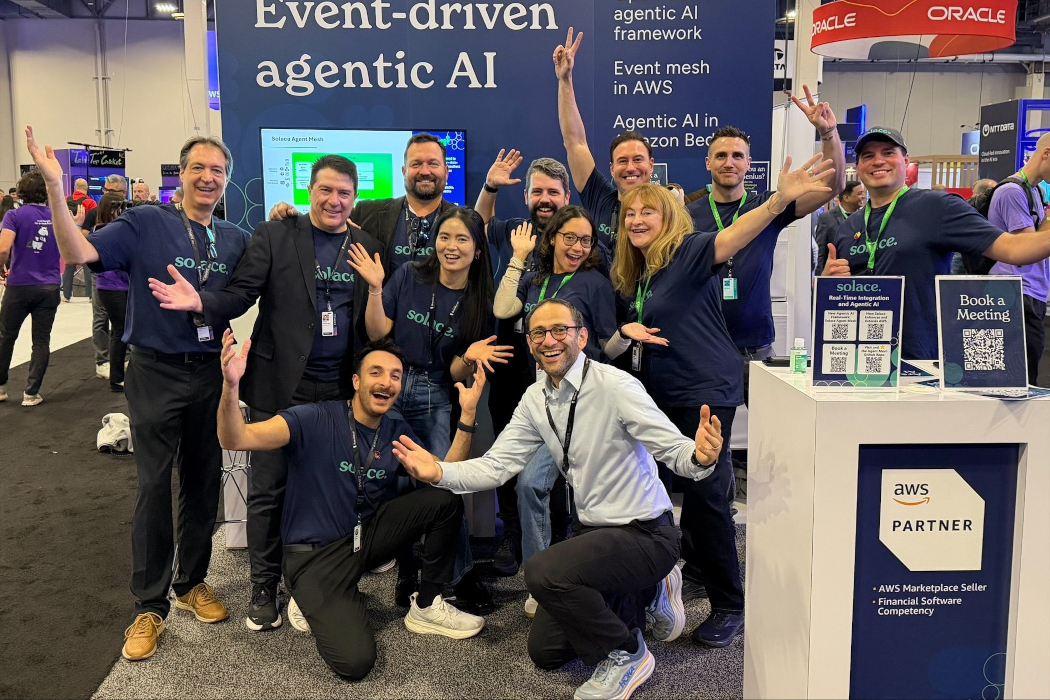
From student to VP, Solace’s Ghaith Dalla-Ali shows how startups can grow talent
Solace combines mentorship and ICTC support to help students build skills that prepare them for leadership.
Many students take internships hoping they’ll lead to a full-time role after graduation. Without the right investment, many internships amount to a few months of busy work before the student moves on. When done right, however, they can be the start of a decades-long career.
“The reason I came back to Solace full-time was the feeling of being a developer like everybody else. I didn’t feel like an afterthought.”
That was Ghaith Dalla-Ali’s journey at Solace after joining the data integration company in 2013 as a QA Engineer through the student placement program. He credits the trust he was given early on, along with mentorship from leaders, with giving him the confidence and skills to keep growing in his role. Now, as Solace’s VP of Engineering, Dalla-Ali remembers being treated like everyone else at the company, not just as a student.
“I had two other placements after Solace,” said Dalla-Ali. “The reason I came back to Solace full-time was the feeling of being a developer like everybody else. I didn’t feel like an afterthought, and they didn’t have me building some random project in the corner. I felt like part of the team.”
Solace provides an event-driven, real-time data integration platform that moves data instantly between a company’s systems. For an e-commerce company, that might mean inventory updates automatically when an order is placed, while the warehouse and delivery systems are notified at the same time. For a bank, that might look like a customer’s credit card being frozen after suspicious activity, while the security team is notified simultaneously.

As VP of Engineering, Agentic AI, Dalla-Ali is now exploring how the same reliable flow of data between systems can help AI agents share information and work together in real time, especially as AI agents become more integrated into company workflows. His engineering team consists of over 250 members, including about 20 who originally joined as students.
Solace has been bringing on student talent for more than a decade and works with the Information and Communications Technology Council (ICTC) to access wage subsidies.
ICTC is a national non-profit that strengthens digital skills and builds business capacity. Its Work Integrated Learning (WIL) Digital program provides grants that support employers to subsidize up to 50 percent of a student’s salary over their work term.
Since 2017, ICTC has facilitated over 23,000 work placements with more than 4,000 employers across Canada.
More than 150 students have joined Solace with ICTC’s support, and Dalla-Ali is not the company’s only success story, with dozens of students hired at Solace full-time.
Students joining Solace develop the same software as everyone else, fix the same bugs, build the same features.
Even those who don’t join full-time leave a lasting impact on the company. Last year, a group of students worked together during Solace’s internal hackathon to build a prototype for an AI Assistant. The goal was to help customers understand Solace’s diverse product range. The chatbot would provide quick answers to common questions without the need to read through lengthy documents.
The project went on to win the People’s Choice award at the hackathon, and today, the Solace Docs AI Assistant is a functioning, externally facing product.
Students who join Solace aren’t given random siloed projects to work on during their term. They develop the same piece of software as everyone else, fix the same bugs, and build the same features.
“Today, the expectation is that within their first sprint, they’ve produced something an end user can experience,” said Dalla-Ali. “That could be fixing a defect in our software or working on a feature that customers can consume right away.”
Dalla-Ali credits a strong onboarding process and intentional mentorship for the success of its students. From their first day, students are paired with a mentor, and each week they are expected to learn a new skill they can add to their resume.
“When I was in my co-op, I was always asked what skills I was learning, and that stuck with me,” remembers Dalla-Ali. “I understood that they were not just trying to extract value from me; they were also putting me in a situation where I was getting value from the co-op, and that I would succeed whether I stayed at the company or moved on.”
PRESENTED BY

Learn how ICTC’s Work Integrated Learning programs help build Canada’s digital workforce.
Feature image courtesy Solace on LinkedIn.