

Google commits $37M to advancing AI in Africa
Tech giant Google has announced US$37 million worth of investments in artificial intelligence (AI) projects and skills development across Africa.
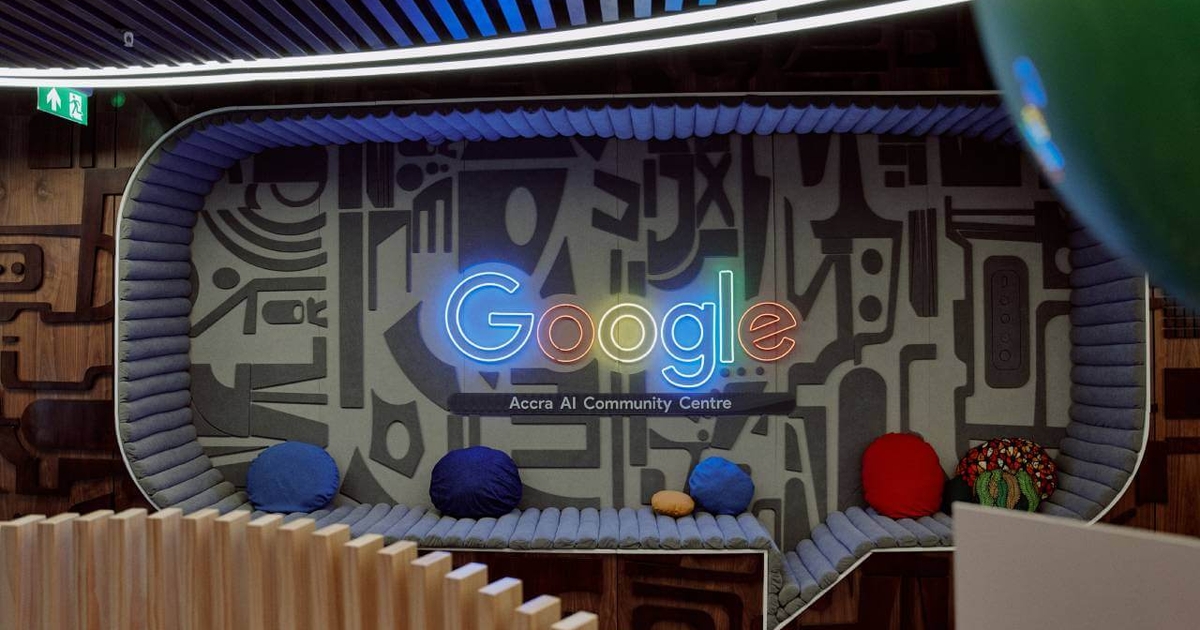
Connecting Africa attended the opening of an AI Community Center in Accra, Ghana on Thursday where the announcement was made.
The funding package includes grants and partnerships that aim to strengthen AI research, support African languages, improve food systems, expand digital skills and build research capacity.
“Africa is home to some of the most important and inspiring work in AI today. We are committed to supporting the next wave of innovation through long-term investment, local partnerships, and platforms that help researchers and entrepreneurs build solutions that matter,” said James Manyika, senior vice president for research, labs, technology and society at Google.
Investment in AI for food security
The biggest part of the funding is a $25 million grant from Google.org towards an AI Collaborative for Food Security.
This project is a multi-stakeholder initiative designed to help researchers and non-governmental organizations use AI to tackle hunger and strengthen African food systems.
The initiative supports projects that improve hunger forecasting, enhance crop resilience and deliver real-time, AI-driven guidance to smallholder farmers, aiming to boost agricultural productivity and resilience in the face of climate disruption.
Startup fund for AI innovation
Google also unveiled a catalytic fund to support impact-driven AI startups across Africa.
This initiative brings together philanthropic capital, venture funding and Google’s technical support to help over 100 startups scale solutions in agriculture, health, education and commerce.
Startups will also receive mentorship, access to tools and technical guidance to support responsible development and help enable local founders to build AI tools for African needs.
“From the start, our belief has been clear: African talent will not just benefit from AI, it will shape its future, both on the continent and globally. This conviction has guided us, focusing on how AI and machine learning can deliver sustainable solutions to pressing societal and business challenges in Africa and worldwide,” said Yossi Matias, vice president of engineering and research at Google.
He said that AI can be a powerful tool for positive transformation across key sectors like healthcare, agriculture and education.
“This new wave of investment reflects our belief in talent, creativity, and ingenuity across the continent. By building with local communities and institutions, we’re supporting solutions that are rooted in Africa’s realities and built for global impact,” Matias said.
According to Manyika the basis for the new funding injection goes back to Google’s mission: to organize the world’s information and make it universally accessible and useful to everybody.
“In particular, in this moment we really believe that AI could be a game changing moment for Africa, but at the same time, we fundamentally believe that a lot of those solutions should be African led. To the extent that we can create conditions, ecosystems, environments and support to enable the development of African led solutions, we think that’s important,” Manyika told journalists in Accra.
AI in African languages
Google also announced a $3 million grant to Masakhane, the open research collective advancing AI tools in over 40 African languages.
The funding will support the development of high-quality datasets, machine translation models and speech tools that make digital content more accessible to Africans in their native languages.
The lack of AI tools in local languages has long been a barrier to adoption, and Google said this initiative will ensuring that African languages are represented and usable in today’s AI-powered world.
AI skills development
Google also unveiled its new AI Community Center in Accra which it called “a first-of-its-kind space for AI learning, experimentation, and collaboration” for locals.
The Center will host training sessions, community events and workshops focused on responsible AI development. Its key focus areas will be AI literacy, community technology, social impact and arts and culture.
Ghana’s Minister of Communication, Digital Technology and Innovations, Samuel Nartey George opened the AI Community Center and said it represented more than just a building: it was a symbol of shared purpose and a powerful testament to what can be achieved through meaningful partnerships.
“For years, Africa has been described in terms of its potential. Today, we are no longer speaking in future tense. We’re building, we’re innovating, and we’re transforming that potential into real, tangible progress here in Africa,” George said.
The Minister said that at the heart of transformation lies the digital economy which is the new engine of global influence and the foundation of Ghana’s future prosperity.
“Digital Transformation is not a luxury for us here in Ghana, it’s an urgent necessity. It is the key to creating sustainable jobs, improving public services, enhancing our global competitiveness and empowering our people to solve problems in ways that are uniquely ours,” he said.
.jpg?width=700&auto=webp&quality=80&disable=upscale "Ghana's Minister of Communication, Digital Technology and Innovations, Samuel Nartey George cutting the ribbon at the AI Community Center in Accra, surrounded by Google executives.")
Ghana’s Minister of Communication, Digital Technology and Innovations, Samuel Nartey George opened the AI Community Center in Accra. (Source: Google)
As demand for AI and digital skills rises, Google is rolling out 100,000 Google Career Certificate scholarships for students in higher learning institutions across Ghana.
These will be fully funded, self-paced programs focusing on AI essentials, prompting essentials and other high-growth areas like IT support, data analytics and cybersecurity.
Google said this will enable more learners to access job-ready training and build careers in AI and the digital economy.
This also forms part of the Ghanaian government’s One Million Coders initiative which was launched in April 2025 with the aim of equipping young people with essential digital skills to position them for work opportunities in the global digital economy.
“We understand that our most valuable resource is not buried underground. It is a boundless creativity and resilience of our people,” said Minister George.
Google established Africa’s first Google AI Research Center in Accra in 2018 and later expanded to Nairobi, Kenya.
Skills training beyond Ghana
As part of its broader AI education mission, Google.org also committed an additional $7 million to support AI talent development across Nigeria, Kenya, South Africa and Ghana.
The funding will support academic institutions and nonprofits building localized AI curricula, online safety training, cybersecurity programs and responsible AI education for youth.
In 2024, Google also pledged $5.8 million in Google.org funding to support AI and cybersecurity training initiatives in Nigeria, Kenya and South Africa.
As part of the new set of pledges, Google.org will provide two new $1 million grants aimed at bolstering AI research in South Africa.
One grant goes to the African Institute for Data Science and Artificial Intelligence (AfriDSAI) at the University of Pretoria in South Africa to support applied AI research and training.
The other supports the Wits Machine Intelligence and Neural Discovery (MIND) Institute in South Africa, which will fund MSc and PhD students’ foundational AI research and help shape innovation and policy from an African perspective.