

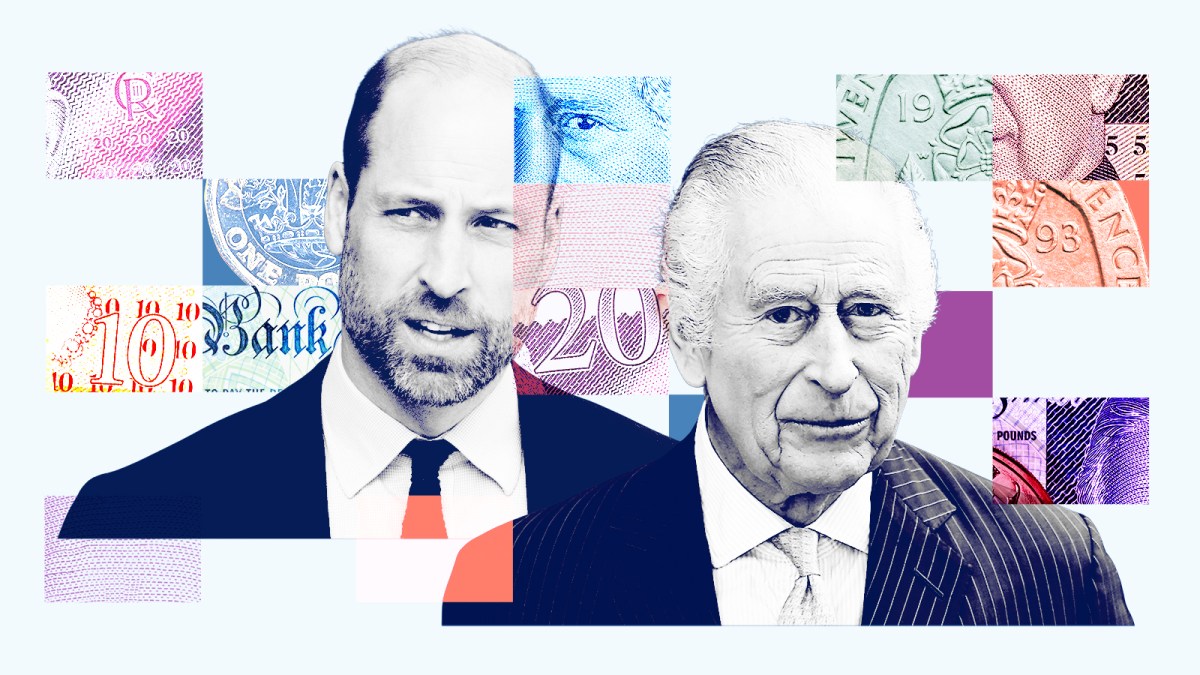
How do the royals make money? Eight unanswered questions
A slice of the profits from the Crown Estate (a collection of assets and land held in a private company) is handed out via the sovereign grant every year to pay for the royals.
Aside from the grant, the other two main sources of wealth for the royals are their inheritance and the Duchies of Lancaster and Cornwall.
The monarch and the heir to the throne receive an income from the surplus produced by their private estates, respectively known as the Duchy of Lancaster and the Duchy of Cornwall.
Funds for the rest of the working royals are distributed from the King’s money, the privy purse, but the amount that each member receives is not known.
Charles inherited more wealth than any monarch for generations, but there is debate about how rich he actually is. Analysis by The Guardian in 2023 estimated his private fortune at £1.8 billion, which includes property, jewellery, the privately owned part of his art collection and even an impressive array of rare stamps. A more conservative estimate from The Sunday Times Rich List is that he is worth £640 million.
The King has several private properties — the Sandringham estate, Balmoral and Birkhall and a number of houses in Romania. Buckingham Palace, Clarence House, Kensington Palace and St James’s Palace are all owned “in right of the crown”, meaning they cannot be sold.
The Crown Estate’s profits are soaring. Norman Baker, the former Liberal Democrat MP and author of Royal Mint: National Debt, a comprehensive investigation into the royal finances, noted in his book: “The crown estate … holds the rights to the seabed around Britain. This means, incidentally, that Britain’s huge expansion in offshore wind, the world’s biggest such development, is giving the royals a huge windfall, hundreds of millions of pounds that before 2012 would have gone into the public purse.”
In last year’s royal settlement, funding for the royals rose by 53 per cent, from £86.3 million to £132.1 million and it is set to rise to £137.9 million for 2026-27. This is expected to fall back again when the sovereign grant is reviewed later this year.
These sums are made public but what will happen next is largely unknown.
How much income tax do the royals pay?
It was the row over repairs after the Windsor Castle fire in 1993 that proved to be the catalyst for the late Queen to start paying income tax voluntarily on the income she received from her duchy. Her advisers convinced the Treasury that many of her costs, including some from the running of her private residences, could be put against tax, as legitimate expenses.
In 2025, the Duchy of Lancaster reported a surplus of £24.4 million for Charles. The Palace says that the King pays tax at the highest rate on the income he took from this, but the precise sum is not disclosed.
• Revealed: the property empires that make Charles and William millions
The same goes for Prince William with the money he takes from the Duchy of Cornwall. Last year it generated a surplus of £22.9 million. The Palace says William also paid tax at the highest rate on his income — though it did not say how much.

Damage after the fire at Windsor Castle in 1992
PHOTO BY ENGLISH HERITAGE/HERITAGE IMAGES/GETTY IMAGES
They are both allowed to make deductions before tax is paid. A memorandum of understanding agreed between the late Queen and the Treasury makes it clear that certain payments to support official duties are deductible, but the details are opaque.
Why do the duchies get other tax breaks?
The Duchies of Lancaster and Cornwall are ancient landed estates, dating to the 14th century. They own tracts of land across many counties and scores of prime properties in central London. They have become wildly more successful in recent decades, moving away from rural homes to more lucrative properties including office blocks, service stations and shipping terminals. An investigation by The Sunday Times in 2024 revealed that the duchies were charging organisations including the NHS and the army to use their land. The Duchy of Lancaster alone received £829,348 annually from the NHS — £11 million over 15 years — to allow ambulances to be parked in a south London warehouse.
The most recent accounts from the Duchy of Lancaster showed that its collective assets were worth £678.7 million.
• King Charles’s estate to review rents charged to NHS and schools
While they operate like commercial estates, they are exempt from corporation tax and capital gains tax because they are Crown bodies, not companies. This is not popular with the public. A 2024 poll found three quarters of those surveyed believed that the royals should pay corporation tax and capital gains tax on their estates.
How was Andrew’s settlement with Virginia Giuffre funded?
Details of the settlement Andrew Mountbatten-Windsor made with Virginia Giuffre in 2022 following the civil claim she brought against him remain confidential. It was reported at the time that he paid about $15 million, although some subsequent reporting said the sum was much lower.

Andrew with Virginia Giuffre and Ghislaine Maxwell
AFP/UNITED STATES DISTRICT COURT FOR THE SOUTHERN DISTRICT OF NEW YORK
The Sun reported last month that Queen Elizabeth provided a “loan” of about £7 million, a further £3 million came from the estate of Prince Philip, and the remainder from other members of the royal family. The King has denied reports that he was party to the 2022 settlement, although it is possible that he inherited obligations from it made by the late Queen.
Questions remain, though, over the loan terms and the precise source of the funds. In particular, whether the sum from the Queen, who died later that year, came from the Duchy of Lancaster, the property portfolio that provides the monarch with an income. This would call into question the Palace’s claim that the settlement was funded by the late Queen’s “private wealth”. The Labour peer Baroness Hodge of Barking, who previously chaired the public accounts committee and has long probed the royal finances, said the duchy income should be considered “public money given to the sovereign”.
• The Queen was blind on Andrew — now the royals play catch-up
Andrew is said not to have paid back a penny. Initially, it was suggested that he would repay the loans by selling his Swiss ski lodge, Helora. However, he is thought to have made little from offloading the Verbier chalet for £19 million in December 2022, as it had a hefty mortgage.
How does Andrew afford it all?
Andrew and his former wife, Sarah Ferguson, had an extravagant lifestyle, but how that was bankrolled has largely been shielded from public view. Andrew’s array of wealthy friends with whom he has struck up working relationships — who include a Libyan gun smuggler and a smattering of Eurasian dictators — want confidentiality too.

Sarah Ferguson and Andrew at Royal Ascot in 2019
MAX MUMBY/INDIGO/GETTY IMAGES
He receives a small pension of about £20,000 annually from his career in the navy. Last year, as part of the King’s attempt to address the Andrew issue, it emerged that he intended to give his brother an allowance for property and living expenses from his private funds. After his withdrawal from public life the late Queen gave her second son an annual allowance, believed to be £1 million a year.
Before this, as a working royal, Andrew received support from the sovereign grant and, before that, through the civil list. In 2010, the last year for which there is a published figure, Andrew received £249,000. After David Cameron’s government replaced the civil list with the sovereign grant in 2012, the sums given to individual family members became more opaque.
• Financier who gave Prince Andrew and Duchess of York £1.4m is jailed
When he was a trade envoy, some of Andrew’s excesses were mopped up by the taxpayer. Despite claims from the Palace that he paid for “all personal expenses” during trade trips, civil servants now allege that some of Andrew’s bills for massages and exorbitant hotels were foisted on taxpayers. In 2009, it was revealed that he had spent £60,000 of public money on chartering a private jet for a three-day jaunt to Azerbaijan to attend the Caspian Oil and Gas exhibition. He was close to the country’s president, Ilham Aliyev, who would go on to win the inaugural Organised Crime and Corruption Person of the Year award in 2012.
Did Andrew receive a tax break from his house?
Sunninghill Park, a mansion near Ascot, was a wedding present to Andrew and Fergie from the late Queen when the pair married in 1986. The property, which was nicknamed Tesco Towers due to its unappealing red brick design, was sold in 2007 to Unity Assets Corporation, a British Virgin Islands-based business, for £15 million — £3 million above the asking price.
Three years later, it emerged that the buyer was Timur Kulibayev, the son-in-law of the then-president of Kazakhstan, Nursultan Nazarbayev. No one ever moved in and the house was demolished a decade ago. Representatives of Andrew and the Kulibayev have always stated there was another potential buyer and that the transaction was purely commercial and legitimate.

Andrew kept the proceeds from the sale, even though the property had initially been owned by the Crown Estate for the benefit of the taxpayer. The Sunday Times revealed last year that the sale went through an opaque trust structure created by his mother.
A source who worked at HMRC in the late 1980s and 1990s alleged that when the property was rebuilt before Andrew and Sarah Ferguson moved in, he and his colleagues were told to treat the reconstruction as a new build, to prevent them having to pay VAT. “The work should have been charged at the standard rate and we zero-rated it because we were told to,” he alleged. “Word came down from above that we had to do it.”
Why are their inheritances secret too?
Under British law, most wills become public upon probate — but not those of senior royals. The monarch’s will is hidden from the public by law and the other royals have long applied to keep their wills secret. In 2021, Sir Andrew McFarlane, the president of the family division of the High Court, ruled that Prince Philip’s will should be sealed for 90 years, following a hearing from which media organisations were barred. The Guardian challenged the decision to hold the hearing in secret, arguing that excluding the press breached the principle of open justice.

The Prince and Princess of Wales at a state banquet in 2025 in Windsor
AARON CHOWN/GETTY
The paper lost in the Court of Appeal and judges agreed with McFarlane that secrecy was necessary to protect the “dignity” of the sovereign, stating: “We are not sure that there is a specific public interest in knowing how the assets of the royal family are distributed.”
In 1993 it was determined that the transfer of assets from one sovereign to the next would be exempt from inheritance tax, avoiding the 40 per cent levy. The justification was to avoid the erosion of the monarchy’s assets. Other inheritances within the family are, in theory, subject to the usual rules but without visibility over the estates themselves the public cannot assess how this works.
Why is there so little transparency over royal finances?
The accounts of the duchies are laid before parliament annually and the public accounts committee has examined aspects of their finances. Proposals to subject them to greater transparency and scrutiny, such as oversight by the National Audit Office, have been resisted.
The Palace line is that these royal financial affairs are “private”, although critics of this secrecy argue that this wealth stems from the public roles they were born into.
Access to the royal archives requires permission and the monarch or heir is exempt from Freedom of Information laws. Monarchs also have mechanisms to shield their finances. When new legislation is proposed they can invoke “Queen’s consent” or “King’s consent”, a procedure that allows the sovereign to review any bill affecting their private interests before it is scrutinised by parliament and, in some cases, opt out.

Andrew and Queen Elizabeth at Royal Ascot in 2014
MAX MUMBY/INDIGO/GETTY IMAGES
For example, when Ted Heath was prime minister, the Conservative government introduced a transparency law in 1973 so the public would be able to know who the investors in listed companies are. Queen Elizabeth’s advisers ensured she and her immediate family were excluded.
The Palace disputes the notion that the royal finances are not transparent, saying: “The royal household understands the importance of transparency and publishes an annual report clearly detailing how the publicly funded sovereign grant is used to fund the official duties of the royal family and the maintenance of the occupied royal palaces.
“In addition, the Treasury receives regular updates on royal finances, and royal household spending is audited by the National Audit Office, in line with the government’s managing public money guidance and financial reporting requirements.
“Further, the Duchy of Lancaster lays its annual report before parliament each year and it is available for the public to view online.”