


Huawei’s commitment to global connectivity bridges digital divide
The use of artificial intelligence (AI) and digital technologies has advanced rapidly around the world in recent years, but the benefits are not available to everyone.
More than a quarter of the world’s population – about 2.2 billion people, according to figures released last November by the International Telecommunication Union (ITU) – remains disconnected from the internet, unable to access essential services such as education and finance, which continue to move online.
This disconnect is particularly prevalent in rural parts of the world, which lack the infrastructure for network coverage. Bridging this gap has become a priority for governments, public institutions and technology companies alike, which in 2021 led to the launch of ITU’s Partner2Connect Digital Coalition to mobilise funding and resources, and facilitate partnerships that enable universal connectivity.
As part of this initiative, Huawei Technologies, the global company specialising in information and communication technology infrastructure and smart devices, made a commitment to help 120 million people in remote areas connect to the digital world by 2025 – a target that the company has long surpassed.
At the Huawei Tech Cares Forum held earlier this month in Barcelona, Yang Chaobin, CEO of the company’s ICT Business Group, reported that it was now providing digital connectivity to 170 million people in remote areas in more than 80 countries worldwide.
“High-speed networks and robust computing facilities are essential foundations for an inclusive and sustainable AI era,” Yang said. The fulfilment of the Partner2Connect Digital Coalition pledge also reflected Huawei’s continuing commitment to innovation and providing improved access to healthcare, education and financial services through digital connectivity to people who live in rural communities, he said.
Jeff Wang, president of public affairs and communications at Huawei, said: “Inclusive connectivity and digital skills empowerment serve as the two core pillars of digital inclusion.
“To bridge the digital skills gap, Huawei works closely with governments and partners to enhance digital access, deliver skills training and advance STEM [science, technology, engineering and mathematics] education for underserved communities.”
To accomplish this, the company had to overcome major barriers to secure connectivity in remote locations. In many rural areas, sparse populations, lower consumer spending and limitations posed by unreliable power infrastructures make network construction less commercially attractive for operators.
It has launched a range of innovative solutions developed for rural villages, which were introduced at the forum by James Zeng, vice-president of the company’s wireless network product line.
RuralStar, for example, was designed to be a cost-effective way to provide voice and data services for villages with 3,000 to 5,000 residents. This solar-powered solution, using microwave backhaul (directional antennas) rather than fibre-optic cables, can be deployed in areas that lack access to both electricity and a fixed network infrastructure. In Kenya, it has brought 2G and 4G connectivity to villages without mains supply, making it easier to carry out mobile payments and agricultural product sales.
RuralLink, which was developed for larger communities of about 5,000 to 8,000 people, simplifies network deployment by reducing the amount of hardware needed to just one remote radio unit and a dedicated channel expansion antenna. Its use in Nigeria has helped carriers increase their user base by over 40 per cent and boosted local economic growth by enabling mobile financial services.
The company’s newest solution, RuralCow, used in smaller villages of 1,000 to 3,000 people, integrates radio, access and backhaul technologies into a compact solar-powered unit. This cuts power consumption by 30 per cent compared with RuralStar sites, which shortens the time it takes for carriers to recoup their investment.
In Nigeria, the first commercial RuralCow site shortened the expected return on investment for operators from about 10 years to just 18 months, to bridge the gap between inclusive development and profitability.
All three solutions address the telecoms industry’s “last mile” challenge by providing cost-effective connectivity to sparsely populated and remote communities.
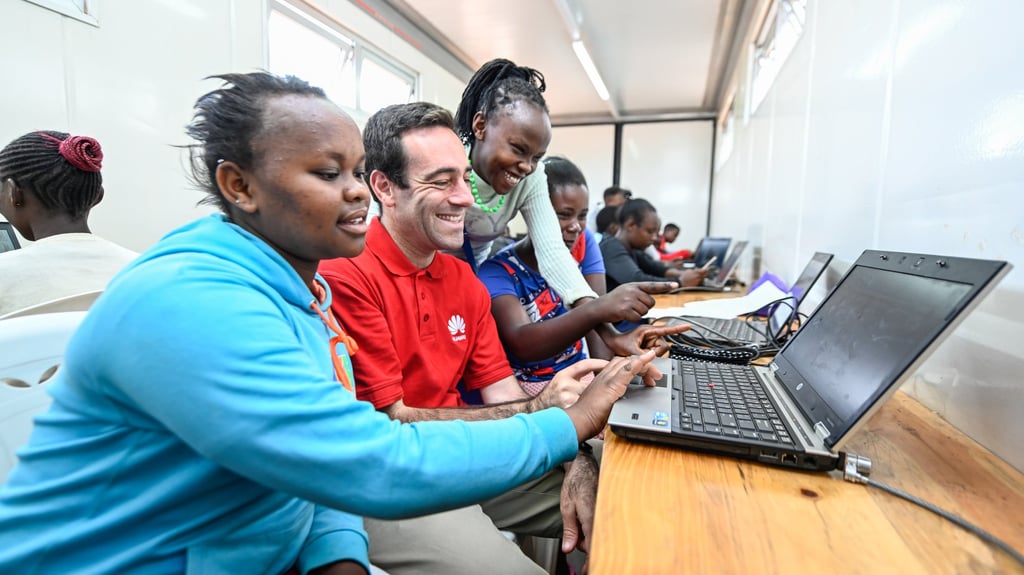
With these solutions in mind, the forum explored how connectivity plays an integral role in supporting broader social and environmental initiatives. One example was Huawei’s “Skills on Wheels” programme, launched in 2019 to bring digital education directly to underserved communities.
The initiative converts shipping containers and buses into solar-powered mobile classrooms equipped with laptops, smart screens, Wi-fi and training resources, allowing instructors to deliver free digital skills training in areas with limited traditional education infrastructure.
As part of this programme, Huawei – in partnership with the NGOs Close the Gap and Computers for Schools Kenya, telecoms operator Safaricom and the Global System for Mobile Communications Association – launched its first DigiTruck in Kenya, where more than 60 per cent of the population remain offline despite 97 per cent of the country having wireless coverage.
Up to the end of last year, the DigiTruck programme had benefited about 7,500 people across 38 communities in Kenya, enabling them to use their digital skills to find jobs, start online businesses and unlock other opportunities.
On a global level, the “Skills on Wheels” programme has helped more than 130,000 people in 21 countries across South America, Africa, Asia and Europe.

The forum also highlighted how digital technologies are being applied to environmental conservation. As part of its Tech4Nature initiative, Huawei partnered with the International Union for Conservation of Nature to deploy digital monitoring tools in protected areas.
One project in the mountainous area of Sant Llorenç del Munt i l’Obac Natural Park in Catalonia, near Barcelona, Spain, focuses on protecting the endangered Bonelli’s eagle. Using cameras, satellite-based global positioning system receivers and a cloud platform, researchers have been able to track more than 70,000 activity locations of the birds, generating insights into how human activity affects their survival. The findings have helped inform conservation measures within the park and guide regional environmental management.
In addition to illustrating how digital capabilities are enabling development across fields including education, finance, healthcare and environmental conservation, the forum also showcased why industry- and sector-spanning collaborations are essential to achieving the goal of universal connectivity.
As deployment becomes more cost-effective, operators can find more incentives to invest in networks in remote areas, creating a positive relationship where business opportunities directly align with supporting the public good.