

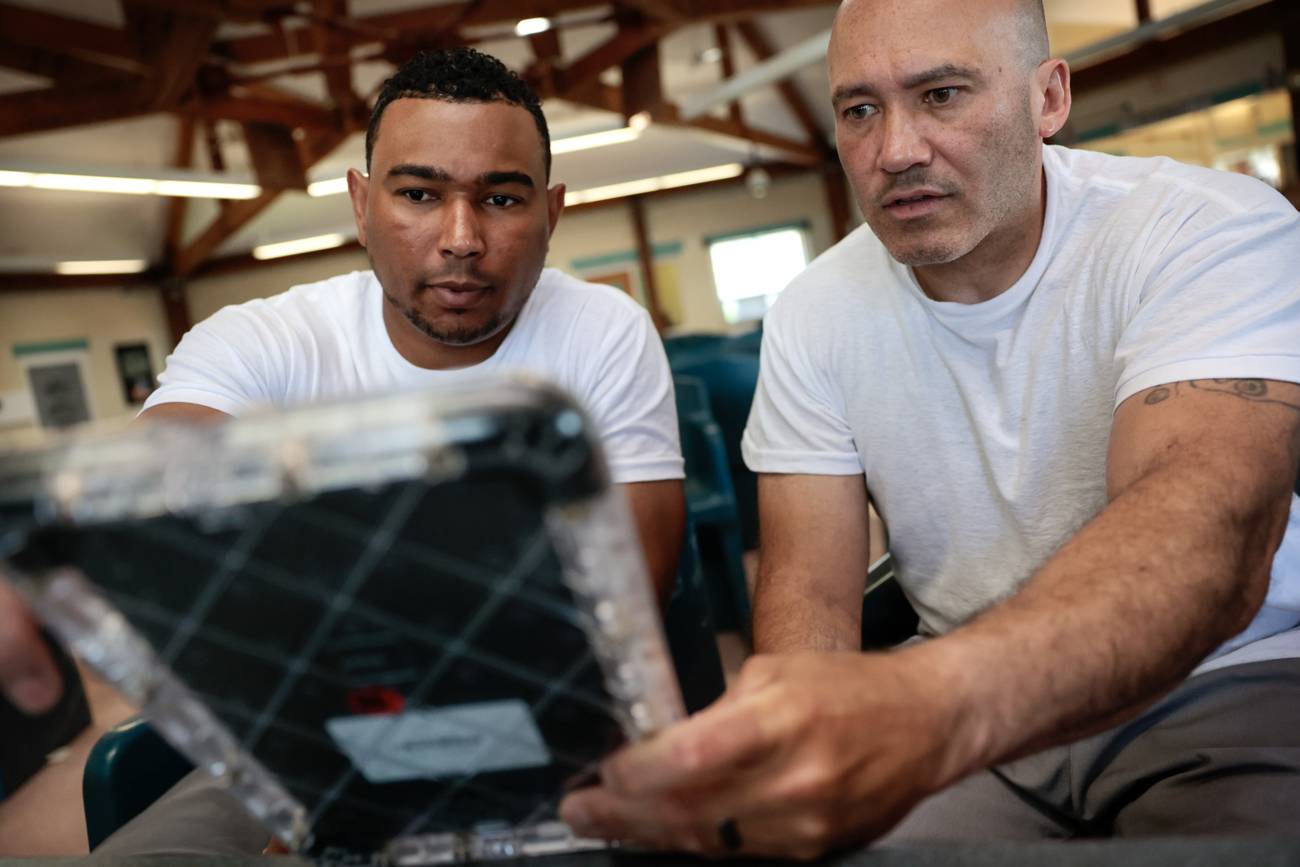
Illinois unveils ‘Journey to Success’ prison tablet education program
The Illinois Department of Corrections on Tuesday launched Journey to Success, a new, customized educational content application portal available on tablets used by inmates across the state.
Though the app from Edovo, a nonprofit learning platform designed for incarcerated people, became accessible on prison tablets last year, the new portal is unique to IDOC. It features programs and resources, such as vocational training and cognitive behavioral programming, curated by the department’s programs teams to support the personal, educational and professional development of inmates.
State officials said the new portal is aimed at improving outcomes both inside facilities and after release, not as a replacement for in-person programming or out-of-cell time.
“Journey to Success represents the best of what we can accomplish when we pair innovation with our commitment to rehabilitation,” Latoya Hughes, the corrections department’s director, said in a press release. “This portal broadens access to trusted information and learning resources while reinforcing the critical work of our educators, program staff, and community partners.”
The expansion of digital education in state prisons is part of the state’s growing push to use technology to support rehabilitation. IDOC began rolling out tablets to state correctional facilities last year, offering streamlined communication services, such as a phone dialer application that allows inmates to connect with loved ones over Wi-Fi.
Corrections agencies are increasingly turning to digital tools such as tablets, education platforms and data systems, to modernize operations and reduce recidivism. According to the nonprofit Electronic Privacy Information Center, at least 25 states use tablets in correctional facilities to enhance communication, aid rehabilitation and curb contraband — though implementation has raised questions around cost, access and oversight. California and Kansas are among the states to have expanded their tablet programs in recent years.
“Tablets have the potential to meaningfully improve the lives of incarcerated people and their correspondents, but they also carry substantial risks: exploitative pricing, inferior service, and state surveillance,” a 2024 EPIC report read.
Hughes said making educational content widely available across facilities, rather than limiting access to specific pilot programs, is critical to long-term public safety.
“Each new tool we introduce helps individuals build skills, strengthen stability, and move closer to success after release,” said Hughes in the announcement.