

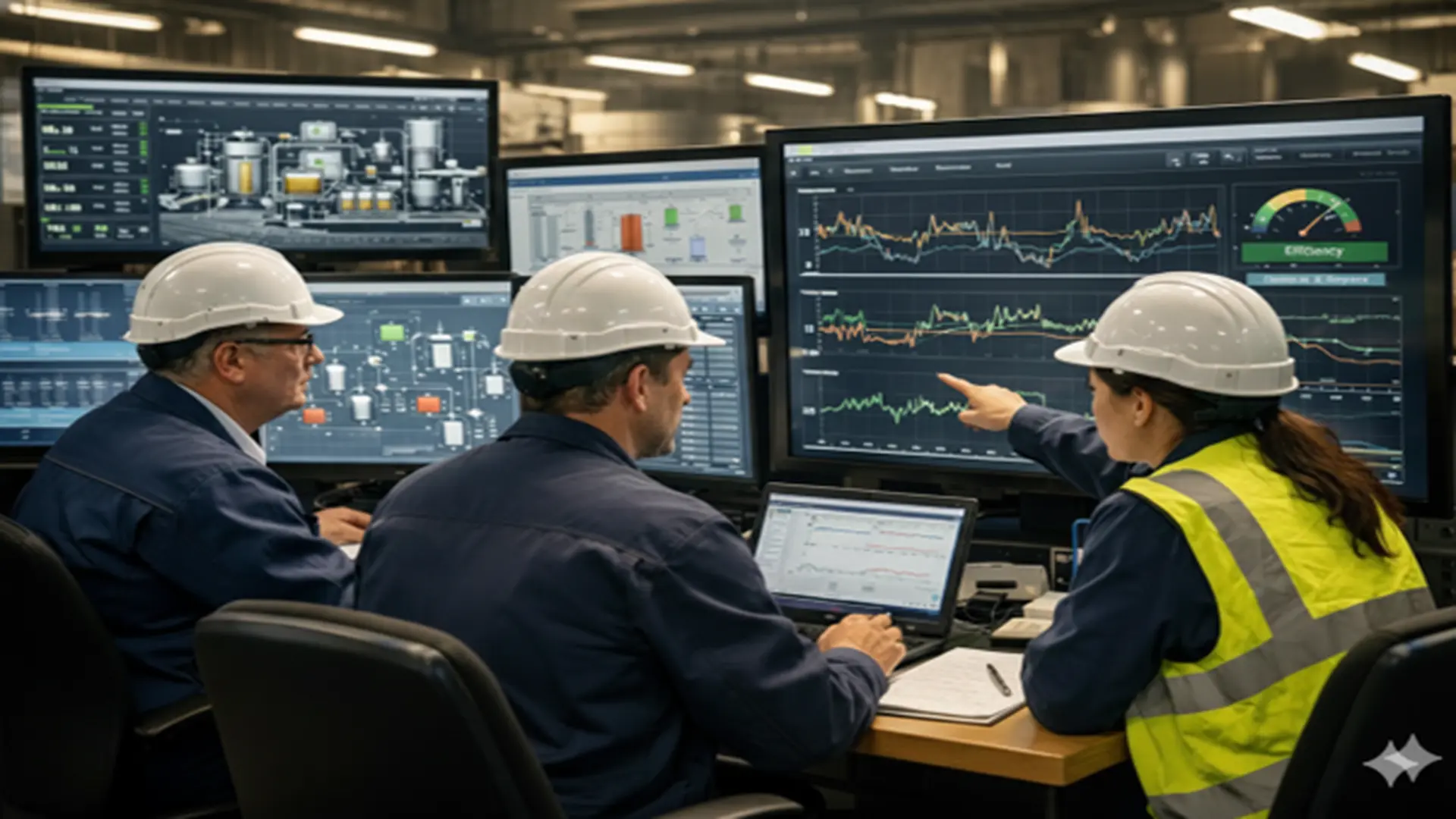
Industrial AI Applied to Key Process Optimization
Technical overview of industrial AI applied to optimize processes, reduce variability, and improve operational stability.
Industrial AI has become a key technical component for the optimization of industrial processes in an environment with increasing demands for efficiency, operational stability, and reliability of production systems. As industrial processes grow in complexity, the ability to analyze real operational data and support engineering decisions becomes decisive for safe and efficient operation.
In sectors such as advanced manufacturing, petrochemical plants, and the aerospace industry, industrial artificial intelligence is integrated as a tool to support process analysis, aimed at reducing operational variability and improving overall performance.
Fundamentals of industrial AI vs. conventional AI
The adoption of artificial intelligence in industrial environments responds to the need to manage complex processes under strict technical, regulatory, and safety constraints. In these systems, every decision directly impacts process behavior, asset integrity, and operational stability.
Operational intelligence acts as an advanced analytical layer that transforms data from sensors, control systems, and plant historians into actionable information, strengthening process control and technical decision-making.
Industrial AI and its difference from conventional AI
Industrial artificial intelligence encompasses models and algorithms specifically designed to operate on real industrial processes. These systems work with data characterized by noise, variability, physical dependencies, and operational constraints that are not present in digital environments.
Unlike conventional AI, which focuses on structured information or virtual environments, operational intelligence must be robust, interpretable, and capable of operating in real time, ensuring that its recommendations do not compromise process stability or operational safety.
Algorithms in process engineering
Algorithm selection depends on the type of process, operational criticality, and the quality of available data. Among the most commonly used are:
- Supervised and unsupervised Machine Learning, applied to the prediction of critical variables, anomaly detection, and identification of operational patterns.
- Neural networks, especially relevant in nonlinear continuous processes such as reactors, separation columns, and thermal systems.
- Predictive and prescriptive models, which allow anticipation of process behavior and recommend optimal operational actions under engineering-defined constraints.
Industrial AI in process engineering and optimization
The application of artificial intelligence enables a shift from static approaches to dynamic optimization strategies based on real process behavior. This capability is key to responding to changing operating conditions without compromising stability, safety, or efficiency.
Real-Time optimization of operating parameters
Through continuous analysis of process variables, operational intelligence enables dynamic setpoint adjustment based on load, system conditions, and operational constraints. This optimization reduces process variability, improves final product quality, and optimizes the use of energy and raw materials.
Operational stability and advanced control
Operational stability is a fundamental requirement in critical industrial processes. Operational intelligence does not replace PID or MPC control systems but complements them with predictive capabilities that allow deviations to be detected before they manifest as alarms or functional failures.
Integration of industrial AI in advanced manufacturing
Automated production represents one of the environments where artificial intelligence has reached the highest level of operational maturity. Its integration enables optimization of highly automated production lines without affecting process continuity.
Smart production lines
Operational intelligence analyzes data from sensors, actuators, and control systems to identify bottlenecks, inefficient sequences, and micro-stoppages (unplanned stops) that impact overall line performance. This optimization translates into higher productivity, reduced waste, and more stable operation.
Product quality and predictive analysis
AI-based inspection systems enable real-time evaluation of compliance with specifications, anticipating defects before the final product goes out of tolerance and strengthening quality control.
Applications by sector (Petrochemical, aerospace, offshore)
In Petrochemical plants
Petrochemical plants operate highly complex continuous processes, where small deviations can generate significant impacts on safety, efficiency, and profitability.
- Continuous process optimization: Operational intelligence allows modeling of nonlinear behaviors and optimization of operating conditions in reactors, separation columns, and thermal systems, contributing to higher energy efficiency and process stability.
- Data-driven predictive maintenance: Analysis of vibration, temperature, and pressure data enables anticipation of failures in critical equipment, reducing unplanned shutdowns and extending asset life.
In the aerospace industry
Aerospace technology demands extreme levels of precision, traceability, and reliability. In this environment, automated intelligence is applied as a key enabler to ensure compliance with technical specifications under highly controlled operating conditions.
- High-precision and zero-tolerance processes: In the manufacturing of critical components, AI technologies applied to industry are used to control dimensional, thermal, and structural parameters with minimal tolerances. These models allow analysis of microscopic variations that could compromise final component performance. Extreme variability control is fundamental in aerospace industrial processes, where repeatability and consistency are non-negotiable requirements.
- Process safety and operational reliability: In aerospace applications, artificial intelligence technology acts as a decision-support tool for critical operations by integrating information from multiple systems. Its use enables evaluation of complex scenarios and anticipation of risk conditions before they materialize. This capability strengthens process safety and operational reliability, adding an extra analytical layer in environments where the margin for error is virtually zero.
In the drilling and energy industry (offshore)
The offshore environment is one of the most demanding for AI due to extreme conditions and asset criticality. The application of intelligent models in this area demonstrates how technology optimizes equipment life.
- Failure prediction in critical assets: As explained by Austin Hay of ADC Energy, AI integration allows analysis of historical inspection data to identify wear patterns in essential equipment. This transforms maintenance from a time-based model to one based on the actual condition of the asset.
- Mitigation of operational risks: The use of deep learning to monitor components such as blowout preventer (BOP) systems enables detection of minimal deviations that could compromise safety. This anticipatory response capability is vital in processes where the margin for error is nonexistent.
- Real case example: In the following video, interviewee Austin Hay details how the convergence of data engineering and field experience is redefining inspections on drilling platforms.

Integration of industrial AI with existing systems
One of the main challenges of adopting asset AI is its integration with existing operational infrastructures.
- Integration with SCADA and DCS: Artificial intelligence is integrated as an analytical layer on top of SCADA and DCS systems, leveraging existing data flows without altering primary control logic.
- Industrial Data Management: Data quality is a critical factor. Proper validation, cleansing, and management of sensors and historical data are essential to ensure reliable models.
- Integration Challenges and Cybersecurity: The implementation of operational intelligence must be approached with a realistic technical vision.
- Implementation Risks: Incomplete data or poorly trained models can generate inconsistent recommendations. Continuous validation and expert supervision are indispensable.
- Industrial Cybersecurity: Industrial AI expands the attack surface. It is no longer just about protecting hardware, but the integrity of the algorithm itself. A manipulated AI model can compromise operational stability without triggering traditional alarms.
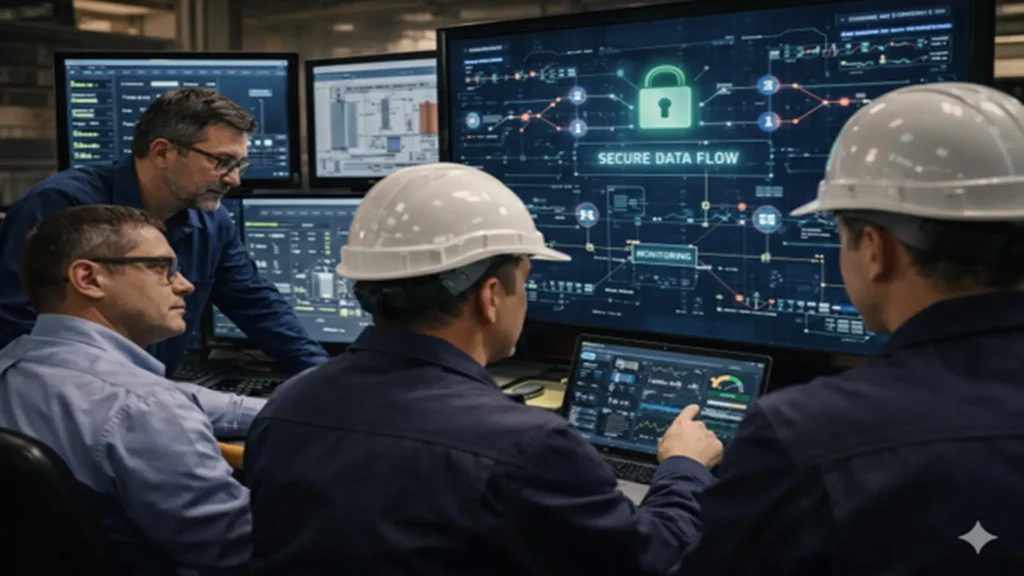
Key risk vectors:
- Data poisoning: Alteration of training data to force incorrect decisions.
- Adversarial attacks: Manipulation of sensors to confuse model perception.
- Model leakage: Unauthorized access to the algorithm’s intellectual property.
Resilience by design: Security must be native. This implies implementing cross-validation (where the physical logic of the system supervises AI proposals) and strict segmentation between data networks and critical control systems (DCS/SCADA).
Current landscape and trends in industrial AI
AI for critical assets has moved beyond the experimental phase and is advancing toward selective adoption, prioritizing applications with measurable operational returns. Convergence with digital twins and advanced analytics strengthens technical decision-making.
Conclusions
Industrial AI is consolidating itself as a strategic enabler for industrial process optimization, complementing traditional engineering through advanced analysis of real operational data. Its effective implementation requires careful integration, rigorous data management, and alignment with principles of safety and operational reliability.
From Inspenet’s perspective, industrial AI should be approached as a tool for solving operational problems, aligned with principles of safety, integrity, and asset management. Its responsible and technically grounded implementation will be a determining factor in the sustainable evolution of industrial processes in the coming years.
References
- International Society of Automation (ISA).
- Artificial Intelligence in Industrial Automation.
- Technical guide on the use of industrial AI in automation and industrial processes.
- McKinsey & Company.
- The rise of AI in industrial operations.
- Analysis of the adoption of industrial artificial intelligence in manufacturing and process plants.
- Seborg, D. E. et al.
- Process Dynamics and Control. Wiley.
- Classic reference on process control, operational stability, and industrial optimization.
- Austin Hay, A. (2025). Inspection of offshore platforms with AI [Video interview]. Inspenet TV. https://inspenet.com/video-tv/inspeccion-plataformas-offshore-con-ia/
Frequently Asked Questions (FAQ)
Does AI replace traditional control?
No. It is an analytical complement to SCADA or DCS systems. It strengthens decision-making through operational data without altering the plant’s primary control logic.
In which processes does AI add the most value?
In continuous and automated processes with reliable data. It stands out in petrochemical, smart manufacturing, and offshore operations, where stability and asset integrity are critical priorities.
How does AI help in the offshore sector?
It detects anomalies in critical equipment before functional failures. By analyzing historical trends, it optimizes maintenance cycles and reduces the risk of accidents or severe environmental impacts.
What are the implementation challenges?
Challenges include operational data quality, integration with existing systems, industrial cybersecurity, and the need for expert supervision to validate technical models.