Intergenerational digital feedback and digital social integration of older adults: an empirical study from personal initiative perspective
Digital social integration
Social integration refers to a process by which the social identity of an individual is constructed; in this process, individuals connect with others, adapt, reshape themselves, assimilate, and finally integrate (Berkman et al. 2000). With the rapid development of digital technology, connections between individuals have become closer. For instance, the emergence of social media platforms like Facebook and WeChat allows individuals from different classes, ethnicities, educational backgrounds, and regions to communicate within the same cyberspace. However, technological development has also created issues such as the digital divide, as well as information cocoons resulting from personalized recommendation algorithms, which deepen divisions between groups with different user profiles. DSI has thus become an important issue in contemporary times. Particularly for older adults, for whom DSI relates to their health status, social interaction, and well-being, DSI is important for building an inclusive society.
The COVID-19 pandemic accelerated the upgrade of information technology, and the subsequent explosive development of AI has brought new changes to the relationship between older adults and digital society. For example, home isolation encouraged older adults to engage more actively with online communities, enhancing their resilience in digital society and improving their level of DSI (Kamalpour et al. 2020). A survey of older adults in Canada and Spain showed that intelligent assistants made significant contributions to helping older adults select interests, develop habits, and construct social networks (Rosales et al. 2024). However, a debate remains about whether older adults should integrate into digital society through using technology as soon as possible. For example, many people question the neutrality and authenticity of AI, which relies on external data (Muñoz et al. 2025). As AI advances, the possibility of technology controlling older adults may exist, increasing their dependency on technology or reducing their freedom in decision-making (Pirhonen et al. 2020). In addition, some older adults believe that accepting these technologies means admitting failure or being weak (Felber et al. 2023). In summary, integration into digital society through AIPs can bring numerous benefits, but issues such as ageism and privacy invasion, persist widely and continuously.
On the subject of DSI, older adults should be allowed to autonomously choose to integrate, to voluntarily participate, and to integrate in an understandable way. The process of integration should focus on psychological and cognitive aspects, rather than on technical usage. Based on the contemporary welfare system and the social relationships possessed by older groups, true isolation rarely occurs at the traditional social level. However, cognitive gaps in digital culture and digital identity are emerging between older groups and younger groups in the digital space (Hülür and Macdonald, 2020). Therefore, we should explore the DSI of older adults from the perspectives of acculturation and identity.
We considered the particular characteristics of older adults in the process of defining acculturation and identity accordingly, to ensure the accuracy of the concepts. Acculturation refers to the process of continuous and direct cultural contact between digital immigrants (represented by the older group) and digital natives, so that the older adults can acquire the values, literacy, and skills related to digital culture and change their behaviors, adapting to the norms of digital culture (Greenhalgh et al. 2013). Identity refers to the psychological process of integrating oneself with the emotional experience and behavior patterns of those in digital society (Spears, 2021).
Intergenerational digital feedback
Intergenerational feedback, the process by which the younger generation mentor the older generation by offering support and knowledge, is an important and common topic of research on aging and social media (Makita et al. 2021). The older generation have made outstanding contributions to the development of society and deserve the help of the younger generation, and of the whole society, to live contentedly and improve their quality of life. In regards to digital society, older adults lack digital expertise and experience, as well as access to digital products, which results in a digital divide and a series of inequality issues in this space (Sourbati and Loos, 2019). Contemporary young people, with their social resources, communication abilities, and digital knowledge, should take responsibility for older adults, allocating digital resources, bridging the digital divide, and helping them integrate into digital society, namely, providing intergenerational digital feedback.
Intergenerational digital feedback has multiple forms and sources due to the diverse support needed by older adults. Therefore, the objectives, scenarios, and providers of intergenerational digital feedback differ significantly from one study to the next. Table 1 lists some of these studies.
As shown in Table 1, intergenerational digital feedback can occur in the context of family, community, or society.
Intergenerational digital feedback at the family level primarily refers to digital assistance provided by the offspring of older individuals, specifically including financial support, instrumental support, and emotional support related to AIP usage (Czaja, 2016). This support provides practical assistance for older adults via face-to-face opportunities to learn about AIPs and recognize their needs related to digital life.
Intergenerational digital feedback from the community is primarily provided by community volunteers, young mentors, and health service providers who help older adults become experts in using AIPs. Community-based support is more professional compared to family support and promotes the systematization of digital knowledge among older adults (Yao et al. 2021).
Societal feedback is provided by the government, enterprises, website designers, and social organizations. These entities mainly focus on policy formulation, product provision, and professional education, ensuring that older adults have equal access to technological benefits and are immersed in an inclusive environment (Wang et al. 2024a).
Family, community, and society constitute a multi-level intergenerational digital feedback system that is mutually connected and functionally complementary, jointly promoting the DSI of older adults. However, current studies largely focus on single or dual sources of intergenerational digital feedback, neglecting either the driving force of families in older adults’ use of AIPs; or the impact of community in developing digital literacy among them; or the significance of a digitally inclusive social environment. Therefore, considering the comprehensive impact of intergenerational digital feedback from family, community, and society on older adults is necessary.
Motivation and intergenerational digital feedback
The origin of individual motivation is often closely related to social support. Many older adults have difficulty feeling motivated to use digital products due to their individual cognition, education, and values (Yang and Lin, 2019). Therefore, motivation arises only when members of the younger generation provide them with knowledge and support. That is, the motivation of older adults to use AIPs is closely related to intergenerational digital feedback.
Intergenerational digital feedback from different sources will affect this motivation. For example, the informational and emotional support provided by offspring might stimulate an older person’s desire to explore social technology and use it to maintain family communication. Seguí et al. show that an intergenerational project of learning information and communication technology based on the community can provide informational and emotional support for older adults through the establishment of a partnership between the older adults and junior high school students; this partnership can not only uncover the older adults’ needs for digital products, but also drive them to use smartphones and tablets actively (Seguí et al. 2019). Yoon et al. believe the government can provide economic incentives to social organizations that provide computer and technical resources (for example, refurbished computers, mobile phones, and personalized training) to older adults, giving them the opportunity to understand the characteristics and functions of smart devices and thus increasing their motivation to use them (Yoon et al. 2020). Rasi et al. believe that public libraries can play the role of technical resource and training centers, providing older adults with access to computers and the Internet as well as training opportunities, so that older adults can experience the ease of use and usefulness of intelligent devices, leading to a desire to use them (Rasi et al. 2021). In conclusion, we believe that different sources of intergenerational digital feedback can enhance the motivation of older adults to use AIPs actively. Thus, we propose the following hypotheses:
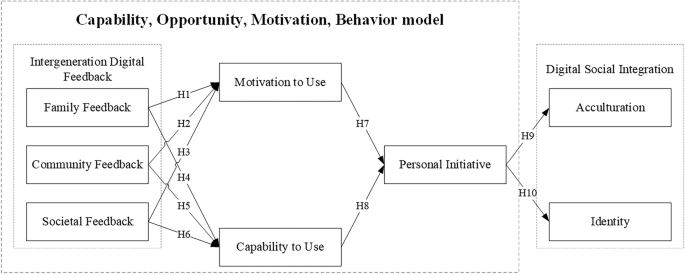
H1: Intergenerational digital feedback from family can significantly affect older adults’ motivation to use AIPs.
H2: Intergenerational digital feedback from community can significantly affect older adults’ motivation to use AIPs.
H3: Intergenerational digital feedback from society can significantly affect older adults’ motivation to use AIPs.
Capability and intergenerational digital feedback
Perceived social support is an important predictor of individual capability. Existing research shows that older adults require digital literacy, economic ability, social capital, and other capabilities in order to use mobile devices (Tirado-Morueta et al. 2018). Considering the lack of cognition toward digital society and the partial loss of ability caused by aging, older adults tend to acquire their ability to use AIPs from social support (information, tools, or emotional support) provided by younger adults. That is, the capability of older adults to use AIPs is often closely related to the intergenerational digital feedback they acquire from different sources. For example, informal support from their children and grandchildren is a key element in improving their digital capabilities (Rosales and Blanche-T, 2022). The social isolation caused by the COVID-19 pandemic highlighted the importance of intergenerational relationships among family members to developing the digital communication capabilities of older adults (Flynn, 2022). Rios et al. demonstrate that the participation of older adults in Internet training programs organized by the community enhances the heterogeneity of these adults’ social networks and improves their social capital and digital capability (Rios et al. 2019). In addition, all kinds of social organizations improve the digital skills of older adults effectively through intergenerational teaching methods, in which younger mentors (Lee and Kim, 2019) or children who attend courses with older adults can tutor them. An interview with educators of older adults shows that social education provided by public libraries, nursing homes, universities for older adults, and non-governmental organizations improves the digital capabilities of older adults (Tomczyk et al. 2022). In conclusion, we believe that different sources of intergenerational digital feedback will enhance the capability of older adults to use AIPs actively. Therefore, we propose the following hypotheses:
H4: Intergenerational digital feedback from family can significantly affect older adults’ capability to use AIPs.
H5: Intergenerational digital feedback from community can significantly affect older adults’ capability to use AIPs.
H6: Intergenerational digital feedback from society can significantly affect older adults’ capability to use AIPs.
Personal initiative, motivation, and capability
Personal initiative is affected by the combined influence of motivation and capability. For older adults, the active use of AIPs requires two factors. On the one hand, higher individual motivation is an important factor for an individual to have personal initiative. For example, an exploratory study in Germany found that the motivation to continuously monitor health is an important reason why older adults actively use smart devices (Germini et al. 2022). Social motivation and emotional motivation are also important drivers for the active use of intelligent technology by older adults (Kim et al. 2019). In terms of social technology and online social networks, Chopik demonstrated that enjoyment is the key factor to encourage older adults to use social technology actively, and this motivation also affects mobile device use (Chopik, 2016).
On the other hand, a higher level of self-perceived capability will improve the initiative of older adults to use AIPs. For example, the results of an interview with older adults with hearing impairment show that they often lack confidence in their knowledge, skills, and ability to use digital technology (Funk et al. 2018), so that they are reluctant to use new devices actively. Furthermore, Schroeder et al. argue that perceived digital capability is a determinant of older adults actively using online services (Schroeder et al. 2023). Jokisch et al. studied the influence of different structures of Internet self-efficacy (general Internet self-efficacy and communication Internet self-efficacy) on the active use of the Internet by different types of older users (Jokisch et al. 2020). Therefore, we propose the following hypotheses:
H7: Motivation to use AIPs can significantly affect the personal initiative of older adults to use AIPs.
H8: Capability to use AIPs can significantly affect the personal initiative of older adults to use AIPs.
DSI and personal initiative
DSI can help older adults maintain their independence and alleviate feelings of loneliness. Studies have shown that actively using AIPs promotes the DSI of disadvantaged groups. Drydakis showed immigrants immersing themselves in local culture and integrating into society by using m-Integration applications, which include m-Health and m-Mental health applications (Drydakis, 2021). Similarly, Chan found that sexual and gender minority individuals hope to reduce public stigma, seek social support, and build greater levels of community connection through actively using social media (Chan, 2022). For older adults, research has proven that the active use of AIPs effectively bridges the digital divide and promotes DSI, including acculturation and identity. For example, Campos et al. studied how older adults maintain their independence, communicate with younger generation, and alleviate their social isolation through the active use of environmentally intelligent technologies, such as robotics, wireless sensor networks, mobile applications, and interactive video games (Campos et al. 2016). An interview with older adults suggested that the active adoption of healthcare information technology helped them to form and maintain multi-level social activities, thereby enhancing their feelings of social integration (Zhao et al. 2022). Thus, we propose the following hypotheses:
H9: The personal initiative of older adults can significantly affect their acculturation in digital society.
H10: The personal initiative of older adults can significantly affect their identity in digital society.
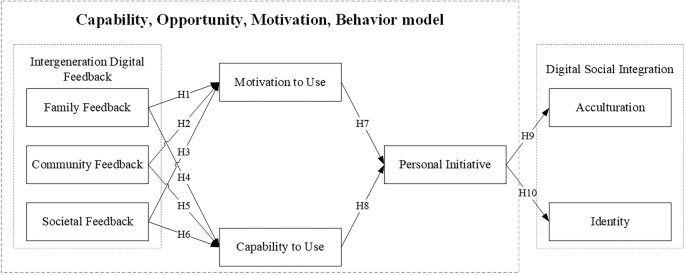
This paper explores the influence mechanism of different sources of intergenerational digital feedback on the integration of older adults into digital society from the perspective of personal initiative, based on the COM-B model. As shown in Fig. 1, intergenerational digital feedback at the family, community, and society levels has an impact on personal initiative through the motivation to use and capability to use AIPs, which in turn affect two dimensions of DSI, namely, acculturation and identity.