

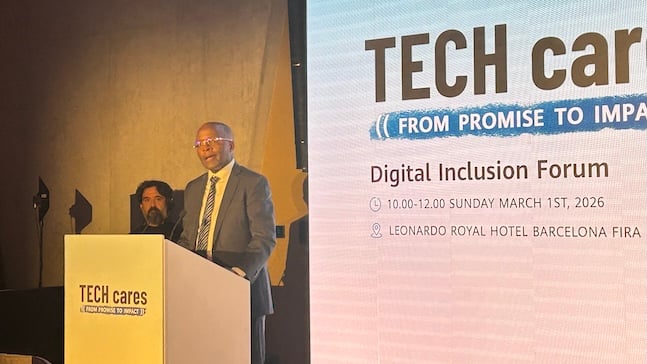
ITU, Huawei highlight connectivity gains
LIVE FROM MWC26 BARCELONA: Speakers at the Huawei Tech Cares Forum held today (1 March) expressed optimism about the transformational power of AI on advancing digital inclusion and connectivity, with some highlighting significant gains in bringing people online.
Standing at the midpoint of the 2030 Agenda for Sustainable Development, Cosmas Zavazava, ITU Director of the Telecommunication Development Bureau (pictured), emphasised “the digital divide remains one of the defining challenges of our times” and the organisations wants everyone to benefit from digital transformation.
He explained the AI era offers life-changing opportunities for individuals, communities and entire economies, but only if people can actually access the technology, because some countries and regions are not well connected.
“We have the responsibility to engage in digital inclusion and get everyone to have access and meaningfully use connectivity.”
“When connectivity is present and inclusive, sustainable development becomes possible and technology becomes a catalyst to development.”
In an update in November 2025, the ITU highlighted progress made since 2023, with the number of people offline dropping from 2.6 billion to 2.2 billion.
Steady gains
Huawei ICT Business Group CEO Yang Chaobin said the company exceeded a target set in 2022 to connect 120 million people in remote regions of more than 80 countries as part of its commitment when it joined the ITU’s Partner2Connect Digital Coalition.
By the end of 2025, the figures stood at 170 million people compared with 90 million at end-2023.
Jeff Wang, president of Public Affairs and Communications at Huawei, argued connectivity alone is not enough.
Subscribe to our newsletter
Get breaking news, exclusive insight, and expert analysis – before anyone else.
He noted in Europe and other developed regions, 44 per cent of people lack basic digital skills.
The figure is higher in developing regions including sub-Saharan Africa, where less than 10 per cent of adults have basic digital skills.
Kenya Special Envoy for Technology Philip Thigo noted East Africa is the least connected region in the world at 26 per cent, but nearly half the population of his nation are connected.
He argued the introduction of AI moved the focus away from the digital divide, creating an opportunity and an existential divide. “No country can develop beyond its knowledge capacity, so if people cannot access, or develop or build intelligence, then we know that countries will be stifled or stunted.”
Jeffrey Sachs, director of the Centre for Sustainable Development at Columbia University, said AI offers incredibly powerful tools which, when combined with networks, are completely transformative for social inclusion and economic advancement.
“We will reach education for all because of the combination of 5G, inexpensive high-quality devices and AI.”
Sachs also believes there will be major advances in agricultural productivity, food security, delivery of healthcare, payment systems and microfinance to ensure government transfers are provided efficiently and not lost along the way.
Huawei also highlighted its Skills on Wheels programme initiated in 2019 involved the conversion of used shipping containers and busses into solar-powered mobile classrooms equipped with smart screens, laptops, Wi-Fi and training resources.
Over the past six years, the project benefited more than 130,000 people in 21 countries including Kenya, Rwanda, Zimbabwe, Italy, France, Saudi Arabia and Peru.