

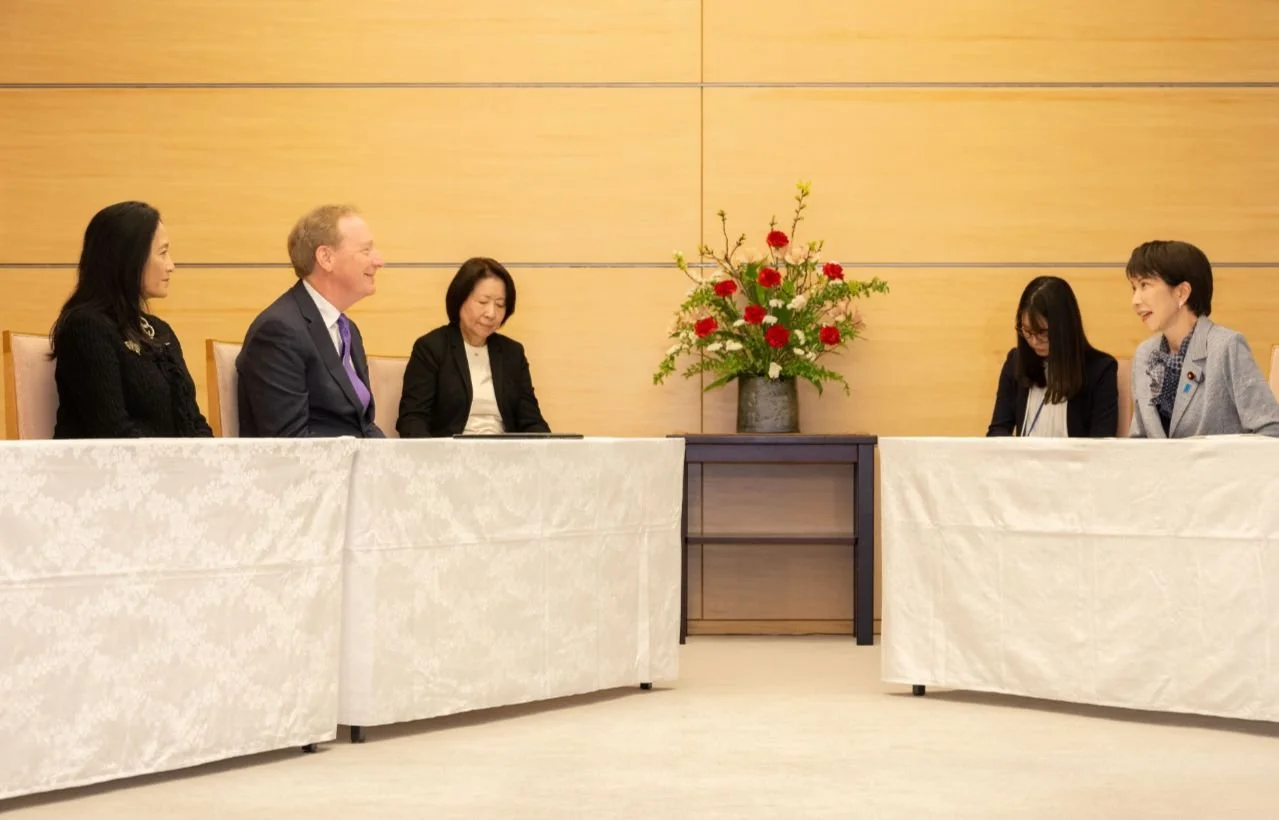
Microsoft invests $10B in Japan AI infrastructure and workforce skills
Microsoft is committing $10 billion to Japan’s AI infrastructure and workforce development between 2026 and 2029, expanding its role in a market where adoption is rising but capacity, control, and skills remain constraints.
The investment builds on a $2.9 billion commitment in 2024 and comes as generative AI usage in Japan moves ahead of the global average, with nearly one in five working-age people now using AI tools.
Brad Smith, Vice Chair and President at Microsoft, says the scale of demand is already shaping how the company approaches the market. He says the investment will help meet “the country’s growing demand for cloud and AI services,” with a focus on infrastructure built “on Japan’s terms.”
That framing reflects a shift away from centralized cloud dependency toward locally controlled AI systems.
Infrastructure shifts toward domestic control
A central part of the strategy focuses on expanding AI infrastructure that operates within Japan, particularly where data residency and governance are non-negotiable.
Microsoft is working with domestic providers including SoftBank and Sakura Internet to deliver GPU-based AI compute through Azure while keeping data within national boundaries.
Junichi Miyakawa, President & CEO at SoftBank Corp., says the partnership is designed to support more sensitive use cases. He notes that customers will be able to use AI “with confidence even in areas that require a high level of confidentiality and data sovereignty,” as infrastructure options expand.
The same emphasis on control extends beyond cloud environments. Azure Local is being positioned for organizations with strict operational requirements, including disconnected systems, while GitHub Enterprise Cloud introduces domestic data residency for development workflows.
Kunihiro Tanaka, Founder, CEO and President at SAKURA internet Inc., points to growing demand for flexibility, saying infrastructure must “take operational requirements into account” as digital transformation accelerates.
Skills gap drives scale of training plans
Alongside infrastructure, the scale of Microsoft’s workforce commitment reflects a widening skills gap. Japan is projected to face a shortfall of 3.26 million AI and robotics workers by 2040, placing workforce readiness at the center of adoption.
Microsoft is committing to train one million engineers and developers by 2030 in partnership with companies including Fujitsu, Hitachi, NEC, NTT Data, and SoftBank.
Miki Tsusaka, President at Microsoft Japan, connects the investment directly to national priorities, saying it is designed to support “the continued growth of the Japanese economy” and move “growth from vision to execution.”
Workforce programs are also being extended through labor and industry partnerships, including collaboration with the Japanese Electrical Electronic & Information Union to reach approximately 580,000 workers.
Masashi Jimbo, President of the union, frames AI literacy as a long-term requirement rather than a risk, describing it as “a powerful means of enhancing the quality of work” and a foundation for sustainable careers.
Security and research align with national priorities
The investment also extends into cybersecurity and research, areas that sit alongside infrastructure and skills in Japan’s national technology strategy.
Microsoft is expanding collaboration with Japan’s National Cybersecurity Office and National Police Agency, focusing on threat intelligence sharing and coordinated responses to cybercrime.
A $1 million research grant program and fellowship initiative will support AI-driven scientific research, addressing constraints around access to compute.
Kohei Itoh, President at Keio University, says AI is already reshaping research across disciplines, noting its role in advancing work “not only science and engineering but also the humanities, social sciences, and interdisciplinary studies.”
Microsoft is also extending its CyberSmart AI Programme through the Kyushu Semiconductor Human Resource Development Consortium, linking AI and cybersecurity skills to one of Japan’s key industrial sectors.
Kazutoshi Hokoya, Deputy Director at the consortium, highlights the importance of collaboration, saying the partnership opens the door to “broad collaboration between Microsoft Japan and companies, educational institutions, and other stakeholders across the Kyushu region.”