


New microcredentials to offer expanded career opportunities for Union students
Starting this fall, Union will begin offering microcredentials, which are designed to help students acquire specific in-demand skills and competencies to make them more desirable to prospective employers.
Complementing Union’s traditional liberal arts curriculum, the pilot microcredential program will focus on areas of high student and employer interest, including personal finance, artificial intelligence, and Microsoft Excel. Additional offerings in other skill areas also are being sourced for fall. They will be free of charge.
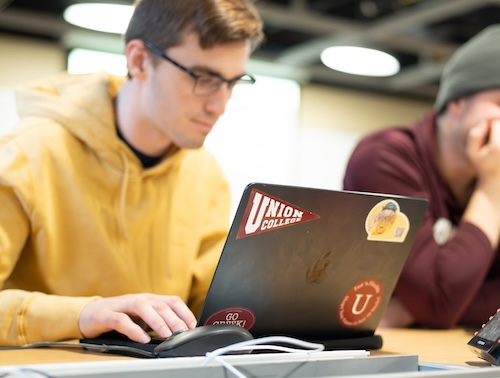
These microcredentialing opportunities, distinct programs of learning in a focused area of study, may be asynchronous (students complete on their own time), in-person or hybrid. They are not for credit and will not appear on a student’s transcript.
Instead, when students complete a specific microcredential, they will earn a digital badge that can be shared on their LinkedIn profile and other online platforms. Through the badge, employers can access metadata indicating what skills the student has developed, and what type of demonstration of learning they had to produce to earn the badge.
Recent surveys have shown that employers consider a college degree along with a microcredential in either a technical or broad skill, as more desirable than a college degree alone.
“With this microcredentialing initiative, Union demonstrates its commitment to innovation and to supporting our students by offering them new opportunities to grow and showcase their human capital to prospective employers,” said Michele Angrist, the Stephen J. and Diane K. Ciesinski Dean of Faculty and Vice President for Academic Affairs.
The College has partnered with Credly to deliver skills-aligned digital badging that allows students to quickly access and share their skills acquisition on digital platforms. Union joins more than 2,000 organizations who have turned to Credly, the world’s largest professional credentialing marketplace.
“Badges are not issued simply for showing up,” said Debra Gelinas, curriculum and program development specialist for Pre-Professional Programs. She joined Union last September to help the College enhance the way it prepares students for their professional futures.
“Students engage in co-curricular learning opportunities, which are often experiential in nature, to develop tangible skills. At the end of each program, students will complete a final assignment demonstrating the skills or competencies required to earn the badge. This capstone assignment is evaluated by a Union College faculty or staff member, who will verify that the student has developed these skills.”
Gelinas said the microcredentials will give Union students an advantage in the job search.
“The digital badge can help Union students (and eventually graduates) become more discoverable, particularly when shared on platforms like LinkedIn, and serve as a differentiator by providing verified evidence of in-demand skills during the recruitment and hiring process,” she said.
The new initiative is the perfect complement to the top-tier liberal arts and engineering education Union is recognized for, Angrist said.
“Parents and students deserve to be confident of what the return will be on their investment in a Union education,” Angrist said. “Our formal curriculum, no matter the major, delivered in impactful ways in small-scale settings by master teachers, continues to equip students with the competencies today’s employers need – including critical thinking, problem-solving, collaboration and teamwork, communication, and the ability to be rapid life-long learners.
“At the same time, microcredentials will allow interested students to further develop and document additional specific skills outside of the classroom.”