

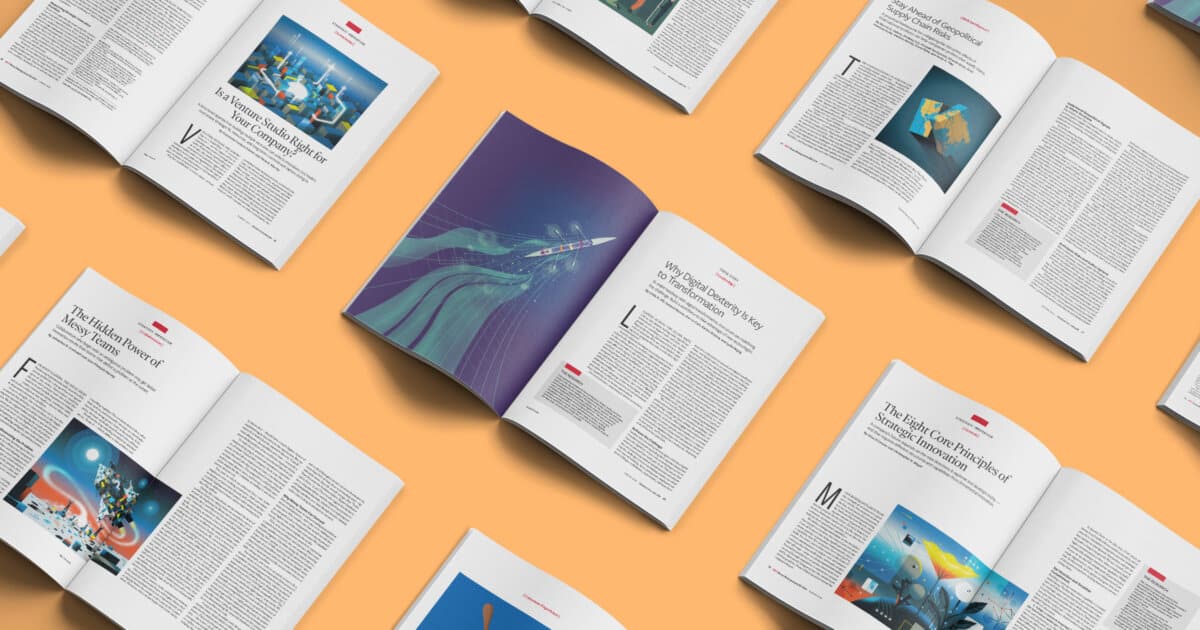
Our Guide to the Spring 2026 Issue

The Eight Core Principles of Strategic Innovation
Gina O’Connor and Christopher R. Meyer
Key Insight: Mature companies that build a strategic innovation capability can systematically renew their product portfolios to sustain long-term growth.
Top Takeaways: Many companies start off with a bang: the launch of an exciting breakthrough product or service. But as time passes, their focus tends to shift to maintaining and incrementally improving existing business lines at the expense of developing innovative new offerings. Research on mature companies that have successfully maintained a flow of innovation has uncovered practices that, together, can help such businesses build and sustain a strategic innovation capability. Key among them is establishing a permanent innovation practice that has strategic vision and commitment at its foundation.
Read the article
Is a Venture Studio Right for Your Company?
Constanze Coelsch-Foisner and Fiona E. Murray
Key Insight: Venture studios can help corporations innovate but require specialized resources, governance, and sustained commitment to succeed.
Top Takeaways: More businesses are establishing venture studios by deploying talent, ideas, and resources into multiple new ventures that operate in parallel to innovate in key strategic areas. This growth is occurring despite challenges like high capital requirements and governance complexity. Venture studios are unlikely to succeed, however, unless they acquire specialized talent, an internal intellectual property portfolio, or market insights; combine internal assets and external capabilities; establish the right governance mechanisms; and make a long-term commitment of time and money.
Read the article
The Hidden Power of Messy Teams
Johnathan R. Cromwell and Jean-François Harvey
Key Insight: Collaborators who start the innovation process with open-ended exploration rather than a specific problem to solve are more likely to generate viable new ideas.
Top Takeaways: Conventional wisdom holds that beginning an innovation project with a clearly defined goal increases teams’ likelihood of successful idea generation and implementation. However, the results of a study of hundreds of ad hoc teams that formed to participate in a global company’s annual innovation competition defied expectations: Teams that started out with an ambiguous problem definition but were able to converge on a single idea by their project’s midpoint had a greater chance of seeing their innovation successfully implemented than teams that began with a well-defined problem.
Read the article
Why Digital Dexterity Is Key to Transformation
Linda A. Hill, Sunand Menon, Ann Le Cam, Karina Grazina, and Lydia Begag
Key Insight: Leaders who frame digital transformation as a cultural shift make more progress than those who take a technology-first approach.
Top Takeaways: It takes more than new technologies or training to digitally transform an organization. A focus on culture and work-process change is instrumental in developing a workforce that is both willing and able to incorporate digital tools and data into their roles. Researchers point to four people-first leadership practices that facilitate successful transformation efforts: reframing the challenge, engaging from the top, bridging people and perspectives, and sustaining long-term commitment.
Read the article
What AI Can Teach Us About Designing Better KPIs
Balázs Kovács
Key Insight: Leaders who adapt four AI model training techniques to design performance measurements can deter gaming behaviors among employees.
Top Takeaways: A fixation on metrics can lead companies to optimize for measures like sales figures while ignoring long-term strategies like customer retention. When employees have incentives that are tied to such narrow indicators, they may engage in unethical practices to achieve rewards. Traditional solutions, such as balanced scorecards and KPIs, are vulnerable to gaming behaviors and require stringent oversight. Organizations that apply new strategies drawn from AI and machine learning research are set up to rethink their approach to metrics while continuing to reap the benefits of performance measurement.
Read the article
Learn From Outcomes to Promote Growth
Vladyslav Biloshapka and Oleksiy Osiyevskyy
Key Insight: A new way to determine why past initiatives succeeded or failed can help leaders make more informed strategic decisions.
Top Takeaways: A longitudinal study on how different countries and industries achieve sustainable growth, resilience, and longevity led to the development of a framework to help managers determine what led to a project’s successful or unsuccessful outcome. Decompose, Interpret, Reward, and Scale, or DIRS, combined with tools for assessing decisions and planning for growth, emphasizes structured learning that leaders can apply to identify future opportunities and develop repeatable growth strategies.
Read the article
Build Business Advantage With Real-Time Decision-Making
Peter Weill and Elizabeth van den Berg
Key Insight: Real-time businesses (RTBs) outperform rivals by enabling employees to make better-informed decisions and quickly execute them.
Top Takeaways: Businesses that operate in real time are able to achieve dramatically higher customer satisfaction by making fast, data-driven decisions more quickly than competitors can. Research points to four key capabilities that the most successful RTBs exercise: real-time data availability and decision-making, empowered employees, better business agility, and a more integrated customer experience. Case studies of United Airlines, Ikea, and Vanguard illustrate how those companies have engaged in the four capabilities to become successful real-time businesses.
Read the article
Stay Ahead of Geopolitical Supply Chain Risks
Morris A. Cohen, Shiliang Cui, Vinayak Deshpande, Ricardo Ernst, Arnd Huchzermeier, Daniela Muhaj, David Pyke, and Andy A. Tsay
Key Insight: Protecting supply chains from disruption caused by global politics requires a structured approach to risk management.
Top Takeaways: The conventional playbook for managing supply chain risk is falling short in the face of increasing disruption from geopolitical events like trade wars, sanctions, and armed conflict. A study of 13 multinational companies led researchers to create a three-part framework that can help leaders interpret geopolitical signals to proactively protect their supply chains. Leaders who have that understanding of geopolitical signals, anticipate risks and define options, and adapt to current conditions are better positioned to manage through uncertainty.
Read the article
Why Mergers Fail and How to Spot Trouble Early
Henrik Cronqvist and Désirée-Jessica Pély
Key Insight: A new framework can help leaders identify risks throughout the M&A process to avoid a future corporate divorce.
Top Takeaways: Nearly half of all M&A deals are eventually undone, with splits occurring 10 years after the original deal, on average. Research reveals that poor initial fit and unforeseen disruptions are the typical causes of corporate merger failures, which ultimately absorb leadership attention, destroy shareholder value, and damage organizations’ credibility. The Corporate Divorce Matrix can help leaders diagnose which path their deal is likely to follow and make smarter, more sound decisions at every stage of the M&A process.
Read the article
A Smarter Approach to Measuring Customer Experience
Charles H. Patti, Maria M. van Dessel, and Steven W. Hartley
Key Insight: Companies can pare down the customer metrics they collect to focus on those that deliver the deepest insights.
Top Takeaways: The proliferation of customer experience measurement tools means that marketers now face the challenge of managing, and deriving value from, an overwhelming number of CX metrics. Research has identified ways for businesses to determine which metrics are of greatest value and align them with customer journey mapping. Collecting fewer metrics yields tracking and reporting efficiencies, and connecting them to key stages of the customer journey gives CX managers more actionable insights.
Read the article