

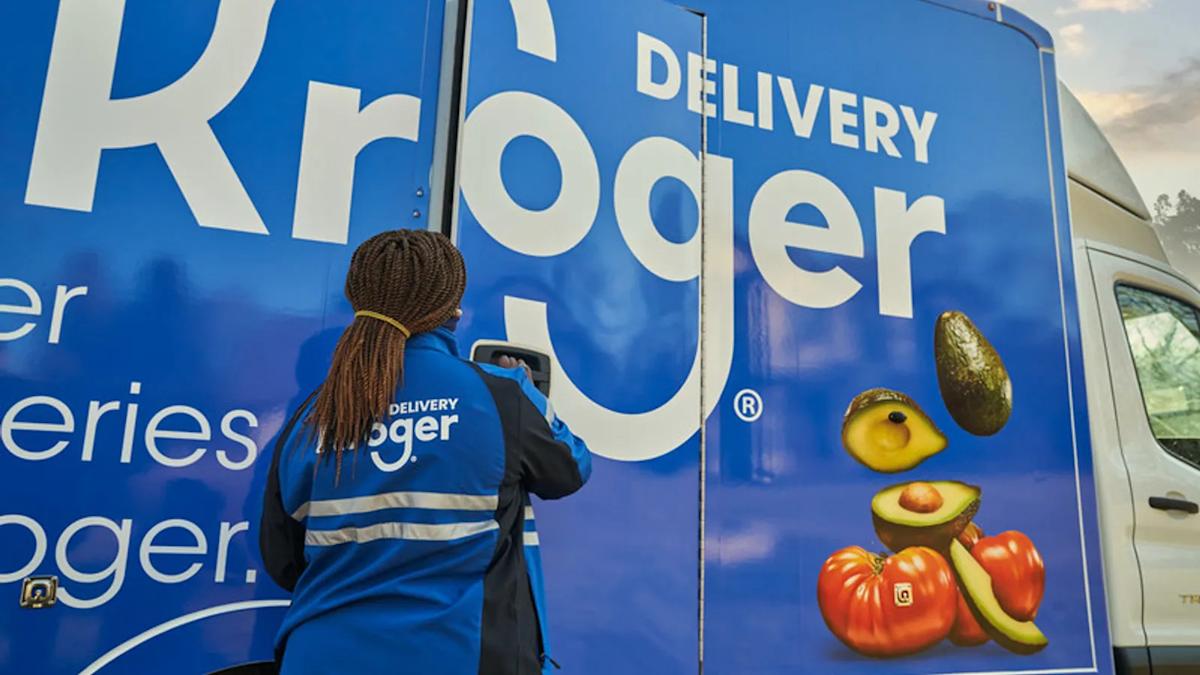
Should retail media sales count toward grocers’ e-commerce profitability?
This story was originally published on Grocery Dive. To receive daily news and insights, subscribe to our free daily Grocery Dive newsletter.
The Friday Checkout is a weekly column providing more insight on the news, rounding up the announcements you may have missed and sharing what’s to come.
After striving for years to turn its online grocery business into a money-maker, Kroger declared this week that it finally has that elusive goal in its sights — but it comes with a significant caveat.
Kroger emphasized that it expects to generate a profit from e-commerce in 2026 because it is closing multiple automated facilities, relying more heavily on individual stores to fulfill orders and stepping up partnerships with third-party providers.
But the company’s CFO disclosed that it also takes sales from its retail media business into account when calculating its e-commerce profitability. In addition, Kroger noted that its arrangements with Instacart, DoorDash and Uber are helping to power its digital advertising operations.
Kroger’s decision to fold its booming retail media business into its definition of e-commerce profitability stands in stark contrast to how Albertsons — which, like Kroger and other grocers, has struggled to make money online — is approaching the challenge. Albertsons’ CEO said in July that the chain is getting close to breaking even on its digital business, but made clear that the company does not include sales from its retail media business when determining the profitability of its e-commerce operations.
It’s hardly surprising that making money online has long eluded food retailers. Consider the costs of picking products from shelves, packing and storing orders — not to mention developing apps and transporting goods to shoppers — and it’s easy to understand why grocers have struggled for years to achieve e-commerce profitability. Still, Kroger’s decision to factor retail media into the equation takes some of the air out of a highly significant achievement at a pivotal time for the company.
Which grocers cooked this Thanksgiving?
While grocery store visits were up overall on the day before Thanksgiving compared with the same day a year ago, some grocers had more to be thankful for than others, according to Placer.ai data. That day, traditional grocers saw visits spike nearly 86% above their 12-month daily average, outpacing value and specialty chains and surpassing last year’s relative uptick. Value grocers saw a larger relative visit boost earlier in the week, though, indicating that budget-conscious customers got a head start on their grocery shopping.