

Teenagers to be offered ‘V-levels’ to learn vocational skills
Teenagers will be able to take new vocational A-level-style qualifications in digital, finance, and education from next year as Bridget Phillipson vows to end “snobbery” in the post-16 system.
The first three V-levels — courses equivalent to a single A-level — will be introduced from September next year, allowing pupils to combine vocational and academic subjects in a mixed programme of study.
The education secretary said that the qualifications would “prepare young people for jobs of the 21st century”, including digital specialists and “content creators who need to learn how to use technology and manage their finances and their business”.
Last year, Sir Keir Starmer set a target to have two-thirds of young people in higher education, technical or vocational training, or doing a “gold standard” apprenticeship by the age of 25.
The first subjects announced for the new qualifications are education and early years, finance and accounting, and digital. They can be combined with A-levels, allowing students to mix academic and vocational study.
Students currently in Year 9 will be the first group able to take the new qualifications when they reach sixth form or college.
From September 2028, further V- levels in business, care services, construction, engineering and manufacturing, health and science, legal, sales and sports could be introduced.
• Schools white paper: the key Send policies, winners and losers
V-levels will sit alongside A-levels and T-levels in England’s post-16 offer. T-levels, which are larger technical courses, will be expanded to include more subjects such as sport, fitness and exercise, science and care services.
From 2027, legacy qualifications, including Btecs will be defunded when there are T or V-levels that overlap.
The government is also introducing two new qualification pathways for pupils with lower attainment who are not yet ready to progress beyond GCSE-level study, a stage when young people are most at risk of becoming not in education, employment or training.
For those who hope to progress to an apprenticeship or into the workplace, there will be two-year Occupational Certificate qualifications starting from next year in catering and hospitality, education and early years.
For students who want to progress on to an A, V or T-level, there will be one-year Foundation Certificate qualifications in education, early years and digital, including IT and technology.
The government has also begun a consultation on stepping-stone qualifications for pupils who are preparing to resit English and maths GCSEs.
Sir Ian Bauckham, the chief regulator at Ofqual, said the new qualifications would ensure “all young people” had a post-16 pathway that “prepares them for their future”, adding that the regulator would ensure the qualifications are “well-designed”.
• Anxious young Britons ‘risk becoming lost generation on benefits’
How post-16 education has changed
The post-16 system in England is changing, with T-levels already in place and a new qualification called V-levels planned for introduction from next year.

Pupils will be able to sit V-levels and A-levels alongside each other
ALAMY
T-levels were introduced in 2020 for students aged 16 to 19 who want a more practical alternative to A-levels. Each student studies one T-level focused on a specific career area, such as engineering, accounting or media production. The course takes two years and are equivalent to three A-levels in terms of Ucas points, which are used for admission to university.
A key feature of T-levels is the industry placement, which requires at least 315 hours (about nine weeks) working with an employer.
V-levels will combine academic and vocational learning. Unlike T-levels, students will be able to mix and match subjects.
Each V-level will be equivalent to one A-level, so students could take three V-levels or combine them with A-levels. V-levels are expected to replace many Level 3 Btec qualifications, which offer vocational study through coursework and practical learning. The aim is to simplify the system and provide clearer choices.
Bridget Phillipson: These are the skills young people need for 21st-century work
How many times have you heard that A-levels are the only path to success?
That view has consequences. Every time we say it, we’re telling a whole generation of young people that any other path they choose and the hard work they put in doesn’t really count.
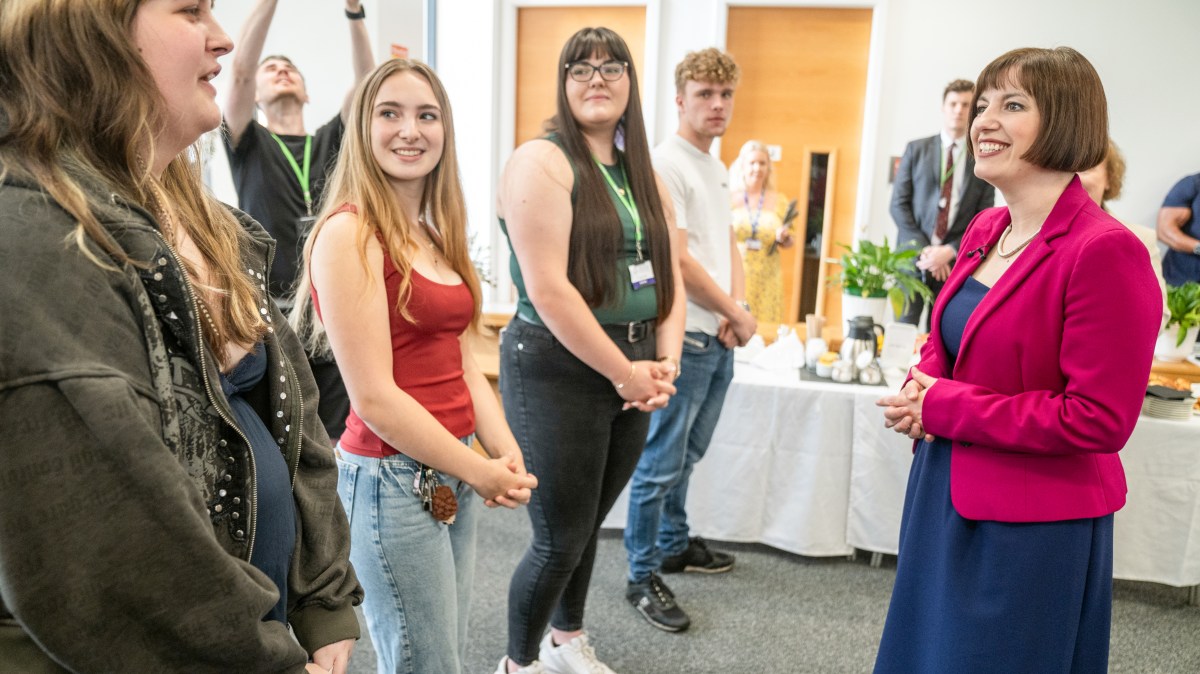
Last week I visited Nottingham College and spoke to bright, skilled young people. They told me they were overwhelmed by all the options available to them after GCSEs and wanted cleared options. They resisted the pressure to pursue academic routes when they knew that didn’t play to their strengths and now they are thriving.

Phillipson visits Nottingham College
PHIL BARNET/PA
They should be the rule, not the exception. I’m determined to end the academic snobbery generations of young people have faced.
Too many people look down at those who aren’t academically minded, those who do the hands-on jobs so many of us rely on in our day-to-day lives. We will always need these jobs. They are critical to our lives and to our economy.
We also need to rethink how we prepare young people for jobs of the 21st century. These include content creators who need to learn how to use technology and manage their finances and their business, or digital specialists to take us through the impending AI revolution.
That’s why today we’re introducing V-levels, a landmark transformation to the skills landscape in this country.
They’ll be equivalent to one A-level, and just as rigorous. They’re being developed hand-in-hand with employers and education leaders so they deliver the transferable skills that businesses actually need.
Half of parents would prefer their child to study a mix of academic and vocational qualifications after GCSEs, and that’s exactly what we’re providing with V-levels. A teenager who loves history but also wants to get a head start in finance? They can do both. Someone who’s interested in a career in early years education but also wants to keep their options open? V-levels give them that springboard.
Be in no doubt: this does not mean the end of T-levels. They remain the best option for young people to learn the specific skills they need to start their career as an engineering technician, content creator or healthcare worker, as well as progressing to further and higher-level study. And we’re going further than ever, with the biggest expansion of T-levels since their introduction in 2020, including exploring new T-levels in sports science and care services.
Nobody knows exactly what the world of work will look like in ten years, but we do know that young people will need practical skills, adaptability and recognised qualifications that employers respect. Half of parents say their biggest concern for their child’s future career is finding stable, secure employment. V-levels and T-levels will give them the skills they need to make that a reality.
Our ambition extends far beyond V-levels. We’re also making sure that every young person has a clear route forward at 16, with the support to manage any difficulties they face.
This government believes that every young person deserves a genuine chance to get on. That’s why the prime minister has set a target for two thirds of young people to be in a quality apprenticeship, higher training or heading to university by 25. V-levels and the reforms announced today are a key part of how we get there.
Whether your child wants to go to university, start an apprenticeship or walk straight into a career, there will be a rigorous, respected qualification to help get them there.
It’s time to end the snobbery. Every young person in this country deserves better than that.
Bridget Phillipson is the education secretary