

The promotion mechanism of physical and mental health of the elderly in China: the impact of the digital divide and social capital | BMC Public Health
Descriptive statistics
Table 3 indicates the statistical distribution of 2906 valid samples, with a gender ratio of 51.2% for females and 48.4% for males, indicating gender ratio balance. Regarding age, the percentage of people over 80 is relatively small, with the majority aged 60 to 79. This age group still possesses ability to learn and master digital technology, and physical and mental health is relatively good. Regarding education level, owing to the limitations imposed by economic and social circumstances of the period, the proportion of elderly people aged high school or below is rather high, while the general education level is rather poor. 70.3% of elderly people are married. In terms of internet usage, 35.2% are internet users, and 64.8% of elderly people have not yet accessed digital technology.
Multiple regression model result
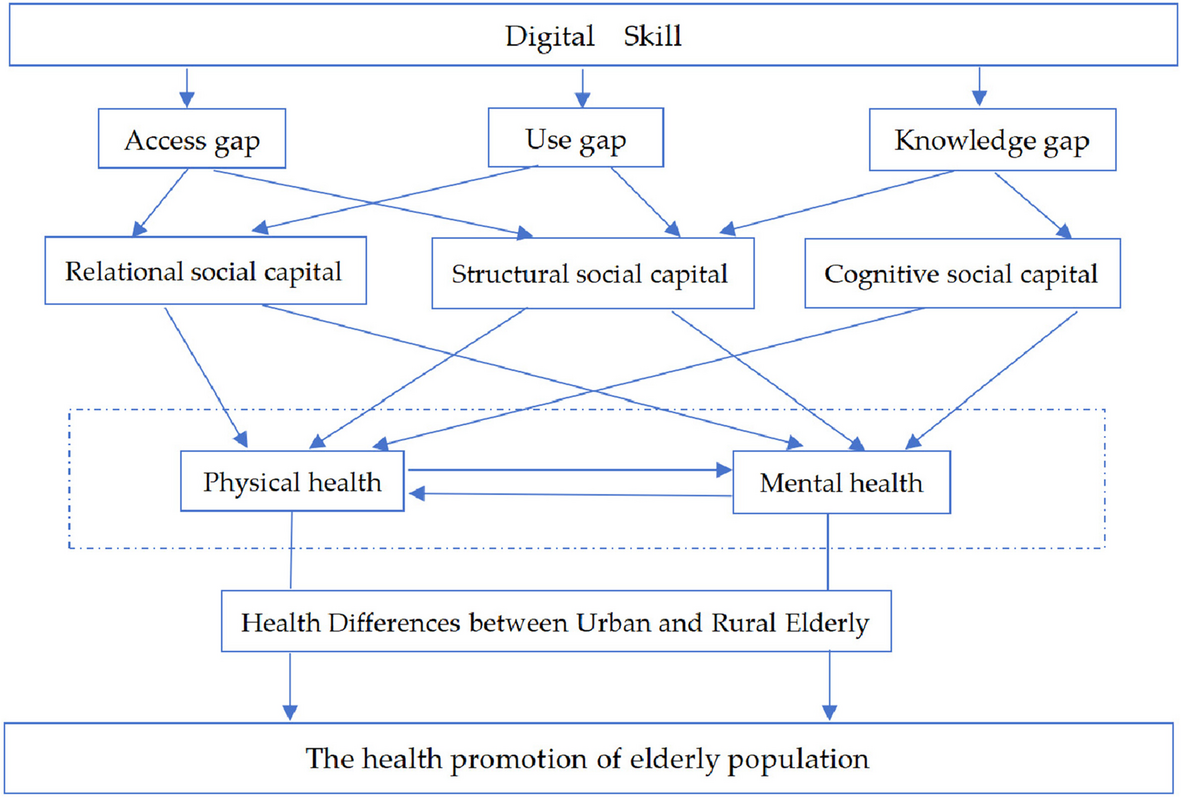
The data of CGSS has been widely applied in many research and government decisions, and its effectiveness has been fully demonstrated. Before conducting multiple regression analysis, the model’s variance inflation factor was firstly adapted to test multicollinearity [60]. The results showed that the variance inflation factor (VIF) in the model was substantially lower than 10, which showing that the absence of multicollinearity issues. This study utilizes Stata17 software, adapts multiple linear regression model to analyse the effect of digital skill on elderly people’s health. Although the R2 value of the regression model is rather low and the explained variance is limited, the P-value of the regression coefficients are all highly significant at the 1% level, indicating a significant linear correlation between variables. The results are statistically significant, and the influence between variables has research and application value. Model 1, Model 2, and Model 3 were constructed to measure health in view of three dimensions of self-rated health, physical health, and mental health, The regression result is displayed in Table 4. Digital skill for self-rated health (β = 0.084, p < 0.01), physical health(β = 0.111, p < 0.01) and mental health (β = 0.083, p < 0.01) was significantly positively correlated. On this basis, control variables of demographic characteristics are added to construct Model 4, Model 5, and Model 6. The digital skill has a significant beneficial impact on self-rated health (β = 0.033, p < 0.01) physical health (β = 0.040, p < 0.01) and mental health (β = 0.027, p < 0.01) among the elderly. One-unit increase in digital skill is associated with a 0.033 increase in self-rated health score, and 0.04 increase in physical health, 0.027 increase in mental health, supporting the research hypothesis H1.
According to Model 5 and Model 6, elderly people’s physical health is connected with mental health (β = 0.324, p < 0.01), has a significant positive effect, whereas the elderly’s psychological well-being also significantly improves their physical health (β = 0.449, p < 0.01). For every unit improve in physical health level, mental health will increase by 0.449, for every unit improve in mental health level, physical health will increase by 0.324, fully validates hypothesis H2. From the perspective of control variables, age is negatively correlated with self-rated health and physical health, while education level, household registration, level of life happiness, socio-economic status, number of children are positively correlated with senior.
citizens’health. Elderly health is not much impacted by ethnic, social security, and number of cohabitants.
Robustness testing
The above analysis preliminarily confirms how digital skill affects elderly people’s physical and mental health, however, the connection between digital skill and old people’s health is complicated, which may lead to endogeneity problems due to the omission of important variables, mutual causality, and deviations caused by data processing. To address this problem, this study conducts robustness testing, mainly including endogeneity test for selecting instrumental variable and PSM propensity score matching methods.
Based on the instrumental variable method
The endogeneity test is performed using the 2SLS two-stage least squares approach,and the provincial internet penetration rate is adapted as the instrumental variable. The findings in Table 5 demonstrates that in the first stage of regression, as a instrumental variable, provincial Internet penetration rate is highly positively correlated with elderly digital skill. Moreover, the F-value for the first stage of regression is 19.1163, which is bigger than the critical value of the rule of thumb of 10. Consequently, the original hypothesis”the instrumental variable internet penetration rate is a weak instrumental variable”is disproved, suggests that the issue of weak instrumental variable is basically not present. In further Durbin and Hausman tests, since the P-value was less than 0.05, the explanatory variable was exogenous. In the second stage of 2SLS regression, digital skill significantly improved elderly people’s health. It basically reflects the previous regression results, confirming considerable robustness of this conclusion.
Balance test
Firstly, the balance test is conducted on the matching quality of the sample. According to the results in Table 6, most control variables have rather high standard deviations before matching, in comparison to the control group and the treatment group, the control variables exist apparent discrepancy. If comparing the health of two groups of elderly people directly from this will cause estimation bias. Following matching, the absolute values of the standard deviation of control variables like age, sex, ethnicity, religious beliefs, degree of education, marriage, household registration, life happiness, socio-economic status, social security, number of cohabitants, and number of children were significantly reduced to within 10%, and the t-values were all less than 1.96. With the exception of the core variable, the systematic discrepancies were largely eliminated for other control variables. Therefore, the balance test for the samples that were matched with propensity scores was passed, the balance of the matched samples was good, which can support further model analysis.
Based on PSM Propensity Score Matching
Further, adapting propensity score matching method (PSM) to verify how digital skill affects older people’s health, it has been demonstrated that the approach works. Firstly, based on the level of digital skill, the elderly sample is divided into two groups:”high digital skill”and”low digital skill”, with high digital skill being the processing group and low digital skill being the control group. Secondly, using the three most common matching methods, namely nearest neighbor matching, radius matching, and kernel matching, and the Average Treatment Effect (ATT) is calculated to more accurately investigate the net effect of digital skill on the aging adults’health. As shown in Table 7, the average processing effects obtained from three different matching methods are statistically significant, indicating that elderly people’s health improve with increasing digital skill level. Propensity score matching outcomes corresponding to the regression result from multiple model, the robustness of the research conclusion is further demonstrated.
Analysis of urban–rural heterogeneity
As can be observed from the results in Table 4, household registration significantly affects the aged adults’self-rated health (β = 0.126, p < 0.01), physical health (β = 0.203, p < 0.01) and mental health (β = 0.204, p < 0.01), and elderly individuals in cities have superior physical and mental health than those in rural areas. The sample in this study is split into sub samples of urban and rural depending on household registration, and explores the urban–rural difference in the effect of digital skill on older health. Table 8 illustrates that among urban elderly persons, digital skill significantly benefits self-rated health (β = 0.033, p < 0.05), has little bearing on one’s physical or mental wellness. The effect of digital skill on rural elderly self-rated health (β = 0.036, p < 0.01), physical health (β = 0.045, p < 0.01) and mental health (β = 0.032, p < 0.05) all has a significant positive impact. The improvement of digital skill has increased the self-rated health score, physical health, and mental health level of rural elderly people by 0.036, 0.045, and 0.032, indicating a significant disparity between urban and rural regions how digital skill affects older adults’health. The research hypothesis H3 is supported.
Model goodness-of-fit and structural model validation
SEM is based on covariance matrix analysis of the relationship between variables. This study using Amos 26.0 software, evaluates the structural validity and suitability of model, a few essential variables were employed in a confirmatory factor analysis, including χ2/df, GFI, NFI, CFI, RMR, and RMSEA indices. The fitting index outcomes of the three models are shown in Table 9. The main fitting indices such as GFI, AGFI, NFI, CFI, IFI and TLI are all greater than 0.90, and the RMR is less than 0.05, RMSEA is less than 0.08. The structural validity of the models has been tested, overall, the model for digital skill, social capital, and elderly health are well adapted.
Mediating effect of social capital
The previous results confirmed that digital skill significantly benefits elderly people’s physical and mental wellbeing, but the mechanism through which digital skill affect elderly health needs further exploration. From a social capital viewpoint, this study examines the mediating mechanism of the effect of digital skill on elderly health, a multiple parallel mediating model is constructed to further analyze the mediating effects of social capital. According to Baron and Kenny’s classical mediation mechanism testing method [61], the mediating effect is displayed in Table 10. First, depending on Model 1, Model 2, and Model 3, digital skill has a considerable beneficial influence on relational social capital (β = 0.071, p < 0.01) and structural social capital (β = 0.018, p < 0.01), while has a negative effect on cognitive social capital (β = −0.030, p < 0.01), supporting research hypothesis H4. According to Model 4, Model 5, and Model 6, compared with the benchmark model result in Table 4, after incorporating relational social capital, structural social capital, and cognitive social capital, the impact coefficient of digital skill on aging adults’ self-rated and physical health decreases, while the impact coefficient on aged population’s psychological health increases. The change in coefficients indicates that compared to self-rated health and physical health, the impact of social capital on mental health is gradually increasing, while the impact of digital skill on mental health is weakening, and the mediating effect is more significant. Social capital plays a more prominent role in the relationship between digital skill and elderly mental health. It is still significantly correlated, indicating that relational social capital, structural and cognitive social capital have a partial mediating effect in relationship between digital skill and elderly people’s health, research hypothesis H5 is valid.
So as to further test the intermediary effect of social capital in the relationship between digital skill and older people’s health, this study conducts a sobel test, findings are displayed in Table 11, declaring that social capital has a statistically significant mediating impact, and the proportion of mediating effects in each pathway was obtained.
On this basis, a structural equation model is further used for multiple mediation effects testing to obtain the effect values of total effect, direct effect, mediation effects of each path, and the proportion of effects. The Bootstrap test accuracy is higher, and the results are more robust and reliable, making it more suitable for complex models with multiple mediators. Therefore, the Bootstrap test results should be given priority consideration. Using Bootstrap method to compute the 95% confidence interval for each effect, 1000 samples were taken from the original sample (n = 2906) to measure the mediation effect. Table 12 contains Bootstrap test result, at the self-rated health level, all effects do not include 0 within the 95% confidence interval of Bootstrap, verifying that the effects of each pathway are significant. The indirect effect generated by relational social capital and structural social capital have positive coefficients, indirect effect values are 0.006 and 0.008. However, the indirect effect cognitive social capital generated has negative coefficient, with indirect effect of −0.003, indicating relational social capital and structural social capital have a significant positive mediating effect on the association between digital skill and elderly health, with mediating effects accounting for 3.6% and 4.7%, respectively. There is a masking effect of cognitive social capital, with an mediating effect accounting for 1.8%.
The Bootstrap test result in Table 13 shows the pathway of digital skill affecting the elderly people’s physical health, with a total effect of 0.184, a direct effect of 0.158, and a p-value less than 0.000. The indirect effect value of relational social capital is 0.009, while structural social capital is 0.019, which does not include 0 within the 95% confidence interval of Bootstrap. The positive mediating effect of relational social capital and structural social capital on the link between digital skill and physical health of the elderly is still significant, with the proportion of mediating effects being 4.9% and 10.3%. The indirect effect of cognitive social capital includes 0 within 95% confidence interval of Bootstrap, indicating that cognitive social capital does not serve as a mediation factor on the connection between digital skill and elderly people’s physical health.
As seen in Table 14, at the level of mental health, the total effect is 0.160 and the direct effect is 0.134. The indirect effect value of relational social capital is 0.007, while structural social capital is 0.025. The Bootstrap 95% confidence interval does not include 0, indicating that relational social capital and structural social capital both play beneficial mediation effect between digital skill and elderly people’s mental health, with effects accounting for 4.4% and 15.6%. The indirect effect value of cognitive social capital is −0.005, Bootstrap 95% confidence interval is [−0.010, −0.002]. Similar to self-rated health, cognitive social capital still has a masking effect on old people’s mental health.