

Turning campus involvement into career skills
When Sam O’Connor started classes at the University of Miami last fall, she knew she wanted to get involved in activities on campus but wasn’t sure where to begin.
Over a year later, she is a student orientation fellow and a student ambassador for the LGBTQ Student Center, but O’Connor also attends about one activity a week outside her usual interests to learn new things.
O’Connor has attended artist talks at the Lowe Art Museum and workshops at the Toppel Career Center, to name a few. She learned about all these activities thanks to a new campus program called Cane Commitment.
The undergraduate program, which launched in the fall of 2024, is now gaining a steady following of students who can connect their college experiences at the U with professional skills—and LinkedIn digital badges—to help them demonstrate the knowledge they gained from their involvement in organizations, activities, lectures, and workshops.
“It’s been a great way for me to keep a list of the things I’ve done on campus and to be able to see that I have accomplished more and helped out in more ways than I thought were possible,” said O’Connor, a sophomore studying health science and one of the most active students on Cane Commitment. “Also, the idea of being rewarded for things I am already doing on campus is really cool.”
For each activity students attend, or leadership position they hold, Hurricanes enrolled in Cane Commitment earn points toward one of six potential competencies. Each of these are each tied to a LinkedIn badge that students can display after meeting its requirements. The badges include civic-mindedness, ethical judgment, social awareness and communication, problem-solving, professionalism, and reasoning. In addition, if students earn a seventh badge in career readiness, they can receive a Cane Commitment medal at graduation.
“Traditionally, students think of education only as what they did in the classroom, but there are so many things that so many students do while they are here—like internships, study abroad, or volunteering—that are almost written in the margins of their college experience here,” said Andrew Lynch, associate dean for undergraduate program development. “The idea of Cane Commitment is to help students articulate these other vital dimensions of their career and learning experiences that are often referred to as soft skills.”
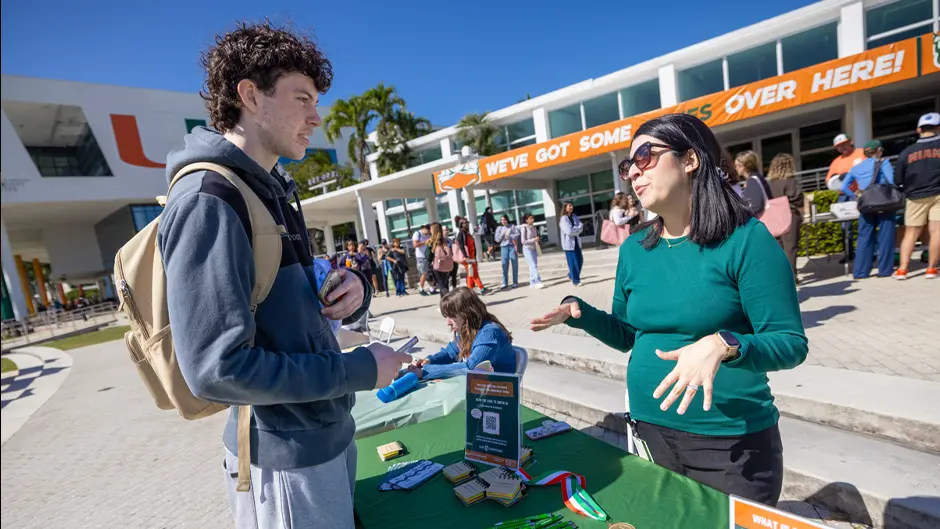
So far, about 25 percent of undergraduate students are enrolled in the program, and they can track their Cane Commitment points through an app called Suitable, which is accessible through the UMiami app. For every event that is part of the program, there’s a QR code at the entrance that students can scan to earn their points for attendance, said Vanessa Barbieri, program director for Cane Commitment.
But the goal of the program is not simply external rewards.
The program sprang from students’ desire to better express the skills they have gained from their University of Miami experience after graduation, said Barbieri. That is why the program organizes activities into categories that correspond to the competencies. These competencies are skill sets that students can relate to their academics or extracurricular activities. And they are also attributes that graduate schools or employers often value in applicants.
“Cane Commitment is a unique way for students to tell the story of what they are doing at the University,” said Barbieri. “And students can get credit for things they are already doing, like internships, leadership experience, and work on and off campus, but they see that participation through the lens of a competency. This can help them to understand how these experiences will help them to be successful beyond their time as an undergraduate.”
Both faculty and students who are enrolled in the Cane Commitment program can add activities or events to the platform, so faculty members who want to give extra credit for attending a lecture or experience can also track attendance through the app. Students who lead different organizations can also request to add an activity, and an administrator can approve it, Barbieri said.
“Our students do so much and take on a lot of projects and volunteer opportunities while they are at the University,” Barbieri added. “This program helps students gain clarity about how their applied learning experiences enhance their undergraduate career because it connects the opportunities they have participated in on campus and shows how those directly contributed to them developing important skill sets for life after graduation.”
Students do not need to join the program during their first year. Emma Craig started Cane Commitment during the fall of her senior year and was able to complete all the competencies before graduation. Now completing a master’s in biomedical engineering, Craig is already working part-time for ConMed, an orthopedic surgical device manufacturer, and will join them full-time upon graduation. She said being part of Cane Commitment prepared her to enter the professional world.
“The Cane Commitment program is helpful because the different pillars help you focus on how to align your involvements in a way that shows skills like leadership and problem-solving, which really help with job interviews and helps you load those things on your resume,” she said. “Also, employers look at and value those LinkedIn badges, so being able to build a strong LinkedIn profile is super important for the job search today.”
To join Cane Commitment, undergraduate students can visit the website and download the app here.