

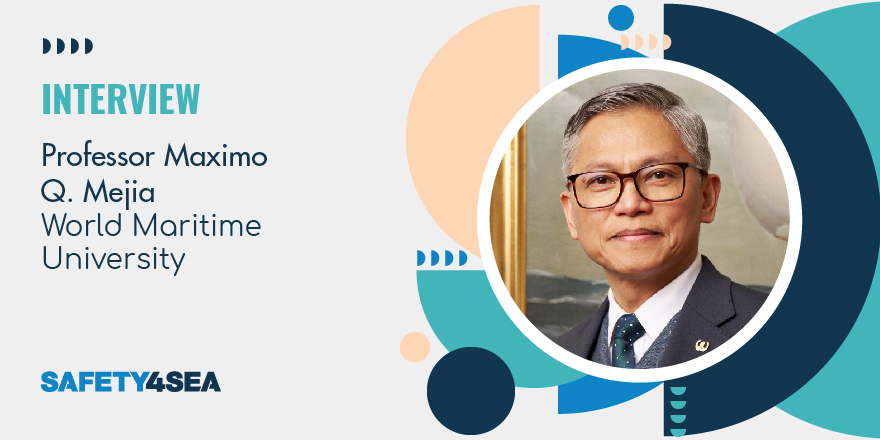
WMU President: Innovation, digital skills and human expertise shape seafaring’s future
In an exclusive interview, Professor Maximo Q. Mejia Jr., President of the World Maritime University (WMU), emphasized that the future of seafaring will depend not only on innovation, but also on continuous learning to ensure the responsible implementation of technology.
Recent WMU research shows that automation, artificial intelligence, advanced sensors and connected “smart ships” will increasingly shape vessel monitoring and operations. However, the human element will remain central, even as the required skill set evolves. Stronger digital competencies, greater familiarity with automated systems, and closer collaboration with shore-based teams and remote control centres will become essential. International standards and maritime education frameworks must therefore adapt to ensure seafarers are fully prepared for these technological advancements, he concludes.
SAFETY4SEA: What are your key priorities on the WMU agenda for the next five years?
Maximo Q. Mejia: Over the next five years, it is a priority to ensure that WMU continues to respond effectively to the evolving needs of the maritime community. An important aspect of this is expanding our reach in educational offerings, professional development, research, and partnerships that support our rapidly changing industry. Close connections with industry stakeholders provide valuable opportunities for cooperation and growth as we work together to address current maritime challenges and develop relevant educational and research solutions that benefit our industry globally. As we continue building on the strengths of the University, ensuring financial sustainability is key as we grow our Endowment Fund and diversify revenue streams through increased engagement with industry, research projects, consultancy work, and outreach programmes. WMU has a significant positive impact on the maritime sector as we transform maritime professionals into leaders equipped with the knowledge required to shape a sustainable future for our industry. Equally important are the international perspectives, networks, and cross-cultural understanding our students develop in WMU’s global environment and through our unique relationship with the International Maritime Organization. As a graduate of WMU myself, I can speak firsthand to how a WMU education transforms both professional and personal perspectives. Its value and impact are truly profound, and it is a priority to ensure that diverse groups of individuals continue to benefit from WMU’s transformative education, which in turn strengthens the maritime industry as a whole.
S4S: How do you see the role of soft skills, such as leadership, communication, and teamwork, evolving in the maritime and marine technology sectors?
M.Q.M.: Soft skills are increasingly important, particularly as the sector advances technologically. Clear authority has always been essential to maritime operations, and there is growing recognition that effective leadership involves creating a positive and supportive working culture that motivates teams, encourages mentorship, and embraces diversity. Strong communication skills are critical to managing complex information flows as digitalization advances, including new requirements for electronic data exchange for ports and ships. The nature of teamwork is also evolving as the industry integrates increasingly advanced technologies. Automation does not replace the human element, rather it requires even closer coordination between people and systems. These soft skills are essential for ensuring safe, effective, and collaborative maritime operations in an increasingly complex environment, and at WMU we place considerable emphasis on developing these key skills in our students across all programmes and offerings.
S4S: The marine sector is facing major technological and environmental changes. What skills do you think the workforce of the future must develop to stay relevant?
M.Q.M.: Our industry is in a period of significant transformation with the influences of decarbonization, digitalization, and increasingly complex regulatory frameworks. In turn, these factors influence the skills required of the workforce. In addition to the soft skills just discussed – communication, leadership and teamwork – technical competence will always remain fundamental. However, it must be complemented by knowledge of emerging technologies. For example, the transition to low- and zero-carbon shipping requires specialized understanding of alternative fuels such as ammonia, hydrogen, and methanol, alongside expertise in safety, energy efficiency, and environmental protection. Digital literacy is also essential as ships and ports transition to automated systems, artificial intelligence, and electronic data exchange. These shifts require maritime professionals to be comfortable working with advanced technologies and managing cyber risks. Adaptability is ultimately the most important skill. International regulations, training standards, and technologies will continue to evolve, and lifelong learning opportunities will be key in helping maritime professionals to navigate opportunities in our rapidly changing industry.
S4S: With the rise of automation and digitalization, how can maritime professionals prepare for the changing nature of work while maintaining human-centric skills?
M.Q.M.: Automation and digitalization are profoundly affecting our industry from navigation systems to port logistics, and vessel monitoring to aspects of ship management. Rather than removing the human element, these technologies are redefining the role of maritime professionals. Digital literacy is key to preparing for this shift as maritime professionals must be knowledgeable regarding how automated systems function, interpreting the data they generate, and integrating that information into sound practice. That said, human judgment will remain indispensable to safety in the maritime sector with the ability to make responsible decisions under pressure remaining an essential competency. The challenge is not to choose between technology and human skills, but to develop both. Maritime education and training programmes must incorporate advanced technologies while continuing to cultivate the leadership, communication, and teamwork skills that remain at the heart of safe and effective maritime operations.
S4S: Looking ahead, do you see other technological or regulatory shifts that will further transform the role and training of seafarers?
M.Q.M.: WMU’s Transport 2040 research highlights how technologies such as automation, artificial intelligence, advanced sensors, and connected “smart ships” will increasingly influence vessel monitoring and operation. These technologies may enable remote operations, data-driven decision-making, and eventually higher levels of autonomous navigation. The research makes an important point that the human element will remain central, and what will change is the skill profile required. Seafarers will remain a critical part of managing complex systems, ensuring safety, and responding to unexpected situations even as automation advances. Stronger digital competencies will come into play as well as the need for familiarity with automated systems, and the ability to work in closer coordination with shore-based teams and remote control centres. The implications are that international standards and maritime education frameworks will need to evolve to ensure that seafarers are adequately prepared for these technologies. In that sense, the future of seafaring will depend on innovation, as well as ensuring continuous learning regarding responsible implementation of technology.
S4S: What message would you like to send to the next generation of maritime professionals about the opportunities and responsibilities they face?
M.Q.M.: This is an extraordinary time to enter maritime professions. Shipping continues to be the backbone of global trade and is increasingly central to major challenges of our time from decarbonization and technological transformation to the sustainable governance of our oceans. There are tremendous opportunities for the next generation. Maritime professionals today are key facilitators in a global industry that is shaping policy, innovation, and the future of international trade. As the industry becomes increasingly interdisciplinary and technologically driven, success in the sector will require technical competence, the ability to work across disciplines and cultures, and a commitment to lifelong learning as technologies evolve. At WMU, we are unequivocally committed to educating maritime and oceans leaders who will navigate a sustainable future for our global industry. Ultimately, success in this field will require technical competence, adaptability, and a strong sense of responsibility—to ensure safety at sea, protect the marine environment, and contribute to a more sustainable maritime future. Maritime professionals carry significant responsibility for safety at sea, protection of the marine environment, and the efficient movement of global commerce. My advice to the next generation is to approach the profession with curiosity and a sense of purpose. The maritime world is evolving rapidly, and those who remain adaptable, collaborative, and mindful of the broader impact of their work will ensure a sustainable and inclusive maritime industry for the future.
The views presented are only those of the authors and do not necessarily reflect those of SAFETY4SEA and are for information sharing and discussion purposes only.