

Empowering Rural and Tribal Futures: Education as the Cornerstone of Opportunity
Quest Global’s CSR initiative, ‘Empowering Rural and Tribal Futures,’ won Gold in
Social Purpose Educational at The Drum Awards. This campaign addresses systemic barriers to education in India’s rural and tribal communities, aiming to unlock potential through scholarships, digital classrooms, and vocational training.
India’s rural and tribal communities—home to nearly 900 million people—face inequities that cut across generations. More than 40% of children lack access to quality education, limiting futures and widening social disparities. At Quest Global, we believe education is the cornerstone of opportunity. Our CSR initiative, ‘Empowering Rural and Tribal Futures,’ is designed to unlock potential by investing in scholarships, digital classrooms, vocational training, sport-integrated learning, and employee-led mentoring.
Context and Challenge
India’s tribal and rural communities face systemic barriers to education and opportunity: geographic isolation, cultural exclusion (especially for women), weak infrastructure, and limited exposure to quality learning. These challenges perpetuate poverty and limit upward mobility.
At Quest Global, we understand that education empowers individuals to secure meaningful employment, support their families, and contribute to the growth of their communities.
Objective
Our initiative addresses these challenges through a community-based education program, aligned with the United Nations Sustainable Development Goals (SDGs). We aim to enable equitable access to education and skill development for underserved populations, helping them build prosperous, inclusive, and resilient lives.
Objectives include:
- Delivering quality education to 3500+ students and beneficiaries in rural areas where access to formal learning is limited
- Integrating 500+ tribal women into the workforce, enabling them to earn a sustainable livelihood, support their families, and break the cycle of poverty
- Enabling communities to access formal employment and build sustainable livelihoods by engaging tribal families
To achieve this, with the support of local NGOs, we lead programs that provide access to quality education across levels – primary, secondary, technical, and vocational – scholarship support, infrastructure development, skill-building programs, sport-integrated education, and employee-led volunteering.
Strategy
Our strategy is anchored in decentralization and collaboration.
While Quest Global drives the design and direction of each program, we work closely with a strong network of NGO partners. These NGOs play a critical role in delivery and outreach.
Alongside this, we actively seek inputs from tribal elders, parents, and local committees to ensure initiatives are trusted, culturally aligned, and relevant to community needs.
We integrate:
- Holistic education: Academic support, digital literacy, life skills, and sport-integrated learning
- Scalable innovation: NSDC-certified curricula, digital classrooms, mentoring, and scholarships
- Multi-stakeholder collaboration: NGOs, government departments, local communities, and The Sports School
- Employee engagement: Quest Global volunteers delivered mentoring, awareness, and digital literacy to 3000+ beneficiaries
Overall Implementation Approach
Quest Global’s CSR initiatives are driven by insights provided through community partnership and cultural alignment, with direction and implementation led by us in collaboration with NGO partners. Engaging local voices while providing the framework and resources ensures programs are relevant, scalable, and sustainable. Every effort from women’s employability to school revitalization and early childhood care reflects our value, Care for People – delivering immediate impact and building long-term resilience.
Key Programs
a. Y4D PCB Assembly Operator Program
Residential training for tribal women in electronics manufacturing
516 women trained and employed, gaining financial independence and role model status
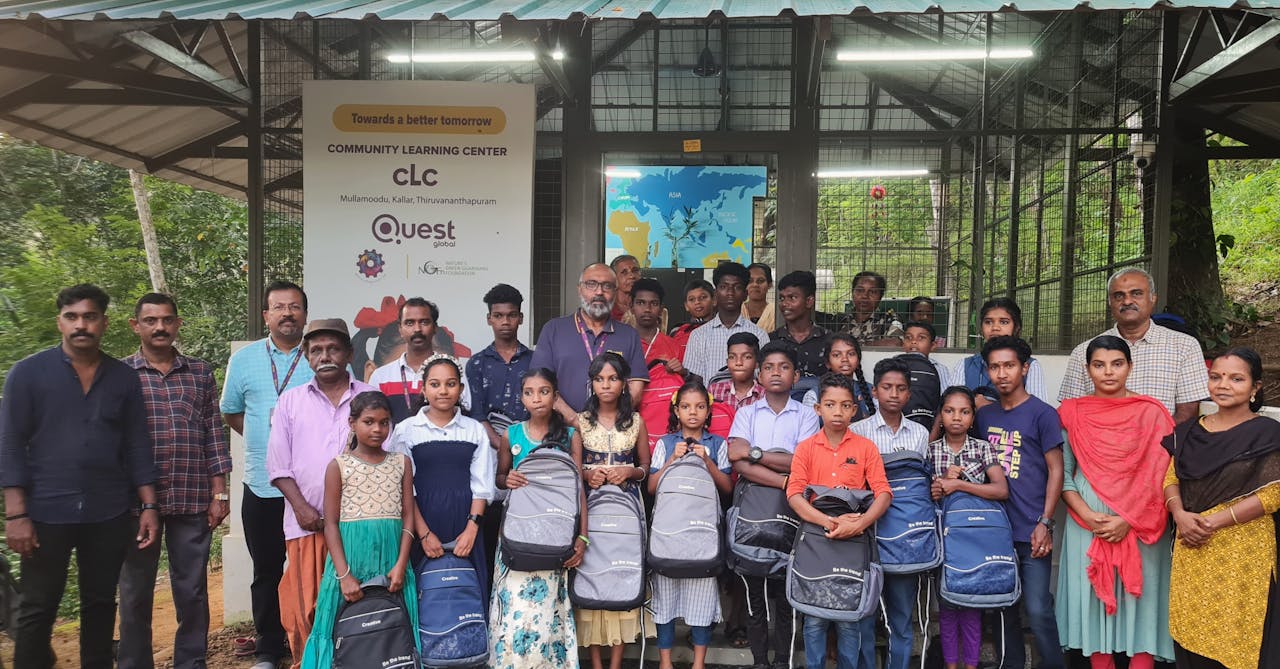
b. Community Learning Centers (CLC)
Established in remote tribal areas, directed by Quest Global with active input from elders and local committees
Programs include academic support, digital literacy, and civic engagement
Pass rates improved from 78% to 100%; enrolment up by 23%
Want to go deeper? Ask The Drum
c. JTS advancement program
Revitalized six Government Junior Technical Schools with digital classrooms, labs, and scholarships
800+ students transitioned to higher education or jobs
School admission rate rose by 17% indicating enhanced awareness towards education
d. Wayanad Anganwadi rehabilitation
Ongoing post-landslide reconstruction of three early learning centres
Once completed, it will serve 500 families annually with childcare, nutrition, and early education
e. Sport-integrated learning
Partnership with The Sports School and Bengaluru FC for a six-year academic program, combined with football coaching
Helps build discipline, teamwork, and emotional resilience among underserved youth
Trained and scouted students are expected to progress into elite sports programs
f. Employee volunteer engagement
Quest Global volunteers delivered mentoring, awareness, and digital literacy to 3000+ beneficiaries
Results (Problem → Outcome)
Challenge 1: Exclusion of tribal women from formal employment
Outcome: 516 tribal women trained and employed in electronics manufacturing, gaining financial independence and becoming community role models. Their success has helped normalize women’s employment and shift long-standing cultural perceptions
Challenge 2: Low enrolment and poor academic performance in rural schools
Outcome: 23% increase in enrolment and pass rates improved from 78% to 100%. Parents became more engaged in children’s education, strengthening community ownership and accountability
Challenge 3: Obsolete infrastructure in Government Junior Technical Schools (JTS)
Outcome: 800+ students advanced to higher education or formal employment, with admissions rising by 17%. Alumni are now employed at Quest Global, leading tech firms, and in healthcare – proof of scalable, long-term impact
Challenge 4: Early childhood education disrupted by Wayanad landslides
Outcome: Once completed, these centers will support 500 families annually, restoring stability and opportunity for young children
Challenge 5: Lack of holistic development and education opportunities, and untapped talent in sports
Outcome: Students will be able to demonstrate greater discipline, teamwork, and confidence. Several students will be able to complete their school education and have the opportunity to progress to elite sports programs, reinforcing the power of sport to unlock potential in underserved youth
Challenge 6: Limited exposure to professional guidance
Outcome: Strengthened employability skills, career awareness, and confidence among students across multiple regions. This not only accelerates student aspirations but deepens employee purpose and engagement
Conclusion
Quest Global’s CSR program is not a philanthropy or funding program as we see other companies engage in. Our initiatives are aligned to our core values focused on the relevance and impact of education. Our CSR campaign and program is designed to challenge systemic barriers and build lasting ecosystems of opportunity through education and training. From overcoming cultural resistance to women’s employment, to revitalizing underfunded technical education, to creating access to modern skills in rural and tribal communities, our programs address not just the symptoms but the root causes of inequality and aim to bring underprivileged communities out of poverty and into a self-sustaining situation for themselves, their families and communities.
We are creating models that can be replicated and scaled by embedding scalability, employee volunteerism, and community ownership into every program. This approach reflects our broader philosophy: just as we bridge silicon to systems in engineering, we bridge education to employability and care to empowerment, in our CSR commitments.
Our accurate measure of success is not only in enrolment numbers or jobs created, but in the lives transformed – where women gain independence, youth discover pathways to purposeful work, and communities chart their own futures. In this way, progress becomes both societal and human-centered, and opportunity is no longer a privilege but a right.
Ready to get your work recognized on a global stage? Enter The Drum Awards today. Need more inspiration? Read our Award Winning Case Studies.