


How AI Will Impact the Job Market: Top Growing & Declining Roles
AI is reshaping the job market by automating routine work, expanding demand for AI-driven roles, and changing the skills employees need to stay employable. Some jobs are declining, others are evolving, and new hybrid roles are emerging across every industry. Leaders have to be ready for their and employees’ roles to shift enormously in 2026 as AI becomes more commonplace in every workplace. Leaders have to know:
- How AI is changing job demand and role requirements
- Where automation will replace or reduce tasks
- Which job categories will grow most because of AI
- How to build a Human + AI workforce
- What skills employees must develop to stay competitive
Does AI eliminate jobs or create new ones?
AI does both. It automates routine tasks, reduces certain job categories, and simultaneously creates new technical and hybrid roles. The job market is being reshaped, not reduced.
The 5 ways AI is changing the job market
1 – Job losses and roles fully eliminated – AI is removing some positions entirely. In 2025, 76,440 jobs were eliminated in areas such as data entry, telemarketing, and administrative support; tasks AI can complete faster and at scale. These losses reflect routine work being replaced, not overall employment decline.
2 – Job displacement and task-level automation – Most roles aren’t disappearing, but many tasks within them are. AI now handles scheduling, reporting, and data processing, allowing employees to shift to higher-value work such as client communication, oversight, and creative problem-solving.
3 – Job creation and new AI-enabled roles – AI is generating demand for roles that combine technical expertise with human judgment, such as:
- Cybersecurity specialists
- Learning experience designers
4 – Blended roles with human + AI collaboration – Most jobs are evolving rather than disappearing. Employees now need strong human skills (communication, influence, creativity) plus digital fluency (AI literacy, data tools, automation oversight).
5 – Net effect is a transformed workforce, not a smaller one – While employment will remain stable, but organizations will shift toward higher-value, human-centered work while routine roles will shrink.
Building a future workforce of humans and AI
In a human + AI workforce, people and AI systems elevate one another, combining strengths to improve decisions, performance, and innovation. So to create a thriving workforce in 2026, you need your talent strategy to reflect that balance. You need to evolve your workforce planning, talent development, and performance measurements.
It’s about creating a balance between developing what makes people irreplaceable (empathy, critical thinking, adaptability, and leadership) and what AI can augment. And workers in high-risk roles must reskill or transition into emerging or hybrid roles to remain competitive.
Fastest growing jobs due to AI
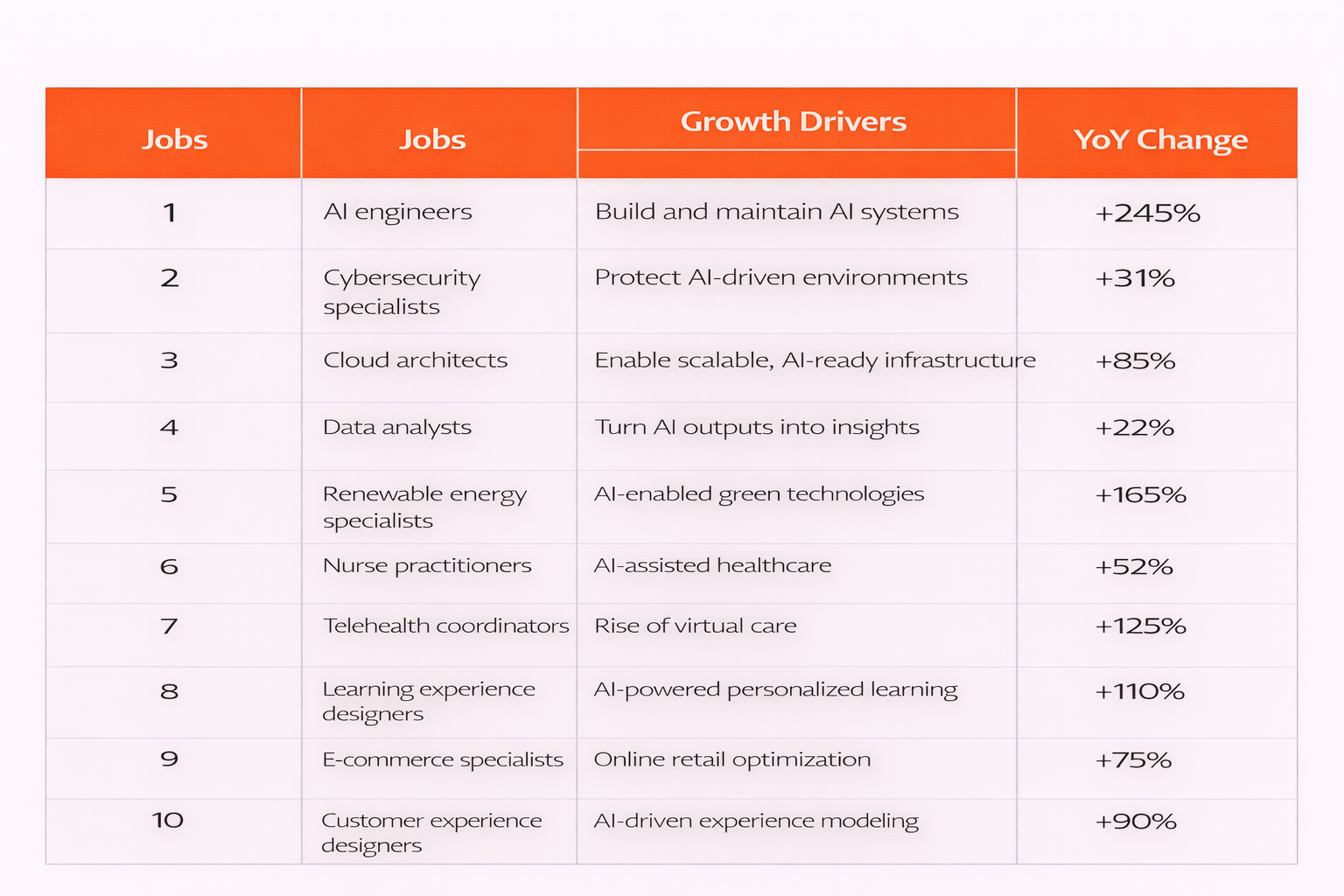
Why AI-driven jobs are growing
- AI automates routine tasks, freeing humans for high-value work
- Organizations need roles that combine human judgment with AI capabilities
- High-growth industries, like healthcare, fintech, green tech, e-commerce, are accelerating demand
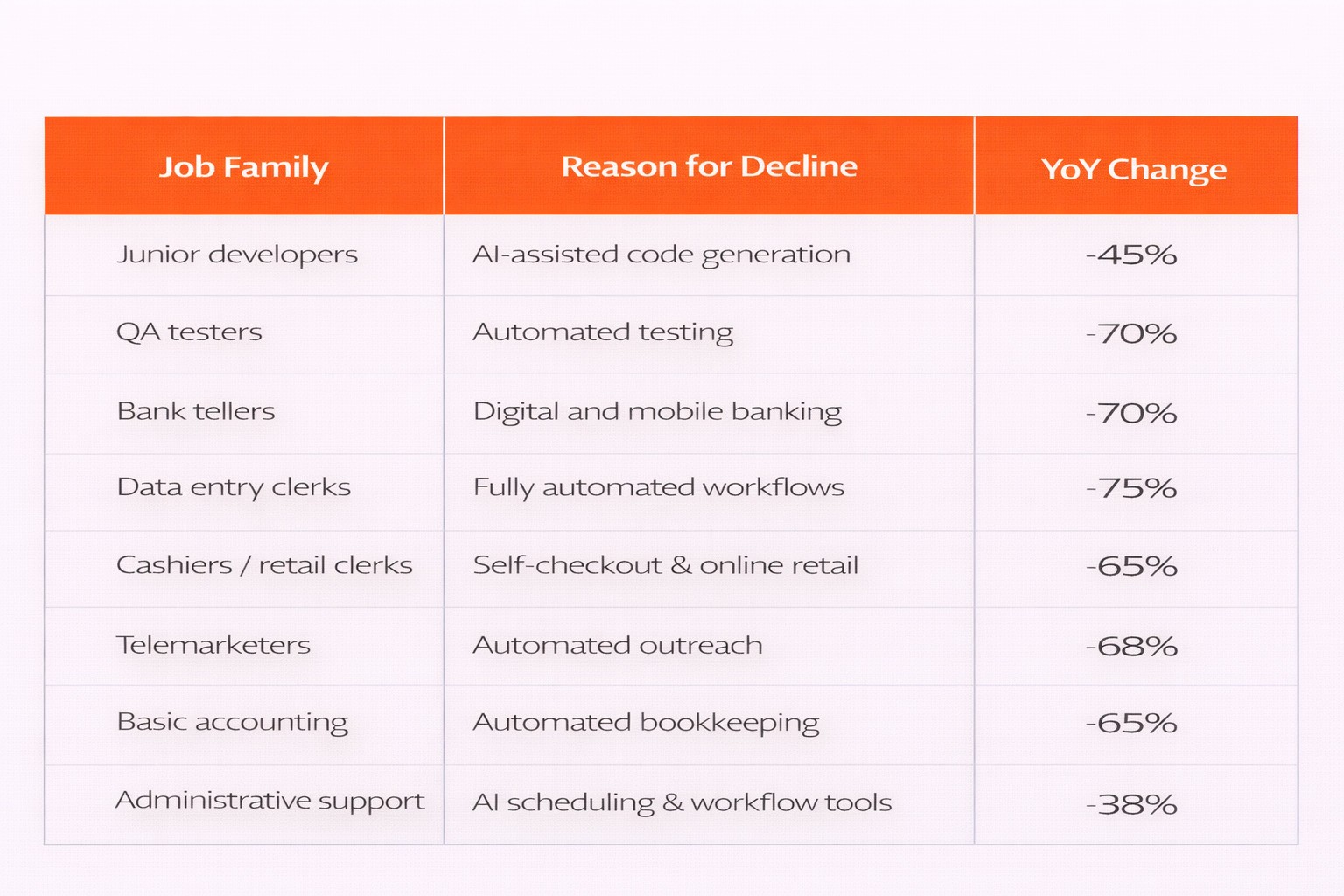
How AI reshapes entire industries
AI’s impact varies by sector, but every industry experienced both job displacement and job creation in 2025.
- Entry-level tech roles were down 50%
- AI specialists were in high demand
- AI engineers, cloud architects, cybersecurity roles surged
- Robot density doubled in 7 years
- Assembly roles (-65%) declined; robotics technicians (+125%) grew
- Digital twin engineers were up +200%
- Traditional banking roles declined sharply
- New fintech and crypto-focused roles surged
- AI risk analysts were up +95%
- Shifted toward online-first business models
- Cashiers were down, while last-mile logistics roles were up
- Customer experience designers were up +90%
- AI automated diagnostics and admin tasks
- High-touch, patient-facing roles grew
- AI health specialists were up +180%
Transportation & logistics
- Autonomous systems reshaped operations
- Fleet managers and drone pilots surged
- AI tutoring and online learning expanded
- Traditional grading and lecturing declined
- AI education specialists grew +150%
Top 2026 skills leaders must prioritize
To thrive in an AI-driven labor market, organizations must cultivate technical, human, and hybrid skills.
The top 4 technical skills in 2026
These power automation, digital transformation, and AI oversight.
The top 5 human skills in 2026
AI can’t replace empathy, ethics, influence, or vision.
The top 4 hybrid skills in 2026
These skills enable people to work with AI instead of competing with it.
- Resilience & adaptability
How leaders, L&D, and HR can prepare in 8 steps
Step 1: Map AI impact by role – Identify where jobs are growing, evolving, or declining
Step 2: Reskill proactively – Blend technical skills (AI, data) with human skills (judgment, leadership)
Step 3: Adopt blended workforce models – Use employees, contingent workers, and AI agents together
Step 4: Align AI strategy with workforce strategy – CHROs and CIOs must co-design future work
Step 5: Embed learning directly in the flow of work – AI tools can offer just-in-time training and personalized development
Step 6: Measure outcomes – Track productivity, skills gained, and workforce adaptability
Step 7: Protect early-career pipelines – Use apprenticeships, internships, and project rotations
Step 8: Monitor labor market shifts continuously – Use workforce intelligence to stay ahead of talent shortages