

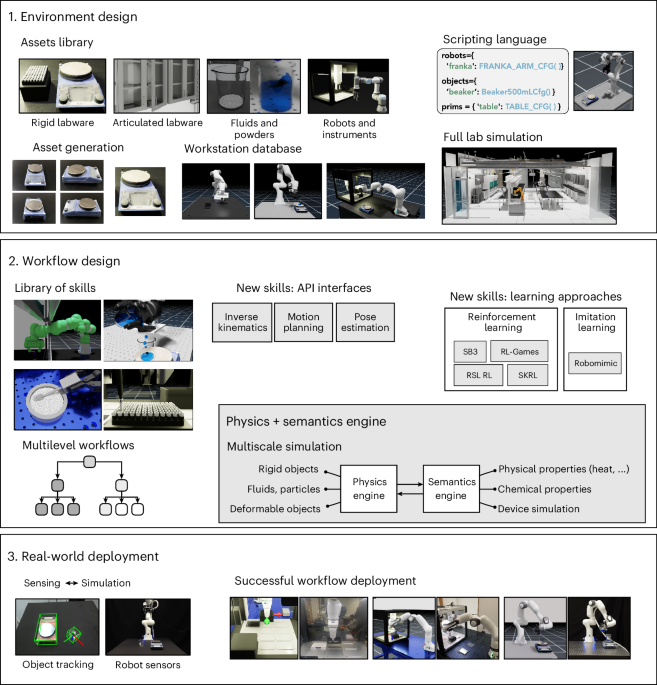
MATTERIX: toward a digital twin for robotics-assisted chemistry laboratory automation
Stein, H. S. & Gregoire, J. M. Progress and prospects for accelerating materials science with automated and autonomous workflows. Chem. Sci. 10, 9640–9649 (2019).
Google Scholar
Tom, G. et al. Self-driving laboratories for chemistry and materials science. Chem. Rev. 124, 9633–9732 (2024).
Google Scholar
Shiri, P. et al. Automated solubility screening platform using computer vision. iScience 24, 102176 (2021).
Coley, C. W. et al. A robotic platform for flow synthesis of organic compounds informed by AI planning. Science 365, eaax1566 (2019).
Google Scholar
Darvish, K. et al. Organa: a robotic assistant for automated chemistry experimentation and characterization. Matter 8, 101897 (2025).
Burger, B. et al. A mobile robotic chemist. Nature 583, 237–241 (2020).
Google Scholar
Lunt, A. M. et al. Modular, multi-robot integration of laboratories: an autonomous workflow for solid-state chemistry. Chem. Sci. 15, 2456–2463 (2024).
Google Scholar
Li, J. et al. Autonomous discovery of optically active chiral inorganic perovskite nanocrystals through an intelligent cloud lab. Nat. Commun. 11, 2046 (2020).
Google Scholar
Vriza, A., Chan, H. & Xu, J. Self-driving laboratory for polymer electronics. Chem. Mater. 35, 3046–3056 (2023).
Google Scholar
Pelkie, B. et al. Democratizing self-driving labs through user-developed automation infrastructure. Preprint at ChemRxiv https://doi.org/10.26434/chemrxiv-2025-zhkrf (2025).
Mehr, S. H. M., Craven, M., Leonov, A. I., Keenan, G. & Cronin, L. A universal system for digitization and automatic execution of the chemical synthesis literature. Science 370, 101–108 (2020).
Google Scholar
Tao, F., Zhang, H. & Zhang, C. Advancements and challenges of digital twins in industry. Nat. Comput. Sci. 4, 169–177 (2024).
Google Scholar
Lu, Y. et al. Digital twin-driven smart manufacturing: connotation, reference model, applications and research issues. Robot. Comput. Integr. Manuf. 61, 101837 (2020).
Google Scholar
Almeaibed, S., Al-Rubaye, S., Tsourdos, A. & Avdelidis, N. P. Digital twin analysis to promote safety and security in autonomous vehicles. IEEE Commun. Stand. Mag. 5, 40–46 (2021).
Google Scholar
Li, Y. et al. Choose your simulator wisely: a review on open-source simulators for autonomous driving. IEEE Trans. Intell. Veh. 9, 4861–4876 (2024).
Google Scholar
Laubenbacher, R., Mehrad, B., Shmulevich, I. & Trayanova, N. Digital twins in medicine. Nat. Comput. Sci. 4, 184–191 (2024).
Google Scholar
Isaac Sim—robotics simulation and synthetic data generation. https://developer.nvidia.com/isaac/sim (NVIDIA Developer, 2025).
Mittal, M. et al. Orbit: a unified simulation framework for interactive robot learning environments. IEEE Robot. Autom. Lett. 8, 3740–3747 (2023).
Google Scholar
Narang, Y. et al. Factory: fast contact for robotic assembly. In Proc. Robotics: Science and Systems Vol. 6 (2022).
Mamou, K. in Game Engine Gems 3 (ed. Lengyel, E.) 141–158 (AK Peters, 2016).
Raffin, A. et al. Stable-baselines3: reliable reinforcement learning implementations. J. Mach. Learn. Res. 22, 1–8 (2021).
Mandlekar, A. et al. What matters in learning from offline human demonstrations for robot manipulation. In Proc. 5th Conference on Robot Learning 1678–1690 (2022).
Makoviichuk, D. & Makoviychuk, V. rl-games: a high-performance framework for reinforcement learning. GitHub https://github.com/Denys88/rl_games (2021).
Rudin, N., Hoeller, D., Reist, P. & Hutter, M. Learning to walk in minutes using massively parallel deep reinforcement learning. In Proc. 5th Conference on Robot Learning Vol. 164, 91–100 (Proceedings of Machine Learning Research, 2022).
Serrano-Muñoz, A., Chrysostomou, D., Bøgh, S. & Arana-Arexolaleiba, N. skrl: modular and flexible library for reinforcement learning. J. Mach. Learn. Res. 24, 1–9 (2023).
Li, S. et al. Chemistry3d: robotic interaction benchmark for chemistry experiments. Preprint at https://arxiv.org/abs/2406.08160 (2024).
Kadokawa, Y., Hamaya, M. & Tanaka, K. Learning robotic powder weighing from simulation for laboratory automation. In Proc. 2023 IEEE/RSJ International Conference on Intelligent Robots and Systems 2932–2939 (2023).
Pizzuto, G. et al. Accelerating laboratory automation through robot skill learning for sample scraping. In Proc. 2024 IEEE 20th International Conference on Automation Science and Engineering 2103–2110 (2024).
Lopez-Guevara, T. et al. Stir to pour: efficient calibration of liquid properties for pouring actions. In Proc. 2020 IEEE/RSJ International Conference on Intelligent Robots and Systems 5351–5357 (2020).
Vescovi, R. et al. Towards a modular architecture for science factories. Digit. Discov. 2, 1980–1998 (2023).
Google Scholar
Beeler, C. et al. Chemgymrl: a customizable interactive framework for reinforcement learning for digital chemistry. Digit. Discov. 3, 742–758 (2024).
Google Scholar
Rihm, S. D. et al. The digital lab facility manager: automating operations of research laboratories through ‘the world avatar’. Nexus 1, 100031 (2024).
Google Scholar
Mildenhall, B. et al. Nerf: Representing scenes as neural radiance fields for view synthesis. Commun. ACM 65, 99–106 (2021).
Google Scholar
Zeng, A., Song, S., Lee, J., Rodriguez, A. & Funkhouser, T. Tossingbot: learning to throw arbitrary objects with residual physics. IEEE Transact. Robot. 36, 1307–1319 (2020).
Google Scholar
Xu, Z., Wu, J., Zeng, A., Tenenbaum, J. B. & Song, S. DensePhysNet: learning dense physical object representations via multi-step dynamic interactions. In Proc. Robotics: Science and Systems (2019).
Openusd: Universal scene description v25.08 (Pixar Animation Studios and the OpenUSD community, 2025); https://openusd.org
Macklin, M. & Müller, M. Position based fluids. ACM Transact. Graph. 32, 1–12 (2013).
Google Scholar
Sundaralingam, B. et al. Curobo: Parallelized collision-free robot motion generation. In 2023 IEEE International Conference on Robotics and Automation 8112–8119 (IEEE, 2023).
Wen, B., Yang, W., Kautz, J. & Birchfield, S. FoundationPose: unified 6D pose estimation and tracking of novel objects. In Proc. IEEE/CVF Conference on Computer Vision and Pattern Recognition 17868–17879 (2024).
Arrhenius, S. Über die dissociationswärme und den einfluss der temperatur auf den dissociationsgrad der elektrolyte. Z. Phys. Chem. 4U, 96–116 (1889).
Google Scholar
Elsner, J. Taming the panda with python: a powerful duo for seamless robotics programming and integration. SoftwareX 24, 101532 (2023).
Google Scholar
Johnson, M. S. & Green, W. H. A machine learning based approach to reaction rate estimation. React. Chem. Eng. 9, 1364–1380 (2024).
Google Scholar
Black, K. et al. π0: a vision–language–action flow model for general robot control. In Proc. Robotics: Science and Systems (RSS) https://doi.org/10.15607/RSS.2025.XXI.010 (2024).
Colledanchise, M. & Ögren, P. Behavior Trees in Robotics and AI: an Introduction (CRC, 2018).
Darvish, K., Simetti, E., Mastrogiovanni, F. & Casalino, G. A hierarchical architecture for human–robot cooperation processes. IEEE Transact. Robot. 37, 567–586 (2020).
Google Scholar
Leong, S. X. et al. Steering towards safe self-driving laboratories. Nat. Rev. Chem. 9, 707–722 (2025).
Liu, Z., Bahety, A. & Song, S. REFLECT: summarizing robot experiences for failure explanation and correction. In Proc. 7th Conference on Robot Learning 3468–3484 (2023).
Yu, W. et al. Language to rewards for robotic skill synthesis. In Proc. 7th Conference on Robot Learning 374–404 (2023).
Skreta, M. et al. Replan: robotic replanning with perception and language models. Preprint at https://arxiv.org/abs/2401.04157 (2024).
Wang, Y. et al. RoboGen: towards unleashing infinite data for automated robot learning via generative simulation. In Proc. 41st International Conference on Machine Learning 51936–51983 (2024).
Tancik, M. et al. Nerfstudio: a modular framework for neural radiance field development. In Proc. ACM SIGGRAPH 2023 Conference article 72 (2023).
Luma ai, Online platform for 3D asset creation. Luma Labs, Inc. https://lumalabs.ai/ (2025).
Buss, S. R. Introduction to Inverse Kinematics with Jacobian Transpose, Pseudoinverse and Damped Least Squares Methods. Technical report (Univ. California, San Diego, 2009).
Robot dynamics lecture notes, Lecture notes (Robotic Systems Lab, ETH Zurich, 2017).
Schulman, J., Wolski, F., Dhariwal, P., Radford, A. & Klimov, O. Proximal policy optimization algorithms. Preprint at https://arxiv.org/abs/1707.06347 (2017).
Wang, X., Chen, Y. & Zhu, W. A survey on curriculum learning. IEEE Trans. Pattern Anal. Mach. Intell. 44, 4555–4576 (2021).
Matterix Developers. ac-rad/matterix: v0.1.0. Zenodo https://doi.org/10.5281/zenodo.17095671 (2025).
Jiang, Y. et al. Autonomous biomimetic solid dispensing using a dual-arm robotic manipulator. Digit. Discov. 2, 1733–1744 (2023).
Google Scholar
Fakhruldeen, H., Pizzuto, G., Glowacki, J. & Cooper, A. I. Archemist: autonomous robotic chemistry system architecture. In 2022 International Conference on Robotics and Automation 6013–6019 (IEEE, 2022).
Yoshikawa, N. et al. Large language models for chemistry robotics. Auton. Robots 47, 1057–1086 (2023).
Google Scholar
Pizzuto, G., De Berardinis, J., Longley, L., Fakhruldeen, H. & Cooper, A. I. SOLIS: autonomous solubility screening using deep neural networks. In IEEE International Joint Conference on Neural Networks (2022).
Lienhard V, J. H. & Lienhard IV, J. H. A Heat Transfer Textbook 6th edn (Phlogiston, 2024).
Kerr, R. M. Rayleigh number scaling in numerical convection. J. Fluid Mech. 310, 139–179 (1996).
Google Scholar