


Europe Corporate E-Learning Market Size & Growth, 2033
Europe Corporate E Learning Market Summary
Europe’s corporate e-learning market is expanding rapidly as enterprises accelerate digital transformation, prioritize large-scale workforce upskilling, and adopt AI-enabled learning platforms to address emerging skill gaps in automation, cybersecurity, cloud computing, sustainability, and data-driven operations. The market is reinforced by strong policy alignment under the European Skills Agenda, increasing public-private training partnerships, and the institutionalization of compliance-driven digital training across highly regulated sectors. At the same time, growth remains tempered by regional disparities in digital infrastructure, fragmented privacy governance, and challenges around instructional relevance and learner engagement, shaping a landscape where e-learning has evolved from a supplemental training tool into a core pillar of strategic workforce development across Europe.
Market Growth & Size
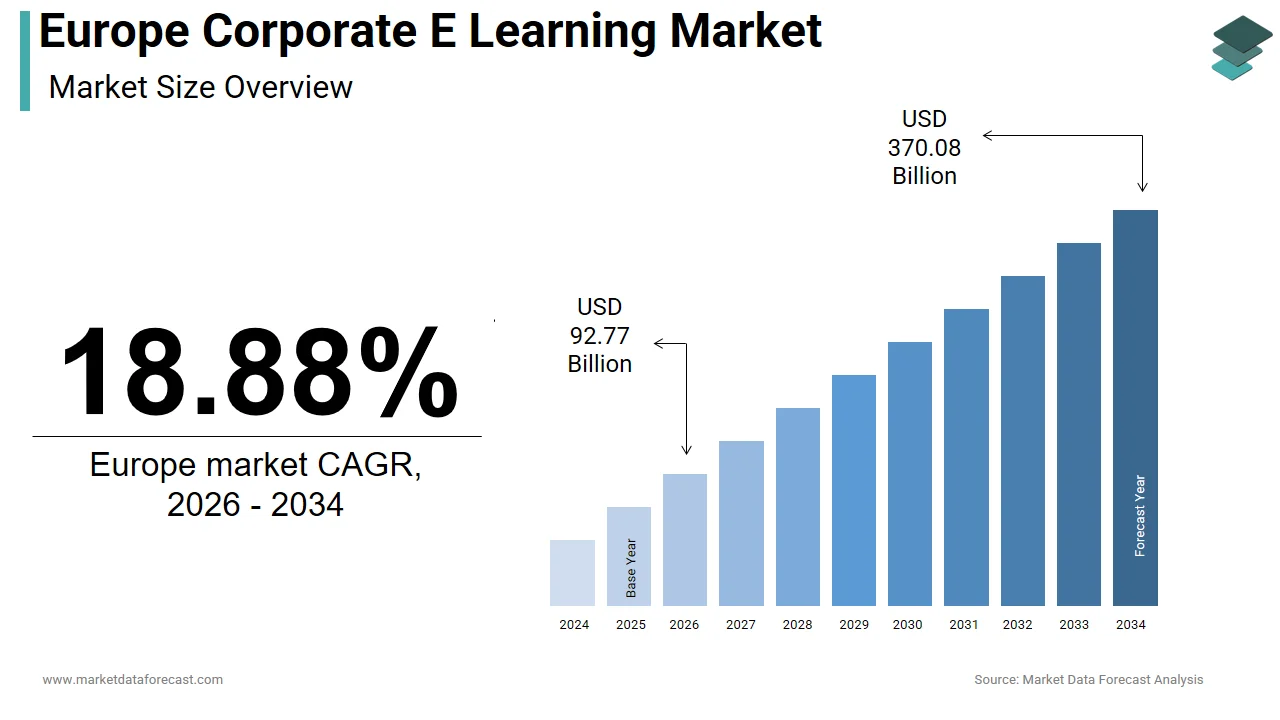
High-Growth Market: The Europe corporate e-learning market was valued at USD 65.65 billion in 2024, is projected to reach USD 78.04 billion in 2025, and is expected to be worth USD 311.32 billion by 2033, expanding at a CAGR of 18.88% from 2025 to 2033. Growth is driven by enterprise-wide reskilling initiatives, expansion of remote and hybrid workforces, and rising adoption of cloud-based learning management and learning-experience platforms that enable scalable, data-tracked professional training delivery across distributed organizations.
Key Segments: Large enterprises remain the dominant adopters due to compliance intensity, multinational workforce scale, and higher investment capacity, while SMEs represent the fastest-growing segment as subsidized skills programs, modular pricing models, and public training grants lower deployment barriers and accelerate digital-learning adoption.
Drivers & Trends
- Digital Transformation & Workforce Reskilling: Automation, AI integration, and cloud modernization across European industries are creating sustained demand for continuous digital skills development, technical training, and role-based competency programs delivered through scalable online platforms.
- Regulatory & Compliance Training Expansion: Strict governance across finance, healthcare, life sciences, and data-sensitive sectors entrenches e-learning as a mandatory, auditable compliance infrastructure, reinforcing recurring platform usage and certification-linked content delivery.
- AI-Driven Personalized Learning Experiences: Increasing deployment of adaptive learning engines, generative training simulations, and predictive performance analytics is enhancing engagement and accelerating time-to-competency for both new hires and transitioning workforces.
- Public-Private Upskilling Alliances: EU-backed national skills initiatives and cross-sector funding programs are strengthening institutional demand for standards-aligned corporate training ecosystems, particularly across green-economy, advanced manufacturing, and digital-services sectors.
Key Players & Ecosystem
The landscape is led by global enterprise-learning and cloud-technology providers — including SAP, Oracle, Microsoft, Adobe, Cornerstone OnDemand, Docebo, IBM, AWS, Skillsoft, D2L, and Udemy — alongside regional specialists delivering localized, sector-specific learning solutions.
Market evolution is characterized by:
- integration of learning with HR, performance, and skills-intelligence platforms
- rapid expansion of AI-assisted content generation and competency mapping
- increasing alignment with national qualification and workforce mobility frameworks
- growing collaboration between enterprises, governments, and academic partners
Together, these dynamics strengthen e-learning’s role as strategic human-capital infrastructure across Europe’s digital economy.
Challenges
- Infrastructure & Digital-Skills Inequality: Regional gaps in connectivity, device availability, and digital readiness limit uniform access and learning consistency, particularly across rural economies and SME-dominated labor environments.
- Fragmented Data-Governance Requirements: Divergent national interpretations of GDPR, labor codes, and works-council frameworks increase platform localization, legal compliance, and deployment complexity for cross-border learning implementations.
- Content Overload & Engagement Fatigue: High training volume without contextual or role-relevant design leads to reduced retention, low behavioral transfer, and declining learner motivation, weakening return-on-investment outcomes.
- Theory-Practice Misalignment: Generic or non-applied training content risks limited workplace relevance, underscoring growing demand for experiential, scenario-based, and industry-specific learning formats tailored to real-world operational environments.
Europe Corporate E Learning Market Size
The size of the Europe corporate e-learning market was worth USD 65.65 billion in 2024. The regional market is anticipated to grow at a CAGR of 18.88% from 2025 to 2033 and be worth USD 311.32 billion by 2033 from USD 78.04 billion in 2025.
Corporate e learning refers to the digital education platforms and services deployed by enterprises to enhance workforce competencies through structured virtual instruction. It integrates learning management systems, learning experience platforms, and mobile-enabled content delivery mechanisms tailored to organizational learning objectives. The market’s relevance has intensified as European employers increasingly prioritize scalable upskilling solutions amid rapid technological evolution and shifting labor dynamics. According to sources, the majority of enterprises in the European Union provide continuing vocational training to their staff, reflecting a general emphasis on workforce development, with the proportion varying significantly by enterprise size. Further, as per research, participation in adult education and training across the European Union is a continuous focus, with an ongoing effort to increase participation rates towards ambitious future targets. The European Commission prioritizes digital education as a cornerstone initiative within the European Skills Agenda, working toward significantly increasing the proportion of citizens who possess essential digital competencies by the end of the decade. These foundational behavioral and policy-level indicators, rather than market valuation metrics, illustrate the fertile ground on which corporate e learning is expanding across the region.
MARKET DRIVERS
Accelerated Digital Transformation in European Enterprises Drives Demand for Scalable Learning Solutions
European corporations are undergoing a profound digital transformation, which necessitates workforce reskilling at scale and speed, and thereby drives the growth of the Europe corporate E learning market. The shift toward cloud-based operations, automation, and data-driven decision-making requires employees to continuously update their technical and soft skills. The International Data Corporation (IDC) projects significant and growing enterprise spending on digital transformation initiatives across Europe, driven by the strategic importance of technologies like Artificial Intelligence (AI). In this context, corporate e learning provides a cost-effective and consistent method to deliver just-in-time training across geographically dispersed teams. Germany’s Federal Institute for Vocational Education and Training (BIBB) emphasizes the consistent high engagement and importance of continuing vocational training within the German workforce to maintain a skilled labor force. This volume makes traditional classroom-based instruction impractical. Moreover, surveys among European human resources leaders indicate a strong consensus that digital learning is a critical tool for addressing pressing skill gaps, particularly in emerging technological fields like artificial intelligence and cybersecurity. Consequently, the urgency to align digital strategy with human capital development fuels demand for robust e learning infrastructures capable of supporting personalized competency pathways and real-time performance analytics.
Regulatory and Compliance Training Imperatives Amplify Adoption Across Sectors
Stringent regulatory frameworks across the region compel organizations to implement frequent and auditable employee training, particularly in highly regulated sectors such as finance, healthcare, and energy, which in turn boosts the expansion of the European corporate market. The European Union’s General Data Protection Regulation mandates regular data protection awareness training for all staff handling personal information. Similarly, the Markets in Financial Instruments Directive II requires continuous compliance education for financial professionals. Industry trends and regulatory guidance indicate a growing emphasis on regular and comprehensive compliance training across credit institutions in the European Economic Area to address evolving regulatory landscapes and mitigate risk. In the healthcare domain, the European Medicines Agency emphasizes Good Clinical Practice training for personnel involved in clinical trials, ensuring alignment with ethical and scientific quality standards. The regulatory pressures create a non-discretionary demand for e learning systems that support content versioning, assessment tracking, and certification. The necessity to demonstrate due diligence during audits further embeds e learning as a strategic compliance infrastructure rather than an optional learning enhancement.
MARKET RESTRAINTS
Persistent Digital Infrastructure Disparities Across European Regions Limit Uniform Access
Disparities in internet quality, device availability, and digital literacy hinder equitable access to corporate e learning, particularly in rural and less developed regions, despite the region’s overall digital advancement, which hampers the growth of the Europe corporate E learning market. Access to high-speed fixed broadband infrastructure remains consistently lower in rural areas of the European Union compared to urban centers. This gap translates into workforce challenges for multinational corporations attempting to deploy standardized learning programs. Small and medium enterprises in Romania and Bulgaria show significantly lower levels of overall digital technology adoption and intensity compared to the European Union average. Furthermore, A significant digital skills gap persists across the European Union, with older age groups, particularly women, demonstrating lower levels of foundational digital proficiency than younger cohorts and older men. These structural limitations constrain the reach and efficacy of e learning initiatives, especially for frontline or non-desk employees who rely on mobile or shared devices. The absence of uniform digital readiness across the European labor force thus acts as a tangible restraint on market penetration even when organizational intent to adopt e learning is strong.
Fragmented Data Privacy Regulations Create Implementation Complexity
The deployment of unified e-learning systems across the region is complicated by the fact that individual countries have their own interpretations of the General Data Protection Regulation and supplementary national labor laws. Consequently, this obstructs the expansion of the Europe corporate E learning market. National supervisory authorities have issued varied rulings on matters including employee monitoring, learning analytics, and cross-border data transfers, which complicates the process of standardizing platforms. For instance, the data protection authority in France mandates explicit employee consent for monitoring learning behaviors, while Germany allows such monitoring only when works council agreements are in place. Companies operating across multiple countries have experienced delays in implementing e-learning programs throughout Europe due to a lack of clarity regarding the lawful processing of data related to learner activity. Furthermore, certain collective bargaining agreements in the Nordic and Benelux countries incorporate specific clauses that restrict how performance data collected from digital training can be used. These legal variances necessitate costly localization of platforms not only in language but also in data governance architecture. Consequently, organizations hesitate to invest in sophisticated adaptive learning or AI-driven recommendation engines due to compliance risks. This regulatory fragmentation undermines economies of scale and discourages innovation, particularly among small and medium enterprises that lack dedicated legal resources.
MARKET OPPORTUNITIES
Integration of Artificial Intelligence Offers Hyper Personalized Learning Pathways
The incorporation of artificial intelligence into e learning systems offers a potential opportunity for European enterprises seeking to enhance engagement and learning retention, which is expected to propel the growth of the Europe corporate E learning market. AI algorithms can analyze individual performance gaps, learning pace, and preferred modalities to curate customized content sequences in real time. According to a source, A general pattern has been observed where a majority of large firms in Europe expressed interest in adopting AI-powered learning tools to address critical skill shortages in emerging domains. Pilot programs using generative AI for scenario-based compliance training showed an improvement in knowledge application when compared to static modules. Countries like Finland and the Netherlands are already funding public-private partnerships to develop ethical AI learning frameworks compliant with the EU AI Act. Furthermore, among organizations utilizing AI-driven platforms, many reported measurable reductions in the time it takes for new hires to reach full competency. This capability is particularly valuable in industries with high workforce turnover or rapidly evolving technical standards. Artificial intelligence significantly improves learning experiences by enabling dynamic and context-aware modules, which boost efficacy and align training outcomes with strategic talent development objectives across diverse European business environments.
Public-Private Upskilling Alliances Create New Market Expansion Avenues
Strategic collaborations between governments, educational institutions, and corporations are generating structured demand for scalable e learning solutions aligned with the region’s economic priorities, which ultimately provides new prospects for the expansion of the Europe corporate E learning market. A broad commitment has been established to enhance the skills of numerous workers within strategic sectors like renewable energy, digital manufacturing, and circular economy value chains. Alliances formed under these initiatives are working towards a goal of upskilling millions of Europeans, primarily utilizing digital learning as the method of delivery. Government funding in France has been directed toward supporting corporate training programs, often delivered via e-learning platforms. In Germany, subsidies are available to cover substantial portions of training costs for employees facing technological changes, with a preference for digital learning formats. Across various national skills portals that feature third-party e-learning materials, there has been an observed increase in the number of businesses registering for these programs. These policy-driven ecosystems lower adoption barriers for small and medium enterprises and create stable revenue channels for e learning providers capable of aligning content with national qualification frameworks. The convergence of public funding and private delivery thus unlocks significant non-organic growth potential across the European market.
MARKET CHALLENGES
Cognitive Overload from Excessive Content Volume Undermines Learning Effectiveness
The proliferation of e learning modules often leads to content saturation, causing cognitive overload that diminishes knowledge retention and application, and negatively impacts the growth of the Europe corporate E learning market. European employees frequently encounter numerous digital distractions during their workdays. When layered with mandatory compliance courses, skill enhancement modules, and onboarding sequences, learners experience fatigue that reduces engagement. Professionals in Europe dedicating a significant amount of time to e-learning weekly may demonstrate a decline in subsequent assessment scores, potentially attributed to shortened attention spans. A substantial portion of the workforce perceives mandatory digital training as a bureaucratic requirement rather than a chance for professional growth. This sentiment is exacerbated when content is not contextualized to role-specific challenges or delivered in non-adaptive formats. Vendors that prioritize quantity over pedagogical quality risk creating superficial learning experiences that fail to translate into behavioral change. Consequently, organizations struggle to justify continued investment despite high enrollment numbers revealing a critical gap between access and actual impact in the European corporate e learning landscape.
Misalignment Between Learning Content and Real-World Skill Application Reduces ROI
The disconnect between theoretical content and practical workplace applicability remains a major hindrance to the Europe corporate E learning market. Many of the off-the-shelf courses focus on conceptual knowledge without embedding contextual scenarios reflective of European business practices, regulatory nuances, or industry-specific workflows. According to sources, corporate e-learning programs often incorporate assessments that may not directly link to observable behaviors in the workplace. This gap is particularly acute in technical fields where hands-on practice is essential. For example, A common issue across various sectors is that general digital learning modules do not always meet the specific requirements for training personnel on specialized equipment. Furthermore, compliance education frequently lacks the simulation of real-world scenarios that employees encounter in diverse operating environments. When learning isn’t grounded in context, students grasp surface-level info but miss the deeper connections needed for practical application, resulting in low success rates. The discrepancy between training content and actual job requirements contributes to significant inefficiencies in organizational education spending. Bridging this gap requires closer collaboration between instructional designers and operational leaders to co-create experiential and scenario-driven content that mirrors authentic European workplace environments.
REPORT COVERAGE
|
REPORT METRIC |
DETAILS |
|
Market Size Available |
2024 to 2033 |
|
Base Year |
2024 |
|
Forecast Period |
2025 to 2033 |
|
Segments Covered |
By Organization Size, Vertical, Learning Type, and County. |
|
Various Analyses Covered |
Global, Regional, and Country-Level Analysis, Segment-Level Analysis, Drivers, Restraints, Opportunities, Challenges; PESTLE Analysis; Porter’s Five Forces Analysis, Competitive Landscape, Analyst Overview of Investment Opportunities |
|
Countries Covered |
UK, France, Spain, Germany, Italy, Russia, Sweden, Denmark, Switzerland, Netherlands, Turkey, Czech Republic, and the Rest of Europe. |
|
Market Leaders Profiled |
Adobe, Inc., Allen Communication Learning Services, D2L Inc., Microsoft Corporation, Oracle Corporation, SAP SE, Skillsoft Corporation, Udemy, Inc., IBM Corporation, Amazon Web Services, Inc. (Amazon.com, Inc.), and Others. |
SEGMENTAL ANALYSIS
By Organization Size Insights
The large enterprises segment dominated the Europe corporate e learning market in 2024. The dominance of the large enterprises segment is primarily driven by its extensive workforce scale, compliance obligations, and greater budgetary capacity for digital learning infrastructure. One critical driver is the imperative to standardize training across multinational operations. Most large European corporations use formal digital learning platforms to maintain consistent skill levels across their workforces. These organizations often manage workforces exceeding fifty thousand employees spread across multiple jurisdictions, necessitating centralized, scalable platforms. An additional factor is regulatory pressure. Large financial institutions within the European Union conduct a significant number of mandatory compliance training sessions annually, illustrating a large volume of training activity that often benefits from efficient, automated delivery systems. In addition, new corporate reporting requirements encourage large enterprises to detail employee education efforts concerning environmental and social governance topics, integrating e-learning into routine business processes. This confluence of scale, regulatory rigor, and strategic talent planning solidifies the dominance of large enterprises in shaping market demand.
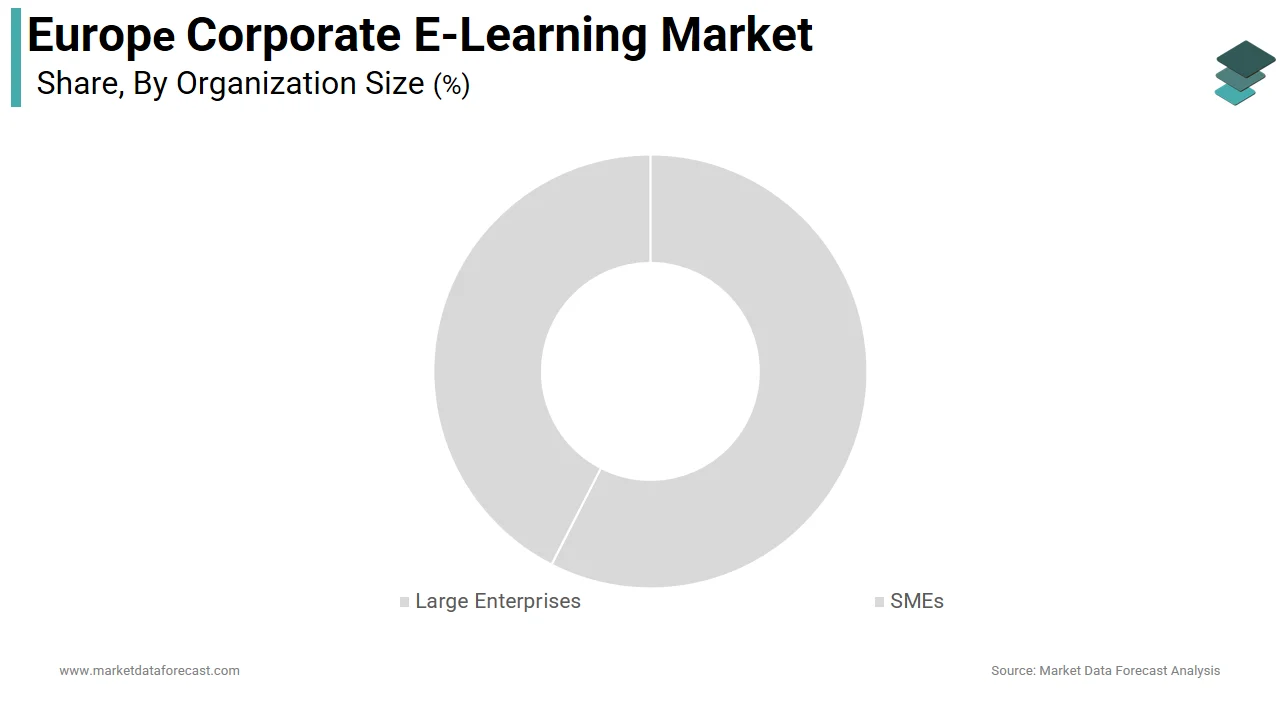
The small and medium enterprises segment is anticipated to witness the fastest CAGR of 14.3% from 2025 to 2033. The rapid acceleration of the small and medium enterprises segment is propelled by public funding mechanisms that have significantly lowered adoption barriers. Numerous small and medium-sized enterprises have utilized subsidized programs to enhance the digital competencies of their workforce. The preferred method for delivering these professional development initiatives has transitioned toward a mandatory digital learning format. Countries like Italy and Spain allocated national recovery funds specifically for SME digital training. Moreover, cloud-based learning platforms now offer modular pay-as-you-go pricing, enabling SMEs to deploy targeted training without large upfront investments. There is a growing trend among mid-sized businesses toward integrating cloud-based software tools for employee training. The adoption of subscription-based learning platforms has seen a notable increase compared to previous years. This shift reflects both enhanced affordability and growing recognition that workforce agility is critical for competitiveness in volatile markets.
By Learning Type Insights
The blended learning segment led the Europe corporate e learning market in 2024 by integrating the structure of instructor-led sessions with the flexibility of digital modules. Moreover, European labor frameworks emphasize human interaction in professional development. Provisions for facilitated learning experiences are a common feature in many agreements in Western Europe, indicating that a purely automated approach to training is generally not sufficient for meeting upskilling needs. In addition, cognitive science supports the efficacy of mixed modalities. Employees participating in programs that blend different learning methods tend to show improved retention of knowledge, particularly in fields requiring specific technical or procedural understanding. Companies like Siemens and Novo Nordisk have institutionalized this approach using virtual classrooms for theory and in-person workshops for hands-on simulation. Dual education systems in several countries incorporate blended structures, which align corporate training practices with established national educational norms. This institutional and evidence-based endorsement cements blended learning as the preferred model.
The distance learning segment is likely to experience the fastest CAGR of 15.1% from 2025 to 2033 due to the geographic dispersion of talent that has intensified. As per sources, the share of employees engaging in remote work within the European Union has increased, indicating a need for flexible learning solutions that can adapt to different schedules and time zones. In addition, generative AI has dramatically enhanced the interactivity and personalization of self-paced content. Pilot programs that use artificial intelligence to guide distance learning courses have demonstrated success in improving completion rates among employees who do not primarily work at desks, when compared to standard video-based modules. Additionally, the proliferation of microlearning platforms catering to mobile-first audiences aligns with the consumption habits of younger European professionals. A significant majority of younger workers prefer learning opportunities that are accessible via mobile devices and available on demand. These technological and demographic shifts position distance learning as the highest growth vector despite its historical perception as less engaging.
By Vertical Insights
The banking, financial services, and insurance segment held the leading share of the Europe corporate e learning market in 2024, which was driven by stringent regulatory regimes, high workforce digitization, and the relentless cadence of compliance mandates. Financial institutions within the EU provided a substantial amount of required training hours per employee across the year, covering essential topics such as anti-money laundering protocols and MiFID II product governance. This volume necessitates automated tracking and certification features native to e learning systems. A further driver is the sector’s early adoption of digital talent strategies. Major European banks are incorporating learning experience platforms into their human resources technology to facilitate ongoing employee development in current financial technologies and sustainability practices. European insurers have conducted widespread cyber risk awareness training for all staff interacting with customers, indicating a focus on digital security and compliance. The banking and financial services industry across the EU maintains a structural reliance on training methods that are both auditable and provided on an as-needed basis, a factor that positions the sector as a primary influence on the broader demand for e-learning solutions.
The healthcare segment is on the rise and is expected to be the fastest-growing segment in the market by witnessing a CAGR of 16.8% during the forecast period, owing to persistent workforce shortages, which demand rapid onboarding and cross-training. Projections from certain organizations indicate a significant future gap in the number of available healthcare professionals within the European Union, implying that scalable digital training methods might become increasingly important for ongoing service delivery. Certain institutions in Germany and France have reportedly utilized digital education in a specific year to train supplementary personnel in foundational diagnostic assistance, which has been associated with a notable reduction in the time needed to integrate them into the workforce. Moreover, medical knowledge evolves at an unprecedented pace. A high volume of new clinical guidance documents is reportedly issued periodically across the EU member nations, suggesting a need for practitioners to engage in continuous learning and professional updates. Digital platforms enable real-time content refreshes and competency validation that traditional seminars cannot match. Furthermore, the EU’s Cross Border Healthcare Directive mandates standardized training for professionals delivering services in multiple countries, further institutionalizing e learning as a mobility enabler across the bloc.
COUNTRY-LEVEL ANALYSIS
Germany Corporate E-Learning Market Analysis
Germany outperformed other countries in the Europe corporate e learning market and accounted for a share of 22.4% in 2024. The dominance of the German market is driven by its robust industrial base, dual education tradition, and strong public-private upskilling ecosystem. The country’s leadership is anchored in its vocational training infrastructure, which increasingly integrates digital components. Several individuals engaged in a combination of traditional and technology-supported workplace education initiatives. Furthermore, a specific legislative framework facilitates complete financial coverage for employees transitioning their skills in response to technological advancements. The manufacturing and automotive sectors, which employ nearly twenty percent of the workforce, drive demand for role-specific technical training. A significant majority of industrial businesses are utilizing advanced learning platforms to certify their personnel on essential operational and safety guidelines. This synergy between policy industry demand and pedagogical innovation positions Germany not only as the market leader but also as a benchmark for scalable workforce digitization.
United Kingdom Corporate E-Learning Market Analysis
The United Kingdom was the next prominent player in the Europe corporate e learning market and held a 18.7% share in 2024, with a mature digital economy strong fintech presence, and flexible labor regulations that encourage continuous professional development. London’s status as a global financial hub necessitates constant compliance and technical upskilling, with firms like HSBC and Lloyd’s of London operating internal academies serving over one hundred thousand learners annually. There has been an increase in the number of employers providing digital training to their staff. This trend suggests that digital skill development has become a more permanent fixture within organizational structures following the pandemic. Funding is being allocated to support small and medium-sized enterprises in adopting online learning platforms. Support for training is particularly focused on those operating within the digital and environmental sectors. Besides, the UK’s departure from the EU has intensified demand for localized compliance content, particularly in data protection and financial conduct. This combination of market-driven agility and targeted public support sustains the UK’s leading position despite geopolitical shifts.
France Corporate E-Learning Market Analysis
France maintains a significant position in the Europe corporate e learning market because of ambitious national upskilling agendas and strong state-led coordination between employers and training providers. France’s economic recovery initiative set aside a significant amount of funding to support businesses in their digital upskilling efforts, requiring that a majority of the training be provided through established online learning systems. This funding was accessed by a substantial number of companies, predominantly to train their employees in emerging technologies such as artificial intelligence, cybersecurity, and environmentally friendly practices. The Comte Personnel de Formation system further empowers employees to use state-funded credits for self-directed digital courses, creating bottom-up demand. The aerospace and luxury goods sectors also drive specialized demand, with LVMH and Airbus deploying immersive VR-based modules for brand and safety training. This blend of top-down policy and sectoral innovation strengthens France’s strategic role in market expansion.
Italy Corporate E-Learning Market Analysis
Italy is a lucrative region in the Europe corporate e learning market due to national recovery funds and a concerted effort to modernize its traditionally fragmented SME landscape. Funding supported efforts to enhance digital literacy, including grants provided to numerous small and medium enterprises to access e-learning platforms. The manufacturing and fashion industries, which form the backbone of Italy’s export economy, are leading adopters. A significant majority of medium-sized industrial companies have adopted cloud-based systems for training employees on modern manufacturing techniques and environmentally friendly production standards. Additionally, Italy faces acute demographic challenges with a portion of its workforce aged fifty-five or older, necessitating knowledge transfer solutions. Training programs, some with support from European funding, have equipped many young technicians with skills through engaging, interactive e-learning modules. These structural interventions address both technological lag and intergenerational skill gap,s positioning Italy as a high momentum market despite historical underinvestment.
Netherlands Corporate E-Learning Market Analysis
The Netherlands is anticipated to expand notably in the Europe corporate e learning market over the forecast period, owing to its advanced digital infrastructure, high English proficiency, and progressive corporate learning culture. Dutch enterprises lead in adopting adaptive learning technologies, with a portion of large firms using AI-driven platforms to personalize employee development. The country’s polder model of consensus-based governance facilitates smooth integration of e learning into collective labor agreements. Sectoral training funds predominantly direct resources towards digital formats, indicating a broader alignment within the system. The logistics and agri tech sectors are key demand drivers with companies like ASML and Ahold Delhaize deploying multilingual microlearning for global workforces. Furthermore, a government initiative supports corporate upskilling efforts, with a focus on data literacy and quantum readiness areas. This unique combination of technological readiness, institutional cooperation, and forward-looking investment ensures the Netherlands maintains disproportionate influence relative to its population size.
COMPETITIVE LANDSCAPE
Competition in the Europe corporate e learning market is characterized by intense technological differentiation, strategic public-private alignment, and granular compliance adaptation. Global vendors compete not only on platform functionality but also on their ability to navigate Europe’s fragmented regulatory and linguistic landscape. Innovation in artificial intelligence content interoperability and skills ontology mapping has become a key battleground. Simultaneously, regional specialists gain traction by offering deep localization and sector-specific expertise, particularly in highly regulated domains such as healthcare finance and energy. The market rewards agility with leaders rapidly incorporating generative AI, launching country-specific data centers, and co-designing curricula with national education authorities. Barriers to entry remain high due to certification requirements, data residency expectations, and the need for multilingual pedagogical design, yet collaboration rather than pure rivalry often defines competitive dynamics through ecosystem alliances and interoperability standards.
KEY MARKET PLAYERS
The leading companies operating in the Europe corporate e-learning market include:
- Adobe, Inc.
- Allen Communication Learning Services
- D2L Inc.
- Microsoft Corporation
- Oracle Corporation
- SAP SE
- Skillsoft Corporation
- Udemy, Inc.
- IBM Corporation
- Amazon Web Services, Inc. (Amazon.com, Inc.)
TOP PLAYERS IN THE MARKET
- Cornerstone OnDemand delivers integrated talent experience platforms that serve enterprises across Europe with personalized learning pathways and robust compliance training capabilities. The company has intensified its presence in the region by aligning its content library with European data privacy laws and sector-specific regulatory standards. It also deepened partnerships with national upskilling initiatives in Germany and France to integrate its platform into publicly funded training programs, thereby embedding itself into Europe’s strategic workforce development ecosystem.
- Docebo operates as a cloud native learning platform provider, emphasizing user-centric design and artificial intelligence to serve both large enterprises and SMEs across Europe. The company has expanded its regional data centers to comply with EU data sovereignty requirements, enhancing trust among public sector and financial clients. It also launched localized learning hubs in Sweden and the Netherlands to support Nordic and Benelux clients with culturally relevant pedagogical approaches and language support.
- SAP leverages its enterprise resource planning dominance to embed learning directly into daily workflows through its SAP SuccessFactors platform. The company’s European strategy focuses on integrating learning with performance management, succession planning, and skills intelligence. It also collaborated with the European Skills Agenda to align its content taxonomy with EU-level occupational standards, reinforcing its role in large-scale public-private upskilling coalitions across manufacturing, finance, and public administration sectors.
TOP STRATEGIES USED BY THE KEY MARKET PARTICIPANTS
Key players in the Europe corporate e learning market prioritize strategic localization by adapting content, data infrastructure, and user interfaces to comply with national regulations and cultural expectations. They invest heavily in artificial intelligence to enable personalized learning journeys, real-time feedback, and automated content generation. Partnerships with public sector bodies and industry associations allow them to embed platforms into national upskilling frameworks and access co-funded training budgets. Continuous product innovation focuses on mobile-first design, microlearning, and integration with broader HR technology ecosystems. Additionally, companies strengthen data governance by establishing EU-based cloud hosting and implementing privacy by design principles to build institutional trust across regulated industries.
MARKET SEGMENTATION
This research report on the Europe corporate e-learning market has been segmented and sub-segmented into the following categories.
By Organization Size
By Learning Type
- Distance Learning
- Instructor-led Training
- Blended Learning
By Vertical
- IT
- Healthcare
- BFSI
- Manufacturing
- Retail
- Other Vertical
By Country
- United Kingdom
- France
- Spain
- Germany
- Italy
- Russia
- Sweden
- Denmark
- Switzerland
- Netherlands
- Rest of Europe