Smart Strategies to Bridge the Skills Gap | Workforce Development

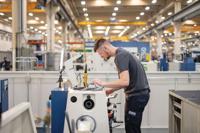
Ethan Cope is part of an apprenticeship program at Grob that offers next-gen workers a chance to earn a living while preparing for careers in a technology-driven manufacturing environment.
We hear it often: As older workers retire—and take their critical hand-on-the-machine knowledge with them—the next-generation workforce isn’t ready to step up, especially in an Industry 4.0 ecosystem. To help bridge this skills gap, manufacturers are increasingly leveraging apprenticeships, partnerships with technical schools and short courses for quick wins and lifelong learning.
“As workers retire, there isn’t the quantity in the pipeline to come into the workforce and do the work—machining, welding, fabrication,” says Chad Schron, vice president of Tooling U-SME, the workforce-development arm of SME. “At the same time, you have this renaissance coming on in manufacturing with new technologies such as additive, robotics and IIoT,” he adds. “Manufacturers can’t develop the workforce of today, let alone the workforce of the future. If major manufacturers are struggling, imagine how much small and medium-sized manufacturers are struggling.”
The skills gap is across multiple generations of workers, observes Dora Smith, senior director, global academic and startup strategy, at Siemens Digital Industries Software.
“The accelerated pace of technological change means the traditional knowledge and skills taught even a few years ago are outdated,” Smith says. “We’re seeing a widening digital-skills gap that needs immediate attention. We must move beyond one-stop training and foster a culture of lifelong learning to ensure the workforce can adapt, innovate and thrive in this dynamic environment.”


Evolving Skills Training
Over the last 20 to 30 years, the focus of skills training shifted from mechanical troubleshooting toward automation, robotics, programmable logic controllers, data analytics, simulation and digital twins, says Kim Humphrey, president and CEO of the Association for Manufacturing Excellence in Rolling Meadows, Illinois.
In fact, the top concern cited by more than a third of the 600 manufacturing executive respondents in a 2025 Deloitte Smart Manufacturing survey was “equipping workers with the skills and knowledge they need to maximize the potential of smart manufacturing and operations,” says Victor Reyes, managing director, Deloitte Consulting LLP.
The future workforce won’t be defined by AI replacing people, but by people who know how to use technology to work smarter, safer and faster, says Vineet Thuvara, chief product officer at Fluke Corp., an Everett, Wash.-based test and measurement device company. Training should blend real-world experience with the digital mindset driving modern industry, he adds.
“A clear trend we’re seeing is the rise of tools that teach,” Thuvara says. “Built-in guidance systems, such as embedded standards, automated prompts and pass/fail indicators, help new technicians build confidence from day one. For example, when a tester flashes green or red, the result is instantly clear, but the underlying numbers are still displayed. Over time, those numbers become second nature. It’s a bridge between early confidence and long-term competence, where technology reinforces learning rather than replacing it.”


Strengthening Soft Skills
Workers who came of age tethered to device screens during the pandemic need to develop soft skills, such as communication and conflict resolution, Schron asserts.
As with their predecessors, younger employees have their set of pros and cons.
“They bring creativity, adaptability and technological fluency to the workplace,” says Kelvin Byrd, dean of Greenville (S.C.) Technical College’s School of Advanced Manufacturing and Transportation Technology. “However, they often need additional development in soft skills, such as communication, resilience and professional accountability. Through experiential learning, we’re helping students refine these skills before entering the workforce.”
Communication, collaboration and problem-solving are just as important as being able to take a precise measurement, Thuvara adds. “Educators often say students across Gen Z (born between 1997 and 2012) and Gen Alpha (born between 2013 and 2025) are confident behind a screen but less practiced in presenting ideas, debating solutions or leading projects.”


Microcredentials Bridge the Gap
Microcredentials, which are short courses that demonstrate a learner’s knowledge/training in a specific subject, are expanding rapidly, Smith explains, addressing specific skills gaps and providing a faster time to competency. Demand is high for courses on digital twins, digital transformation and sustainable business practices.
These courses often are stackable, allowing students to work toward a certificate or degree. The number of microcredentials available in the United States nearly tripled between 2018 and 2020, and 45% of U.S. workers report having some kind of alternative credential, according to the Society for Human Resource Management.
“The agility allows us to respond quickly to evolving industry needs, offering highly relevant, up-to-date skills that traditional longer-form degrees might struggle to incorporate rapidly,” Smith says. “The flexibility enables learners to acquire specific knowledge and skills without committing to a full degree, making it ideal for working professionals or those looking to pivot careers.”


Values that Matter
Unlike previous generations, next-gen workers are less motivated by tenure and more by opportunity and innovation, Byrd says. While seasoned workers often prioritized steady pay, long-term job security, pensions and predictable shift work, technology and rapid reskilling were less central.
The new workforce values purpose, flexibility, technology integration and rapid career mobility. They are highly collaborative and digital-first, and expect employers to provide meaningful work environments that align with their values, Byrd adds.
To that end, recruitment and retention strategies must focus on career development, mentorship, recognition, flexibility and high wages, Byrd says. “Employers who invest in ongoing learning and clearly outline advancement pathways tend to retain younger workers longer. A culture of innovation, teamwork and inclusion also resonates strongly with this generation.”
Non-wage benefits, such as childcare, transportation and housing, are becoming increasingly important as part of a long-term retention approach.
“Today’s workers prioritize career growth and continuous learning, opportunities to work with cutting-edge technology, a positive culture, teamwork, work-life balance and benefits that support personal well-being and skills mobility across organizations,” Humphrey says. “They have a strong emphasis on teamwork, safety, inclusion and green manufacturing.”

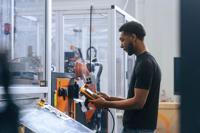
Donovan Miller is a recent graduate of the Greenville Technical College mechatronics program.
Partnerships Pay Off
Manufacturers are increasingly partnering with technical colleges and innovating on their own to educate and train workers on current tools, software and systems that manufacturers actually use.
“In the past five years, collaboration between manufacturers, high schools and trade schools has improved significantly,” Humphrey observes.
For example, Fluke partners with more than 250 universities, 14 trade unions, and thousands of trade and technical schools worldwide, according to Thuvara. The company is now embedded in 246 of 1,100 apprenticeship programs and connected to more than 400,000 students and educators through SkillsUSA.
“We are in it for the long term and committed to this community,” Thuvara adds. “These relationships ensure students learn with the same tools they’ll use in the field.”
Closing the skills gap means meeting learners where they are, he says. “We’re also focused on access. Scholarships, free training and equipment grants help remove financial barriers and bring more people into the trades. Embedding this technology early helps students strengthen both their hands-on and analytical skills, building the confidence and fluency they need to thrive in modern, connected industries.”
The Funding Conundrum
Even as technical schools become more important to bridge the skills gap, they receive less funding per student than traditional four-year schools, notes David Gillespie, president and founder of Virginia Technical Academy.
“The U.S. faces a paradox: High unemployment persists even as industries struggle to fill skilled trade positions,” Gillespie says. “Historically, the U.S. Department of Education has defined eligibility for federal student funding, a system built primarily to support academic, degree-based institutions,” Gillespie says. “This framework leaves most trade schools—especially those emphasizing performance-based learning—without equitable access to resources, despite their essential role in preparing workers for high-demand industries.”
Skilled trades education is different, Gillespie asserts. “It’s competency-driven, grounded in repetition, hands-on learning, and mastery of real-world tools and systems. Nonprofit and mission-driven training organizations like Virginia Technical Academy prove that hands-on, performance-based learning produces confident, job-ready graduates who meet employer needs from day one.”
The Appeal, and ROI, of Apprenticeships
Employers and education providers are rapidly expanding registered apprenticeships and youth apprenticeships as a preferred pipeline, Humphrey says. According to the U.S. Government Accountability Office, there were about 940,000 participants in registered apprenticeship programs across industries in fiscal year 2024, she says.
Paid apprenticeships have been a key part of German-based Grob Systems Inc.’s manufacturing plant in Bluffton, Ohio, says Mark Reed, training manager at Grob Systems. He explains that when Grob North America was started, the Grob family felt that it was necessary to follow the same apprenticeship-program model that was established in Grob’s German headquarters.
“Apprenticeship in Germany is universally viewed as a necessary part of any skilled occupation,” Reed says. “Because of that German heritage, it was not so much a decision of if, but how to have the apprenticeship. Investing in and training up our own technicians has been a big part of who we are as a company and has led to a lot of our success over the last 35 years here in the U.S.,” he adds.
Since its first class of six apprentices, the four-year program has grown steadily. In the last three years it has jumped from 26 participants in 2023 to 45 in 2024 and to 57 last year, according to Reed.
Apprentices work three days a week at Grob and take classes two days a week for two years at nearby Rhodes State College. In those two years, students earn a degree in electromechanical engineering technology, with Grob paying for the education.
In years three and four, students are placed in a specific department at Grob based on their interests, Reed says. After completing the program, students earn a Certificate of Completion of Apprenticeship issued by the Ohio State Apprenticeship Council in cooperation with the U.S. Department of Labor, certifying them as an industrial machinist technician. The apprentices then owe Grob a four-year commitment at the company.
“We justify the cost of paying for our apprentices’ education by looking at the results … the success of former apprentices,” Reed says. “The ROI we see is both immediate and long term. We can recruit the talent that we are looking for at a level that is unheard of in our area because of the company investment, providing immediate return.”
Success Stories
Ethan Cope, a first-year apprentice going through the mechanical side of the Grob Systems program, chose this option because he didn’t think a four-year college could provide the hands-on education he wanted. But while he heard many good things about the program, others were skeptical.
“The most pressure to get a conventional four-year bachelor’s degree I ever got was from my parents, who were initially worried that I would not be able to realize my full potential here,” Cope says. “The more they learned about the program, the more they realized that this was the perfect opportunity for me. … I still meet people who are excited that I am working at Grob. With all the support I got, I decided that there was no other choice for me.”
Cope is getting the hands-on education he sought.
“Everything we learn here at Grob has a practical, real-life application,” Cope says. “Everything we do, no matter the project, has a purpose, and the skills learned from those projects carry me through to this day.”
And his parents are fully on board with his decision. “Now that I have been working here for some time, they believe whole-heartedly that going through the apprenticeship was the best choice that I could have made for myself. They are all in and support me through the ups and downs.”
Grob’s retention rate speaks for itself. The apprenticeship currently has a completion rate of 91% finishing four years, Reed says. Of the 611 people who have been a part of the apprenticeship in the last 35 years, 58% of them are still with the company, including two of the original apprentices. Apprentices comprise 35% of Grob’s total workforce and nearly half of the skilled trades/technical portion of employees, he says.
Moreover, 75 former apprentices have advanced into management roles or what Grob considers nontraditional career paths within the organization. One of Grob’s four-member executive team began their career as an apprentice.


Dora Smith, senior director, global academic and startup strategy, Siemens Digital Industries Software, pictured with the winning team of the sustainability design hack at Realize LIVE Americas in June 2025 in Detroit.
Managing Change and Achieving Resilience
The pace of technological change makes it almost impossible for traditional educational models to keep up.
“Technology is evolving faster than the systems designed to teach it,” Thuvara says. “Education and training need constant adaptation to remain relevant as industries shift toward AI-driven operations, connected infrastructure and digital diagnostics. That means building programs that evolve as quickly as the technology itself, and that requires closer collaboration between industry, educators and policymakers.”
Another challenge is ensuring depth of understanding as tools become more intuitive. “Simpler interfaces can build confidence quickly, but they also risk creating surface-level knowledge if not paired with solid technical grounding,” Thuvara explains. “We need to make sure new technicians not only know what the results mean, but also understand why they matter. That balance between usability and technical mastery is at the heart of workforce readiness.”
U.S. manufacturers need to find the right mix of humans and machines to be competitive and resilient in the new landscape, Reyes says. This involves investing in data architecture, technology, governance, cybersecurity, talent and workflow redesign, as well as identifying the uniquely human capabilities that their engineers, operators, salespeople and others bring to the table in an AI-enabled world.
Strengthening digital supply chain tools could become essential for managing ongoing volatility and trade uncertainty, Reyes adds. Leveraging new growth opportunities, such as those created by the demand for semiconductors and data center components, as well as favorable policy incentives, will be important.
“At the same time, workforce planning should prioritize an adaptive approach that emphasizes agility, skills-based hiring, continuous upskilling and leveraging AI to accelerate onboarding and knowledge transfer,” Reyes says. “Remaining focused on the long-term goal of creating a strong workforce, while also managing potential uncertainty and volatility, could be essential in the years ahead.”
Ultimately, the future of technical work will depend as much on empathy and curiosity as it does on engineering, Thuvara says. “The workforce that succeeds will be the one that pairs precision with understanding—people who can interpret data, collaborate across experience levels and keep learning long after the technology has changed.”


Kelvin Byrd, dean of the School of Advanced Manufacturing and Transportation Technology at Greenville Technical College, speaking at the 2025 Manufacturing Technology Series SOUTHEAST event.