

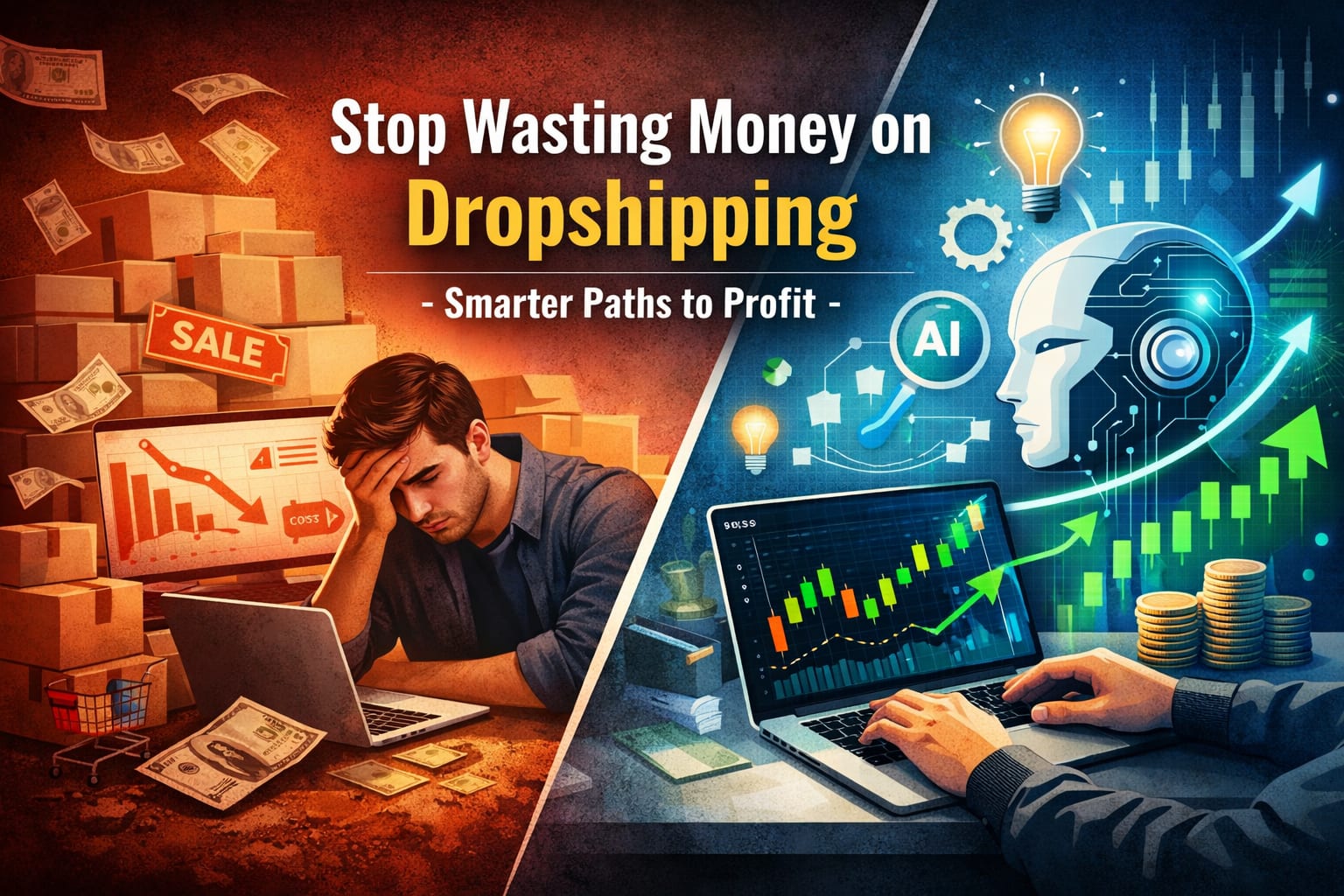
Why You Should Not Waste Money on Traditional Dropshipping. And What to Do Instead
For years, traditional dropshipping has been marketed as one of the easiest ways to make money online. Social media feeds are full of screenshots showing sales dashboards, rented luxury cars, and influencers promising income with minimal effort.
Platforms like Shopify and suppliers such as AliExpress have made it simple to launch an online store without holding inventory. At first glance, it seems like the perfect business model — low risk, low overhead, and high potential.
But there is another side to the story that rarely gets discussed.
In 2026, traditional dropshipping is far more competitive, more expensive to operate, and less predictable than it once was. While it can still work in certain situations, it is no longer the easy opportunity many beginners expect.
If you are thinking about starting a dropshipping business, it is important to understand the current landscape — and why alternatives such as AI-powered ecommerce strategies or developing skills in financial markets may offer different paths forward.
Let’s look at the reality.
The Problem With Traditional Dropshipping
The Market Is Saturated
A few years ago, launching a simple online store and running ads could be enough to generate sales. Today, thousands of sellers compete in the same product categories.
That trending LED lamp or posture corrector you see advertised? There are likely hundreds of nearly identical stores selling the exact same product — often from the same supplier, using similar images and nearly identical marketing angles.
When everyone sells the same item, competition increases and profit margins shrink. Businesses begin competing on price instead of value, making it harder to stand out and maintain consistent profits.
Advertising Costs Continue to Rise
Traditional dropshipping depends heavily on paid advertising, particularly on platforms like Facebook and TikTok.
Over time, advertising costs have increased. Testing a product might cost $50 to $100. Scaling it can require several hundred dollars more. Even after that investment, there is no guarantee of profitability.
Many beginners focus only on revenue numbers and overlook the full cost structure, which often includes:
Refunds
Payment processing fees
Chargebacks
App subscriptions
Shipping complications
When these expenses are added together, the margins can become thinner than expected.
Shipping Times Affect Customer Experience
Many traditional dropshipping stores rely on overseas suppliers. This typically results in shipping times ranging from one to three weeks.
Modern consumers are used to fast delivery from large ecommerce companies. Waiting several weeks for a product can lead to frustration.
Long shipping times may result in:
Refund requests
Negative reviews
Customer service complaints
Payment disputes
In today’s ecommerce environment, customer experience plays a major role in long-term success. Slow fulfillment can make building trust difficult.
Limited Control Over the Business
One of the biggest challenges with traditional dropshipping is the lack of control.
Store owners often do not control:
Product manufacturing
Supplier pricing
Shipping reliability
Brand loyalty
If an advertising account is restricted or a supplier changes pricing, the business can be disrupted quickly. This makes it difficult to build something stable over the long term.
A More Strategic Approach: AI-Powered Ecommerce
Instead of relying on guesswork and trending products, some entrepreneurs are shifting toward more data-driven methods.
AI-powered ecommerce focuses on using technology to analyze market trends, improve decision-making, and automate certain processes.
For example, AI tools can help with:
Researching product demand
Studying competitor pricing
Writing product descriptions
Creating marketing copy
Analyzing advertising performance
While this approach still requires effort and strategy, it allows decisions to be guided by data rather than impulse. Combined with strong branding and a focused niche, it can help create a more structured business model.
Rather than selling random products, the goal becomes building a recognizable brand with repeat customers and long-term potential.
Another Option: Developing Market Skills
For those less interested in ecommerce, exploring financial markets may be another path worth researching.
Unlike dropshipping, trading does not involve managing inventory or handling customer service. Instead, it requires analyzing price movements and understanding market behavior.
However, it is important to approach trading carefully. It requires:
Risk management
Technical understanding
Emotional discipline
Continuous learning
It is not a guaranteed or simple path to income, but for some individuals, developing these skills can offer a different way to participate in the digital economy.
Comparing the Approaches
Traditional Dropshipping
High competition
Rising advertising costs
Thin margins in crowded markets
Limited operational control
AI-Focused Ecommerce
Data-driven decision-making
Automation advantages
Potential for stronger branding
Still requires strategy and effort
Market-Based Skill Development
No physical products
No customer management
Performance depends heavily on education and discipline
Each path carries risk. The key is understanding those risks rather than chasing trends based on social media highlights.
The Bigger Lesson: Avoid Chasing Hype
The biggest mistake many aspiring entrepreneurs make is jumping into whatever appears easiest or most glamorous.
Traditional dropshipping gained popularity because it was presented as simple. But simple does not always mean sustainable.
Building something meaningful — whether in ecommerce or financial markets — usually requires patience, research, and a willingness to adapt.
Final Thoughts
The online economy evolves quickly. Strategies that worked five years ago may not work in the same way today.
Traditional dropshipping is not necessarily “dead,” but it is far more competitive and complex than many promotional videos suggest. Anyone considering it should approach with realistic expectations and a clear strategy.
Instead of chasing shortcuts, focus on:
Learning how systems work
Using technology intelligently
Building long-term assets
Managing risk carefully
Financial independence rarely comes from copying trends. It is more often the result of consistent learning, thoughtful decisions, and long-term planning.
That is the real difference between following hype — and building something that lasts.