

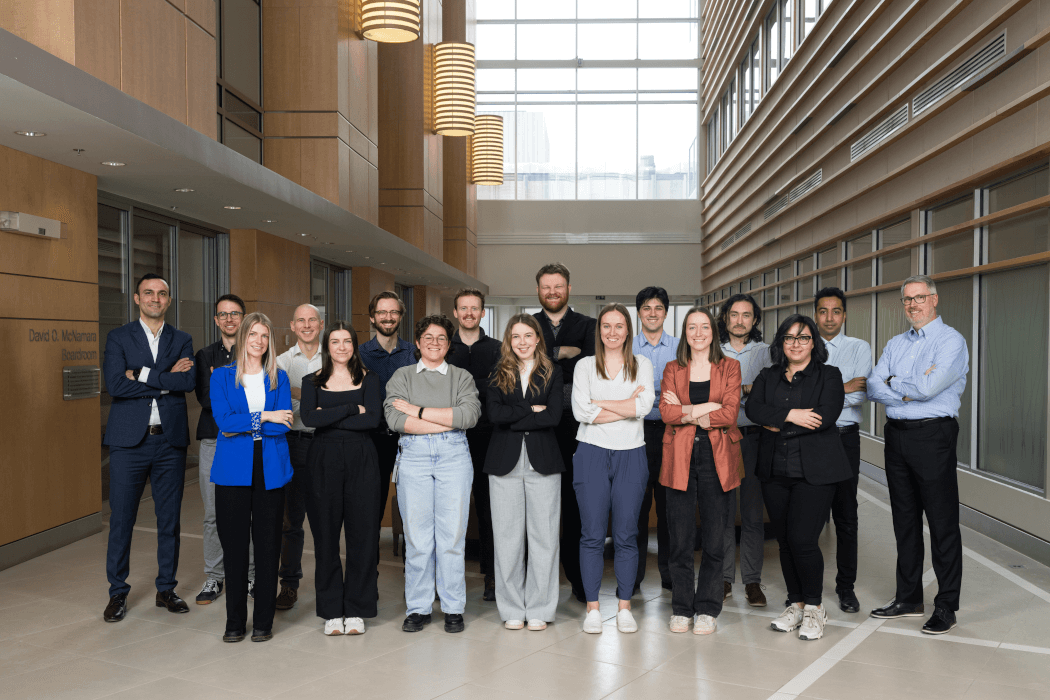
What’s powering the algorithm that gets you a good night’s sleep?
How NovaResp is using student talent and AI to improve sleep apnea therapy.
Hamad Hanafi saw an opportunity to rethink a solution that hadn’t meaningfully changed in years.
“We use machine learning to train the CPAP device on the breathing patterns of patients. It knows the apnea is coming, and it gently intervenes.”
Hamad Hanafi,
NovaResp Technologies
With a PhD in biomedical engineering focused on breathing respiratory mechanics, Hanafi knew there was significant room to improve the patient experience for those living with obstructive sleep apnea, which occurs when breathing repeatedly stops and starts during sleep, increasing the risk of heart attacks and strokes. When his father was diagnosed with the condition, the problem became personal.
“My father has severe sleep apnea, and he had it growing up without knowing,” said Hanafi. “After he was diagnosed, it became clear that the discomfort patients and doctors complain about with CPAP machines is very real.”
Today, Hanafi is the Founder and CEO of NovaResp Technologies, a Halifax-based medtech company developing a new generation of sleep therapy for the roughly one billion people worldwide living with obstructive sleep apnea.
The standard treatment is Continuous Positive Airway Pressure (CPAP) therapy, the machine that many people recognize as the mask, tubes, and humming device by the nightstand.
“When a doctor says you’re at risk of heart attacks and strokes, you’re going to try the therapy,” said Hanafi. “Getting used to the CPAP machine is one thing, but if you don’t use it more than four hours a night, insurance won’t cover it.”
Many patients struggle to tolerate the machine for more than four hours a night. Not only is the device uncomfortable to wear to bed, but traditional CPAP machines also react to breathing events after they happen, which triggers increases in air pressure. Those abrupt changes can wake patients up, disrupt sleep, and ultimately lead many to abandon therapy altogether.
NovaResp has taken a different approach. Instead of reacting to apnea events, its AI-powered algorithms predict them before they happen, allowing the device to intervene gently.
“We use machine learning to train the CPAP device on the breathing patterns of patients,” said Hanafi. “It knows the apnea is coming, and it gently intervenes. The apnea doesn’t occur, so the need to increase the pressure is gone.”
The company just finished two clinical trials and is exploring inbound interest from CPAP machine manufacturers looking to use the software. But building breakthrough medical technology is slow, deliberate work that no founder can do alone.
From a team of one to a talent pipeline
Hanafi launched NovaResp in 2017 as a team of one, originally intending to build both hardware and software. Over time, the company sharpened its focus.
“We eventually came to our senses that our core strength is in algorithms and software,” he said. “So now we build the best software and sell to CPAP manufacturers that can quickly get it to patients.”
NovaResp required highly technical talent to scale, with expertise spanning algorithm development, data analysis, and clinical trial preparation. As an early-stage startup, it also needed to access that talent in a capital-efficient way.
In 2021, Hanafi hired his first intern with the support of the Information and Communications Technology Council (ICTC), a national non-profit that provides research, advice, and programs to strengthen digital skills and build business capacity. Since then, NovaResp has engaged 34 student placements through ICTC’s Work Integrated Learning (WIL) Digital program, which allows participating employers to apply for grants to subsidize up to 50 percent of a student’s salary over their term.
ICTC’S WIL Digital program offers a pathway for students to gain that experience. The program takes place over three terms a year: Winter (December-March), Summer (April-July), and Fall (August-November). Since 2017, it has facilitated over 23,000 work placements. More than 4,000 employers across Canada have participated, and over 65 percent of placed students identify as belonging to underrepresented groups.
For NovaResp, the program became more than financial support. It became the backbone of the company’s talent pipeline.
One of the most valuable benefits of ICTC’s WIL Digital program is that it creates the flexibility for businesses to retain students part-time as they return to school. Instead of losing trained workers each term, NovaResp has been able to continue developing their skills across multiple terms, and at least five have transitioned into full-time roles after graduation.
“There’s just a difference with people who started with us as interns,” said Hanafi. “It’s not just about being smart, they understand the product, the culture, and how we work.”
PRESENTED BY

ICTC’s WIL Digital program provides employers with wage subsidies of up to 50 percent of a student’s salary up to $5,000. Learn more about applying for upcoming terms here.
Feature image courtesy ICTC.