

Liberia: Experts Warn Digital Divide is Crushing a Generation’s Dreams and Locking the Country in Poverty
Summary:
- Nearly two decades after Liberia’s Ministry of Education pledged to bring computer literacy to public schools, thousands of students still graduate without ever touching a keyboard.
- Experts warn a growing digital divide locks Liberians out of global job and entrepreneurial opportunities and forces the country to depend on foreign tech experts, sending public funds abroad.
- Although millions in donor funds have been invested, experts warn that ICT projects often fail due to poor infrastructure, lack of trained teachers, and weak planning, leaving Liberia unprepared for rapid global digital and AI advancements.
By Augusta S. Lafalay with New Narratives
BARNESVILLE ESTATE, Montserrado County— Sarah Sackor and her classmates were excited the day in September when a computer teacher told their 12th-grade class early that they would finally begin internet lessons. For years, “computer class” had been mostly theory — copying notes from textbooks. Most students at E. Jonathan Goodridge Memorial High School had never used a real computer.
The teacher came once, told them to bring their phones for an “internet lesson,” and promised they would soon begin practical training. Then, for weeks, he did not return.
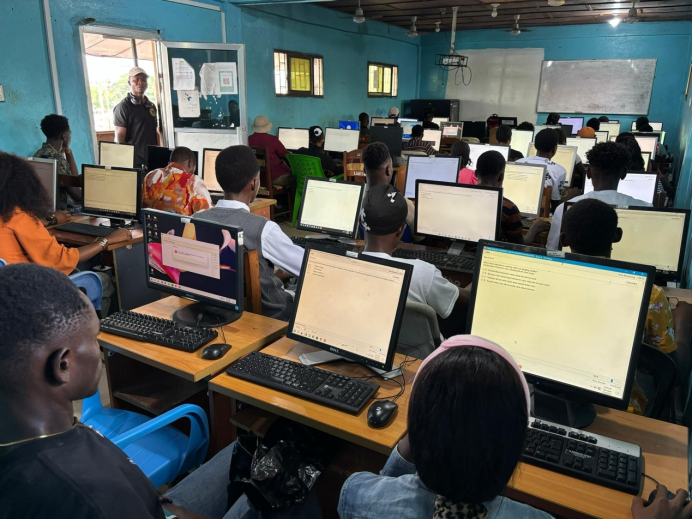
Just down the corridor, the school’s computer lab sits behind locked doors. Inside, new machines delivered by the Ministry of Education earlier this year remain unused. By the second academic period, Sarah said, her class had not held a single practical session in the lab.
“This is the direction the world is going,” Sarah said. “If you do not have computer knowledge, you cannot get anywhere. And I do not have it, so it feels hopeless sometimes.”
This is the reality across much of Liberia, where the promise of digital education remains largely unfulfilled nearly two decades after the government pledged to bring computer literacy to public schools. While their peers in private institutions practice coding and online research, thousands of public-school students struggle even to find electricity to power their classroom—let alone access the computers that increasingly define opportunity in the modern economy.
The consequences reach far beyond the classroom. Experts warn that Liberia’s digital divide is not just an education problem—it’s an economic crisis in the making, locking an entire generation out of entrepreneurial opportunities that are reshaping economies across the developing world.
Experts say the stakes couldn’t be higher. “If policymakers ignore this warning, we’ll have an unqualified workforce,” said Dr. Darren Wilkins, vice president for Information and Communications Technology at the University of Liberia. “In a digital age, that’s disastrous for the economy. With the rise of AI globally, if we invest in human capital, we can still benefit, but we must act now.”
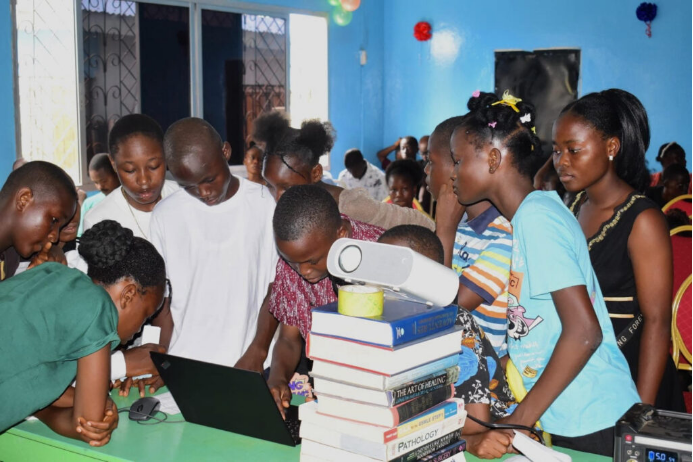
Across the world, the internet has become an engine of wealth creation. In the Philippines, young people work as virtual assistants and accountants for clients worldwide. Students in Ghana pay their way through university, driving for Uber and making deliveries through digital apps on their phones. Designers in India manage websites for companies they’ve never met in person.
But Liberians are being shut out of this digital economy before they even begin. The numbers paint a stark picture. Research shows that digital transformation in Sub-Saharan Africa could create millions of jobs by 2030, but only for those with information and communications technology knowledge. Without basic computer skills, experts say young Liberians cannot access these opportunities.
During his final year, the weight of his unfulfilled dream became too much for student Karmoh A. Kamara. “I cried during my studies when I was about to graduate because I didn’t have a computer to meet my ambitions,” he said.
Now graduated, Kamara faces a painful choice. His parents can only afford to send him to the University of Liberia, where he said the specialized ICT training he wants is limited. Private institutions like Starz University offer more intensive programs but remain financially out of reach.
At the Frank E. Tolbert High School, student Peter Sandoz says his dreams have been similarly crushed. “I came to this school because I wanted to learn computers,” he said. “I heard they had a computer lab. But when I finally came to the school and went to the computer lap, we spend few time and our instructed will tell us to go back to class.”
The school has 24-hour solar panels, a gift from a government project meant to power computer labs. But students said the facility still struggles with reliable electricity when the rainy season blocks the sun. When students do enter the lab, only 12 students can sit at functioning machines. The rest stand and watch. “It has been my passion since I was small to become an IT specialist,” he said. “But my environment doesn’t support my passion.”
On two days in October and February, this reporter visited Frank E. Tolbert School and observed that the lab was closed and the only lab instructor, whom the school said was an unpaid volunteer, was absent from campus.
Students told FrontPage Africa/New Narratives that the instructor had not attended classes for two weeks. On one visit to the campus the school principal acknowledged that the instructor was not present on campus. On a second visit in February, the vice principal said the ICT lecturer was a volunteer at the school which hindered his presence in class. He said the lecturer who was on the payroll had left the school.

At E. Jonathan Goodridge Memorial High School, the computer lab was physically open on the day this reporter visited, and the instructor was present on campus. But students said they still had not received hands-on sessions using the machines, and the lab remained unused for regular practical lessons. When contacted, the lecturer told this reporter that students visit the lab as per schedule and with a target number of 20-30 students.
As Regional High School Exams Go, Online Students They Will Be Locked Out
As the West African regional high school examinations move toward computer-based testing, Liberian students fear they will be left out. The West African Senior School Certificate Examination used across the region, shift toward digital formats has sparked panic among students who have never learned to log in, type, or navigate basic software.
“We are halfway into the year, and we still don’t know how to log in,” Sandoz said. “Some students say they can, but many can’t. We don’t know the platform or how the test will work. It will be hard.”
The digital education crisis has deep roots. In 2008, Liberia’s Ministry of Education acknowledged computers were vital for contemporary learning and formally committed to incorporating digital literacy into school curricula. International donors poured resources into pilot projects, teacher training, classroom renovations, and policy recommendations.
Despite these investments, Liberia still lacks a comprehensive national strategy for technology in education, and many schools have little to no access to computers, electricity, or the internet.
“This is a real national problem,” said Latim Dathong, deputy education minister for administration under the George Weah administration and chairman of the board at Starz University, a technology institution in Monrovia. “When I say it’s a national problem, I mean it’s not the responsibility of one government. It’s not any one administration’s fault. But successive governments need to continuously work on this so that 10 to 15 years from now, we can see real solutions.”
According to Dathong, over 7,000 schools operate across Liberia — both public and private — yet many lack power entirely. “Without current, computers won’t work. We don’t have electricity across the whole country yet, and even where it exists, it’s not affordable for most people,” he said.
Even when infrastructure exists, sustainability remains elusive. Darren Wilkins, vice president for Information and Communications Technology and chief information officer at the University of Liberia, said he has watched the pattern repeat itself for years.
“Most technology projects fail due to a lack of proper planning and sustainability,” Wilkins said. “People build nice computer labs, but no mechanisms are put in place to maintain them. After six months to a year, the equipment starts deteriorating. There are no parts for repairs, and internet subscriptions aren’t paid. Poor planning and no sustainability — that’s the core problem.”
Schools that do manage to acquire computers often struggle to pay teachers qualified to use them. ICT instructors command higher salaries than traditional teachers, creating budget pressures that many institutions cannot afford.
The digital literacy gap follows students into higher education. At the University of Liberia, Alphonso Zeacoli enrolled in a mandatory ICT course in 2025. The instructor made clear expectations: every student needed a personal computer for coding and presentations.
Alphonso, like many of his classmates, could not afford to buy one. The instructor allowed students to form groups, sharing two or three computers among several people. But Alphonso said this arrangement leaves gaps. The university maintains computer labs, but access proves difficult. Students must submit admission letters or recent grade sheets to enter. Once inside, they often find that most machines don’t work. “You may find five or ten computers in the lab, and only two or three working — and those are usually occupied,” Alphonso said.
The burden weighs on him. “Not having a computer is a major gap. We’re in a digital world, and most of our work is done on computers. You have to type assignments, convert them to PDF, do research, save documents—all of that requires a computer.”
Wilkins estimates that the vast majority of Liberian youth lack full computer literacy. “About 80 percent can use smartphones and social media. That is basic digital literacy. In terms of productivity tools like Word and PowerPoint, maybe 50 percent have some exposure.”
The University of Liberia operates over 15 computer labs, but most contain obsolete equipment. Wilkins designed a foundational course called CAPS 100 to ensure every freshman gains basic skills: typing, Microsoft Office, internet use, and e-learning. But with nearly 5,000 freshmen yearly and limited functional labs, he said many students skip the course entirely.
The digital divide doesn’t impact Liberians equally. Private schools and urban institutions maintain significant advantages. Starz University, for instance, runs over 500 computers daily with reliable power and maintenance.
“We are dealing with a smaller number of students,” Dathong explained. “Public schools face different mathematics. Thousands of institutions serving vastly larger populations with fewer resources.”

For student Sarah Sackor, the inequality feels personal. “In terms of practical lessons and what you learn, we are left behind. It creates inequalities between UL students and students from other institutions.”
Experts say the disparity reinforces cycles of poverty. Students from wealthier families attend private schools with functioning labs and trained instructors. They graduate with marketable skills, access better universities, and secure higher-paying jobs. Meanwhile, public school students – already facing economic disadvantages – graduate without basic digital literacy, limiting their employment prospects.
Government officials acknowledged the challenges and said the issue has been a priority for the two-year-old Boakai administration. In 2024, the administration promised to train 10,000 young people in digital skills as part of its effort to expand the economy through information and communication technology. But the Liberia Telecommunications Authority, which implemented the project, did not publish a report online. It was only after multiple requests that this reporter was shown a hard copy of the report.
The report said the program was rolled out across all fifteen counties in partnership with institutions including Blue Crest University, Starz University, New Breed Tech, NETLIB Vocational Training Institute and the Atlantic Vocational Training Institute among others. More than 11,000 young people registered nationwide for the program, and more than 9,000 attended the training.
Kleeji Tukon, technical assistant in the office of the deputy minister for planning at the Ministry of Education, said the ministry also partnered with the World Bank on a project designed to improve access to resources for high school students.
“They provided 156 computer labs to 156 senior secondary schools across Liberia. That has helped equip students with technical knowledge,” Tukon said.
But that project underscored the challenges. A June 2025 World Bank progress report on the project said while it had performed well on several education goals, the Bank found no progress in three key areas tied directly to technology. The number of students with access to digital devices remained at zero, and the share of students, including girls who showed improved digital skills also remained at zero. The report linked the shortfall to delays in procuring equipment and rolling out the systems needed to support digital learning.
Dr. Wilkins said these projects are good, but too slow to meet the urgency of the problem. He proposed a three-part solution: a modern, 21st-century-relevant curriculum; comprehensive capacity building for teachers; and clear sustainability plans with dedicated budgets for at least five years. “There must be a national ICT strategy with proper budgetary allotments. Not one-off projects. A national long-term plan that every public school follows.”
He said that public schools should hire their own technology specialists, just as they hire teachers for other subjects. “Donors shouldn’t pay for that. The government should. Every public school should have at least one ICT specialist to train teachers and maintain the technology environment.”
Datomo underscored the urgency for the whole economy. “Liberia’s greatest resource is its people. Not gold, not diamond, not oil. If we prepare our children well and give them the skills we are talking about, the country’s sustainability and growth will move upward. If we fail, we will continue going in circles for a long time.”
Like students in Bensonville and around the county, Sarah thinks about her future. She wants to study journalism and secretarial science, both fields requiring strong computer skills.
“We are pleading, we need basic computer knowledge,” she said. “That is my plea. Do not just announce it and leave it. The people in charge need to be pushed, actually, to do the work.”
This story was a collaboration with New Narratives as part of the “Investigating Liberia” project. The Swedish International Development Cooperation Agency provided funding, but the founder had no say in the story’s content.