


NIHR invests £5.4m in digital technology research to transform social care
The National Institute for Health and Care Research (NIHR) has awarded more than £5.4 million to nine research projects aimed at transforming social care through digital technology.
The funding, totalling £5,444,562, has been allocated through the NIHR Research Programme for Social Care (RPSC) and will support projects across England, Scotland, and Wales, each running for between 18 months and two years.
The NIHR called for collaborative proposals exploring how cutting‑edge technologies, including artificial intelligence (AI) and smart devices, can improve outcomes for adults and children using social care services.
A key focus is on addressing barriers to technology adoption, inequalities in access to digital tools, practical applications in under‑used or emerging care settings.
The programme aims to generate real‑world evidence on how digital innovation can support independence, wellbeing, and more effective care delivery.
The nine funded projects reflect a wide range of innovative approaches to improving social care.
These include:
- Virtual reality (VR) training to help carers support people with severe mental illness
- Use of low‑cost smart‑home technology to improve safety and social connection for people with dementia
- Exploration of how everyday devices, such as smart speakers and video doorbells, can support independence for disabled adults
- Development of AI tools to help social workers access and use evidence more effectively
- Digital toolkits to improve confidence and skills in using technology in care home settings
Together, the projects aim to test scalable, practical solutions that could benefit social care across the UK.
Several projects focus on how technology can help people live independently for longer.
Research led by Cardiff University will examine how smart‑home technologies can enhance social connection for people living with dementia, while another study will explore how common digital devices can give disabled adults greater control over their home environments.
A separate project from the University of Stirling will investigate how councils use smart devices to support people after hospital discharge, with the aim of reducing delays and improving outcomes.
Other projects focus on improving care for specific populations, including older adults and those living with dementia or hearing loss.
Research from the University of Worcester will explore how different technologies can support people with both dementia and hearing loss, as well as examining how noise levels in care settings affect wellbeing.
Meanwhile, a study led by the University of Glasgow will develop a practical toolkit to support digital adoption in care homes, improving quality of life and safety for residents.
Artificial intelligence also plays a key role across the programme.
One Cardiff University project will develop an AI‑based tool – the Social Worker Evidence Engagement Tool (SWEET) – designed to help social workers quickly find and summarise relevant evidence for decision‑making.
Another study from Manchester Metropolitan University will explore how generative AI can support people with learning disabilities in their daily lives, providing accessible information and practical support.
Research from the University of Oxford will examine how proactive telecare can be embedded into everyday practice, working directly with care providers and service users to identify what works best.
This includes understanding how technology can support people at home while also improving care coordination and service delivery.
A central theme across all projects is tackling inequalities in access to digital technology.
Researchers will investigate how factors such as cost, digital skills, infrastructure, and confidence affect adoption, particularly among vulnerable or underserved groups.
By identifying these barriers, the projects aim to inform strategies that make digital care solutions more inclusive and widely accessible.
Professor Mike Lewis, NIHR Scientific Director for Innovation, said:
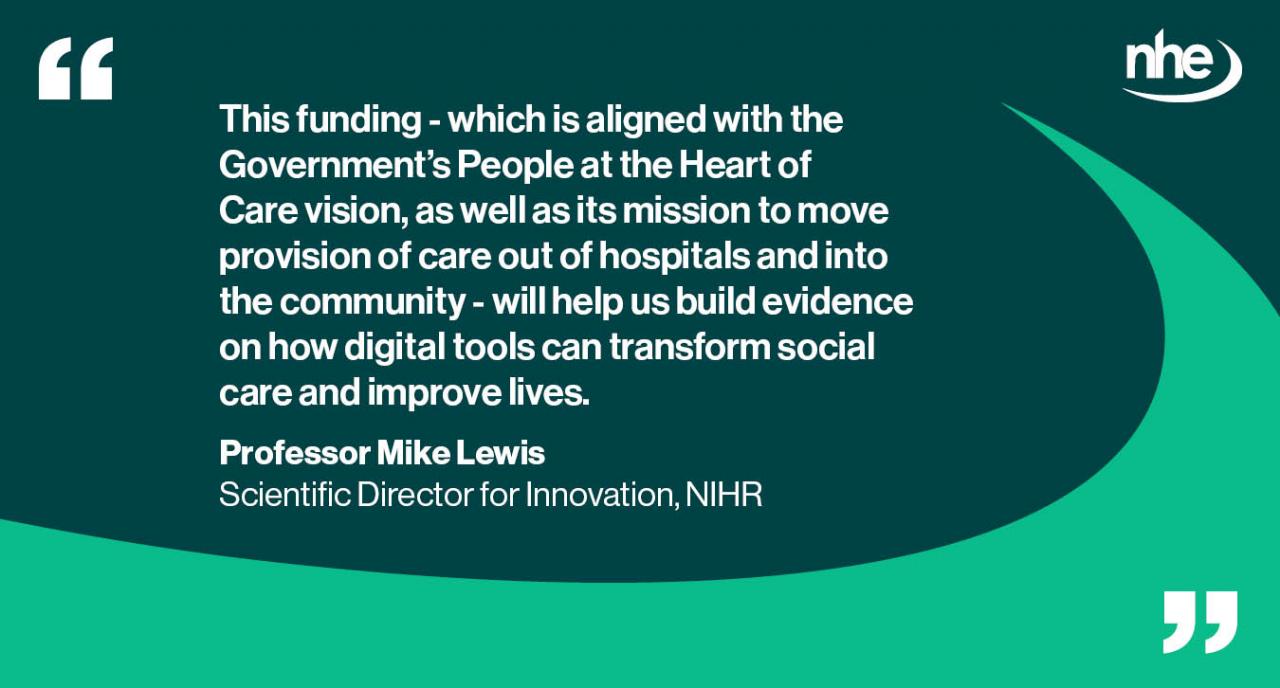
“The NIHR is fully committed to using digital innovations to improve the delivery of social care in the UK. This funding – which is aligned with the Government’s People at the Heart of Care vision, as well as its mission to move provision of care out of hospitals and into the community – will help us build evidence on how digital tools can transform social care and improve lives.
“It reflects the NIHR’s commitment to building capacity in social care research and ensuring technology is harnessed to support independence, enhance quality of life and strengthen the effectiveness of care for adults, children and carers across the UK.”
By testing innovative solutions in real‑world settings, the research will help determine which approaches are:
- Effective and scalable
- Acceptable to users and staff
- Cost‑efficient for services
Findings will help guide future investment and support the development of digitally enabled social care systems.
The funding reflects a growing recognition of the role technology can play in transforming social care.
From improving communication and independence to supporting staff decision‑making and reducing system pressures, digital innovation offers significant potential to enhance care delivery.
By investing in these projects, the NIHR aims to accelerate progress towards a more responsive, inclusive, and sustainable social care system.
Image credit: iStock