

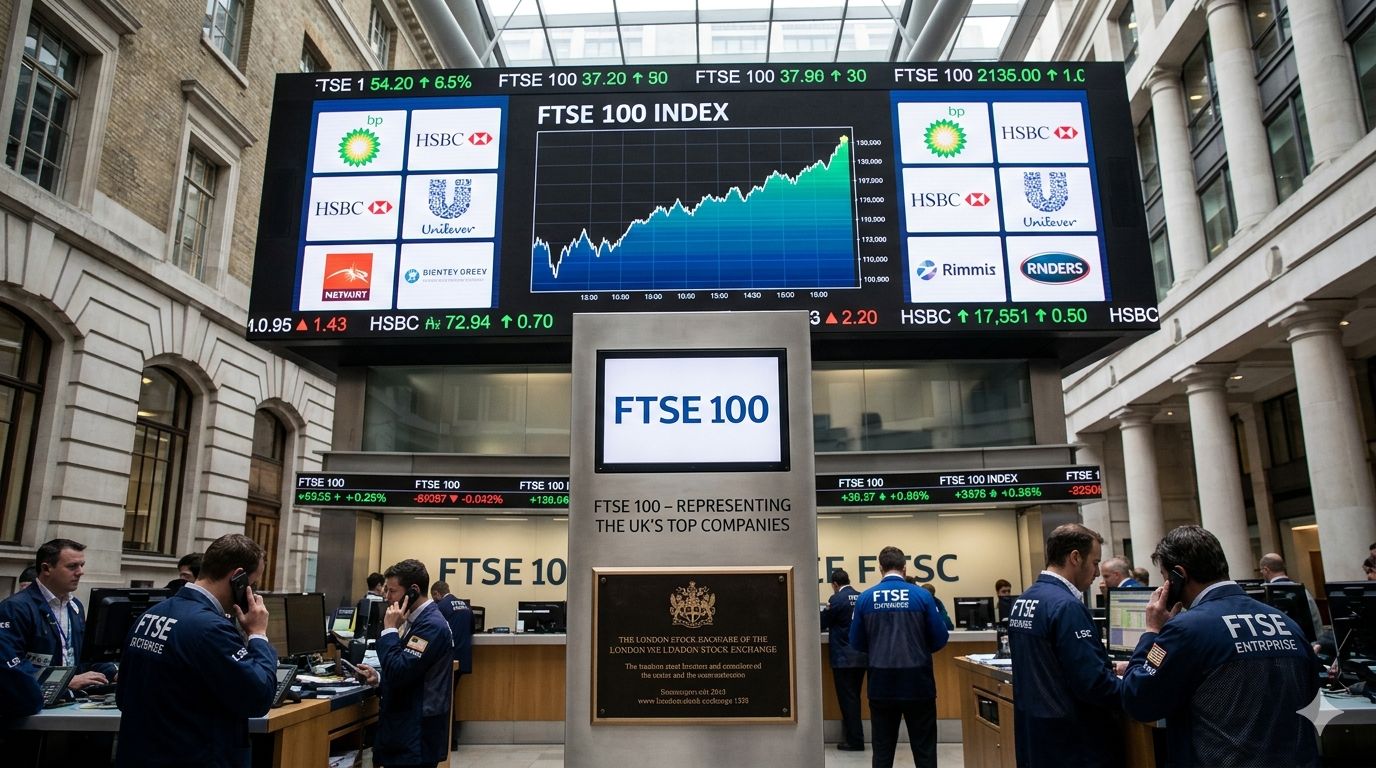
FTSE 100 Price Forecast for 2026: Where Will It Go?

Ruby Layram
7th Apr 2026
If you’ve been watching the FTSE 100 lately, you nay have noticed that the headlines are full of uncertainty, from geopolitics to interest rates. No one really knows what’s going to happen (with any market!)
So, where is the price of the FTSE100 actually forecast to go in 2026?
Let’s cut through the noise and look at what the experts are really saying, because the truth (as always) sits somewhere between wildly optimistic and cautiously pessimistic.

Before we dive into forecasts, it’s worth noting just how strong the FTSE 100 has been recently.
The index surged over 20% in 2025, its best year since 2009, and even crossed the 10,000 mark for the first time at the start of 2026.
That’s important, because when markets have already had a big run, future gains often come a bit more, slowly!
In other words: don’t expect another straight-line surge (sadly).
So, What Are the Experts Predicting for 2026?
Here’s where things get interesting, because forecasts vary quite a bit depending on who you ask.
The ‘steady growth’ camp
Many major institutions are fairly conservative.
For example, UBS expects the FTSE 100 to hover around 10,000 by the end of 2026, with a more optimistic scenario closer to 10,800.
Similarly, some models suggest a range of roughly 11,300 to 11,800 by year-end.
According to these forecasts, growth is likely, but not explosive.
The ‘bullish’ camp
Now for the more exciting predictions…
Some analysts believe the FTSE 100 could push past 12,000 in 2026 if conditions stay supportive.
Even more bullish forecasts suggest levels as high as 13,000+ by the end of the year, implying significant upside from current levels.
These forecasts tend to rely on:
- Strong corporate earnings
- Continued investor demand for “cheaper” UK stocks
- Falling interest rates boosting valuations
Great if it happens, but definitely not guaranteed.
The ‘cautious’ view
Of course, not everyone is convinced the FTSE will keep rising smoothly.
There are real risks:
- Geopolitical tensions affecting markets
- Higher borrowing costs and inflation
- Slower global growth
We’ve already seen how quickly things can wobble, recent market dips wiped out earlier gains amid global tensions and rising energy prices.
And that’s the key point, volatility isn’t going anywhere.
What’s Actually Driving the FTSE 100 in 2026?
If you want to understand where the index might go, you need to understand what moves it.
Here are the big drivers experts are watching:
1. Interest rates
There’s an expectation that the Bank of England may cut rates slightly in 2026.
Lower rates tend to:
- Boost company valuations
- Make shares more attractive than cash
- Support borrowing and growth
But… if inflation stays sticky, rate cuts could be delayed. And markets won’t like that.
2. Global economy
The FTSE 100 is surprisingly international, many of its companies earn money overseas.
That means:
- A strong global economy = good news
- A slowdown = not so good
Analysts broadly expect global growth to remain resilient, but with plenty of risks bubbling under the surface.
3. Valuation
One reason some investors are bullish? The FTSE 100 is still considered relatively undervalued compared to markets like the US.
That “discount” has been attracting global investors, and could continue to do so.
4. Dividends
The FTSE isn’t just about price growth. It’s famous for income.
Analysts highlight strong dividend payouts and buybacks, with a combined “cash yield” of around 5.5%. That makes it particularly attractive in uncertain times for investors who want attractive yields.
So, where Will the FTSE 100 Go in 2026?
If we pull all the forecasts together, a realistic range looks something like this:
- Bear case: ~9,500–10,000
- Base case: ~10,000–11,500
- Bull case: ~12,000–13,000+
That might sound like a wide range, but that’s the reality of investing. No one knows for sure.
The FTSE 100 in 2026 is likely to grow, but probably not in a straight line.
Expect bumps. Expect headlines. Expect moments where it feels like everything is about to fall apart (it usually isn’t).
But if the fundamentals hold, steady earnings, attractive valuations, and decent dividends, the long-term picture still looks pretty solid.
And remember, investing isn’t about predicting the future perfectly. It’s about positioning yourself sensibly, whatever happens next.
I recommend taking a look at our guide on how to build a diversified portfolio to learn how.
This is not investment advice. The price of stocks can go up and down quickly and future returns are never guaranteed. Do your own research before putting any money at risk.
