

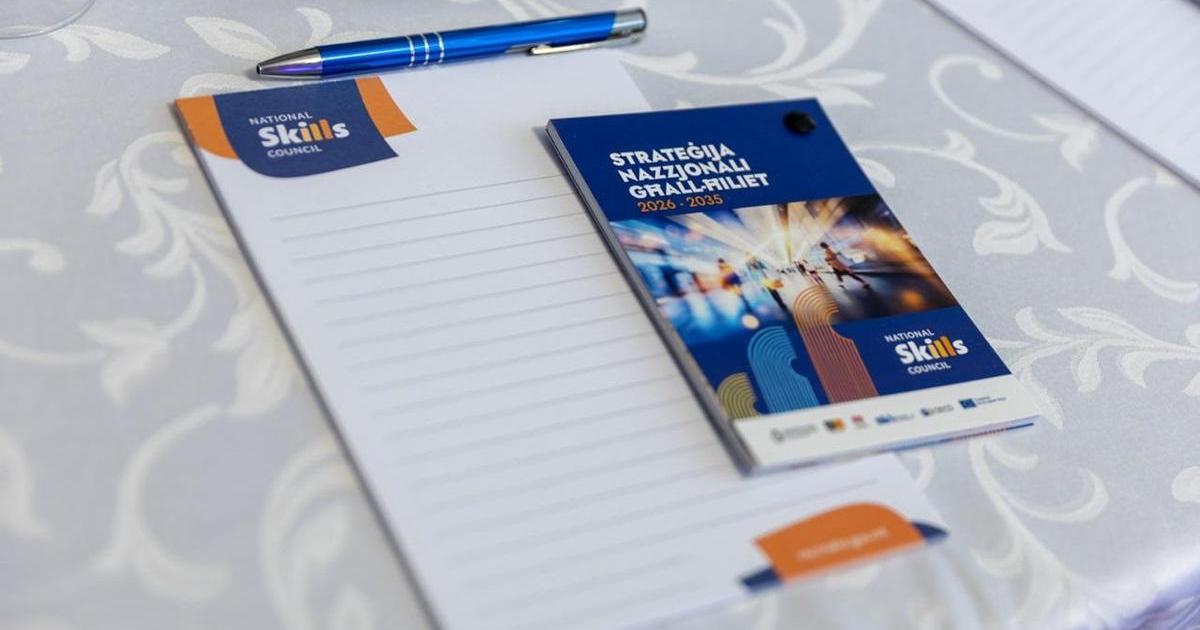
Sparking a national conversation on skills
Yesterday, on April 8, 2026, Malta launched its National Skills Strategy 2026–2035, a roadmap for empowering people, businesses, and communities to thrive in a rapidly changing world. The strategy is now open for public consultation on the National Skills Council (NSC) website, inviting every individual to contribute to the country’s future.
This is about more than education or training. It is about building confidence, resilience, and opportunity for all, from the student taking their first steps into the workforce, to the worker retraining for a new career, to those who thought learning was no longer for them. It is not intended to be a static policy document, but a living framework shaped by evidence, partnership and public engagement.
 Jeffrey Pullicino Orlando, Executive Chairman of the National Skills Council.
Turning global megatrends into opportunities
Skills are at the heart of the Malta Vision 2050, underpinning the country’s ambition for enhancing quality of life and strengthening economic and social foundations. The country faces the profound impact of global megatrends, through digital transformation, the net-zero transition, and demographic change, which are reshaping education and work. Malta’s response is not merely to adapt, but to leverage these shifts as opportunities for sustainable growth and competitiveness.
In recent years, Malta has made notable progress: early school leaving has declined sharply, higher education enrolment now surpasses EU averages, and participation in adult learning is on par with European targets. The labour market is robust, with one of the lowest unemployment rates in the EU and high job vacancy rates. However, challenges persist.
The strategy recognises this reality and responds with a vision: skills are the bridge between today’s challenges and tomorrow’s possibilities. A key principle of the strategy is simple but powerful: learning never stops. Education is not just a phase of life, it is a lifelong and lifewide journey. Learning is viewed in its widest meaning.
The strategy strengthens skills at every stage: from early education to vocational training, higher education, and adult learning. It emphasises not only technical skills, but also transversal skills like problem-solving, creativity, and adaptability. These are the tools people need to succeed in work, life, and society, and these same tools are also defined as the skills for the future in international literature such as that by the World Economic Forum.
 Clifton Grima, Minister for Education, Sport, Youth, Research, and Innovation in Malta.
A strategy built on evidence and partnership
The National Skills Strategy was developed through a structured, evidence-informed process, combining research, analysis, and extensive stakeholder engagement. The project is funded by the European Commission’s Technical Support Instrument and is being developed with the technical expertise of the OECD Centre for Skills, in close cooperation with the European Commission. The NSC led the process nationally, engaging ministries, agencies, social partners, industry representatives, and education providers through consultation workshops and bilateral meetings.
This collaborative approach ensured that the strategy is grounded in Malta’s realities, aligned with national policy objectives, including Malta Vision 2050 and the National Recovery and Resilience Plan, and informed by international best practices. The development process took place between 2024 to 2026, with key milestones including a comprehensive analysis of Malta’s skills system, multi-stakeholder workshops, and the formulation of 30 evidence-based policy recommendations.
Eight priority areas and 30 recommendations
The strategy is organised around eight priority areas, covering the full skills journey – from anticipating future needs, to developing skills, to using them effectively in the workplace.
Each priority is supported by targeted, actionable recommendations. The eight priority areas include strengthening skills intelligence and foresight through a Malta Skills Observatory; improving access to clear, timely skills information and career guidance through a skills intelligence platform; empowering educators and school leaders to enhance leadership capabilities; embedding green, digital and transversal skills across learning pathways; promoting adult learning and upskilling; encouraging learning-driven workplaces; making better use of Malta’s talent; and reinforcing skills governance and coordination. Taken together, these priorities aim to ensure that learning is relevant, accessible and valued.
Implementation and monitoring
The National Skills Strategy will be accompanied by a detailed Action Plan, developed in collaboration with lead entities for each recommendation. This plan will ensure that every recommendation is translated into concrete steps, with clear timelines and accountability. A robust monitoring mechanism, led by the Ministry for Education and the NSC, will track progress and enable the strategy to adapt to Malta’s evolving needs. This approach ensures that the strategy is not static, but a dynamic framework for continuous improvement.
An invitation to shape Malta’s future
The launch of the National Skills Strategy is not the end of the journey, but the beginning of a national conversation. The NSC invites all stakeholders, employers, educators, students, and citizens, to participate in the public consultation process and share their feedback on https://nscmalta.gov.mt/national-skills-strategy. Through collective engagement, Malta can strengthen a skills system that underpins sustainable growth, social inclusion and long‑term prosperity.