

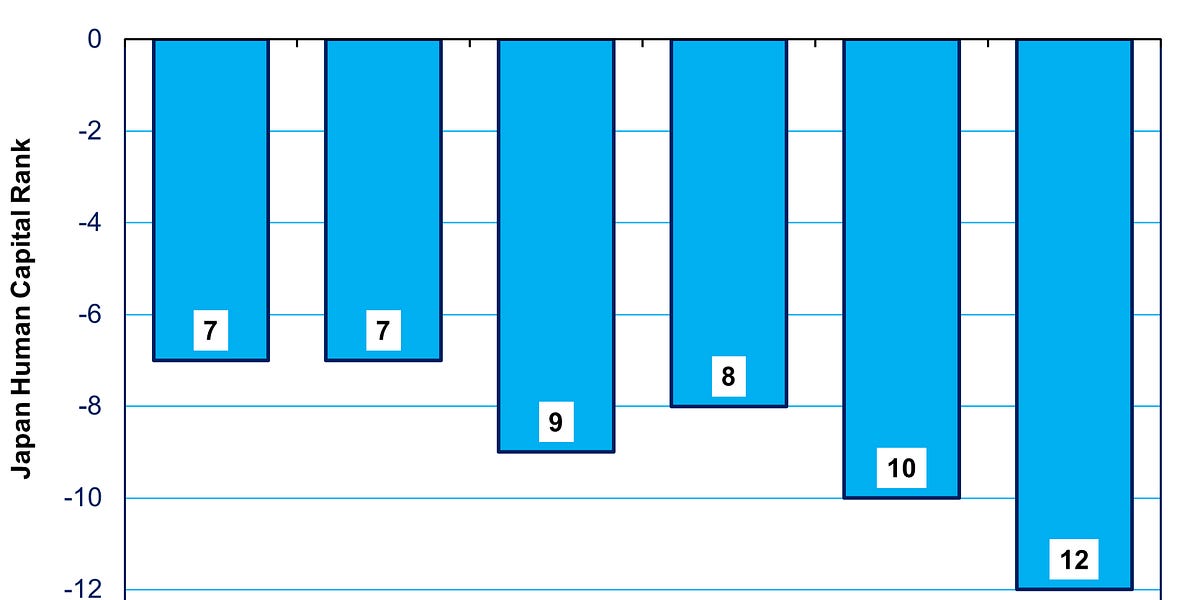
Why Japan Gets “Less Bang for the Buck” From Its Educational Achievements

Source: https://dataverse.nl/api/access/datafile/554105
This is the third in a series begun in this post and followed by this.
Smarter tools need smarter workers. Consider what today’s auto mechanic needs to know to work on the software-filled car of today. How can companies employ the latest in digital equipment and software if they can’t hire enough ICT professionals? Smarter products also need smarter consumers. How can you sell smart TVs or smartphones if your customer base is technophobic? Hence, improvement in “human capital” is indispensable to economic growth.
If one measures human capital only by years of education and scores on international PISA tests, Japan excels. In 2020, Japan was third on the World Bank’s Human Capital Index, behind Singapore, Hong Kong, and just ahead of Korea. The US, by contrast, ranked only 35th, mainly because of the huge socioeconomic inequalities among students.
If, however, one also includes a country’s ability to reap innovation and efficiency from all this learning, then the picture is very different. In the Human Capital Index published in the Penn World Tables, Japan has steadily dropped from 7th among rich countries in 1975 to 12th in 2023 (see chart at the top of this blog). The US ranked fifth because its companies were better able to transform learning into economic value.
Why Does Japan Get Less Economic Output From Its Education Input?
Why did Japan’s ranking fall?
At one pole, 30% of Japan’s workers say they lack the specific skills needed to do their job well, the worst mismatch in the OECD. At the other end of the spectrum, 35% of Japanese workers say they are overqualified for their jobs, in the sense that they have more years of education than their jobs require. That’s the second worst. The latter problem hurts growth because it means Japan is not creating the kind of high-value jobs that leverage its people’s education. Few countries suffer from both handicaps (see chart below).

Source: https://stat.link/smlvj6
Among the 30% saying they are under-skilled, some of their deficiencies lie in areas pivotal for creating economic value, from team-leadership (40% of the under-skilled, the worst among 28 OECD countries), project management (39%, also the worst), and digital skills (42%, 16th from the top).
I would have expected Japan to perform worse in digital skills, since Japanese companies derive the least economic benefit from their investments in information and communications technology. But perhaps the jobs given to workers are not that demanding. As I detailed in this post, the same Japanese students who perform so well in math and science perform quite poorly in digital skills, last among 29 countries in some areas. Japan’s top performers on the math and science tests come in dead last in the share who foresee themselves working in STEM (Science, Technology, Engineering, and Math) occupations. They are not given training in digital skills because, until recently, universities did not put questions on these topics on the entrance exams. In addition, pay in STEM jobs is low relative to the time and money required to become qualified for such jobs. So, high test scores don’t translate into economic value.
To make matters worse, companies have decreased their investment in worker training. They are especially reluctant to spend money training non-regular workers who may be working elsewhere in a few years. Among 1,066 companies surveyed, 92% provided training for regular workers, but only 42% did so for non-regular workers. That is “penny-wise, pound-foolish.” As the International Monetary Fund (IMF) pointed out, Japanese workers who receive less training are less productive. Moreover, the staff these companies hire in the future will not have been trained by their previous employers and will thus bring even lower skill levels to the job. Meanwhile, company spending on off-the-job training for all workers, regular or non-regular, dropped 40% between 1990 and 2020. In the past, Japan’s companies used to provide more training than those elsewhere. However, in recent years, among 22 OECD countries, Japan has ranked 19th in the share of business value added invested in on- and off-the-job training.
The consequences can be stark. In 2014, Nippon Steel & Sumitomo Metal had to halt operations at its Nagoya plant due to a power failure. Weeks later, the plant was still operating at 10%-20% below capacity. The cause was that the required maintenance expertise had not been passed on to the current workforce. For details, see Chapter Three of The Contest For Japan’s Economic Future in English or Japanese (click on URLs at the bottom of this post).
Then there is the resistance among companies to hiring academically trained PhDs. Instead, they prefer to hire college students as a blank slate, implant the company mindset in them, have them learn on the job, and have them earn a different sort of PhD based on their work for the company. The problem, as I detailed here, is that the latter type of PhDs are not as inventive as the academically trained. Moreover, even when Japan’s top scientists and engineers produce globally pioneering work, e.g., in quantum computing, company technologists do not understand the science well enough to translate it into economic value. But it is only when the latter happens that technology boosts GDP. For more details see this post.
Japan is the only major country where the number of PhDs per million people is falling. In fact, the number of new PhD candidates has fallen by a third since 2003. One reason is that salaries for PhDs are relatively low compared to the high costs in time and money of earning an academic PhD. For details, see this post.
Bottom Line For GDP Growth: Decline in “Quality” of Both Labor and Capital
The result of all of this is that the “quality of labor” and its contribution to GDP growth have fallen, not just relative to other countries, but in absolute terms. Labor helps economic growth in two ways. First is simply growth in the number of hours of work, which is no longer happening in Japan, The second is growth in the quality of those hours as measured by education, experience, skills, occupation, wages by occupation as a proxy for marginal productivity, etc. Labor quality rises partly because each company hires a larger share of productive employees, and partly because more workers shift from lower-skilled jobs and companies to higher-skilled ones.
In Japan, despite more people finishing college, the poor use of these people has caused labor quality to decline. During 1995-2000, of the 2.9% annual growth in Japan’s private sector GDP, 0.36 percentage points was attributable to growth in labor quality. If not for that quality improvement, GDP would have growth 12% less. From 2015 to 2020, declining labor quality reduced private sector GDP growth by -0.21 percentage points per year, making growth 10% slower than it otherwise would have been (see chart below). Labor quality declined over the entire 1995-2020 period (see chart below).
By contrast, a study of 21 other rich countries during 2014-18 shows that every single one except Estonia showed positive growth in labor quality (Japan was not included in this study). This is why, as we saw at the outset, Japan’s ranking fell in the Human Capital index that factors in the impact of education on growth.

Source: https://www.rieti.go.jp/en/database/JIP2023/data/jip2023_4.xlsx
The quality of capital also fell. It’s harder for companies to improve the quality and complexity of tools—and how they use them—if the quality of workers is falling. In tandem with the fall in labor quality, the decline of capital quality reduced private sector growth by 0.07 points during 1995-2020 (see chart above). That’s not a huge decline, but it’s a decline when more improvements in technology and education should have caused the quality to grow.
The decline in labor quality shows up even in Japan’s most advanced sectors. In the chart below, I looked at sectors ranging from digital services and equipment to various sorts of machinery, chemicals, and pharmaceuticals. In several of them, labor quality began to decline in 2010-15 and fell further during 2015-2021. In the digital area, labor quality was still improving in 2010-15 but began falling from 2015 onward, particularly in digital equipment (see chart below). No wonder Japan has shifted from a surplus in digital trade to a deficit.

Source: https://www.rieti.go.jp/en/database/JIP2023/data/jip2023_3-5.xlsx
Low Incentive For Students To Invest Time and Money in Advanced Skills
Low pay for high-skilled jobs is a big hindrance to growth. Whether in STEM areas for college grads, or in nurturing PhDs, Japan is not paying people enough to lure them into investing the time and money to gain the required skills and qualifications.
Japan comes in second worst in the wage increases its workers get for every “standard deviation” in their years of education. One standard deviation means one-third of the workers are above the average and one-third below it. So that’s a big change. By contrast, Korea comes in second, just ahead of the US (see chart below).

There are two kinds of income equality, one good and one bad. The good kind is equal pay for equal pay for lathe operators, or for janitors. Workers in the same occupation with the same skills and experience should be paid similar wages, whether they are regular or non-regular workers, or whether they are men or women. The bad kind is when there isn’t enough wage difference between janitors or software engineers to give smart people the incentive to gain advanced skills. Japan has too little income equality of the first kind and too much of the second kind.
Let’s look at how much benefit people get in additional lifetime earnings in return for all the costs they pay to get a college degree. These costs include not only the direct out-of-pocket expenses but also the income they forgo by being in college instead of working full-time. This benefit-to-cost ratio is much higher in countries with higher per capita GDP, so the chart below accounts for that. The percentage number in the two charts below is the average annual net return on a higher education over one’s lifetime. The farther below the trendline a country is on this scale, the less incentive its people have to invest in education, for example, in post-college courses required for employable IT skills. This is 2007 data. The OECD did a similar study in 2018, but Japan did not submit data.
When it comes to men, Japan is far below the rich-country trendline and has the fourth-lowest rate of return among all 24 countries, at just 7.4% (see chart below).

Source: http://dx.doi.org/10.1787/888932463327
Regarding women, Japan is also far below the trendline and the fifth-lowest-ranked country. In most countries, women do worse than men. Japan ranks 9th by this measure, with women getting 27% less than men in the “net present value” of their lifetime benefits, $104,000 for women vs $143,000 for men in purchasing power parity dollars (see chart below).

Coming up: Education and the “Great Gatsby Curve”
Paid subscribers will be eligible for my new memos, an addition to these regular posts. Beyond that, if you feel you’ve gained insight from this blog, ever restacked it, if you ever subscribed to my previous publication, The Oriental Economist Report, and certainly, if you or your firm have gained insights that helped guide your investments, please support the blog with a subscription or by “buying me a cup of coffee.” You can buy a cup or two on a one-time basis, or once a year, or once a month.

