

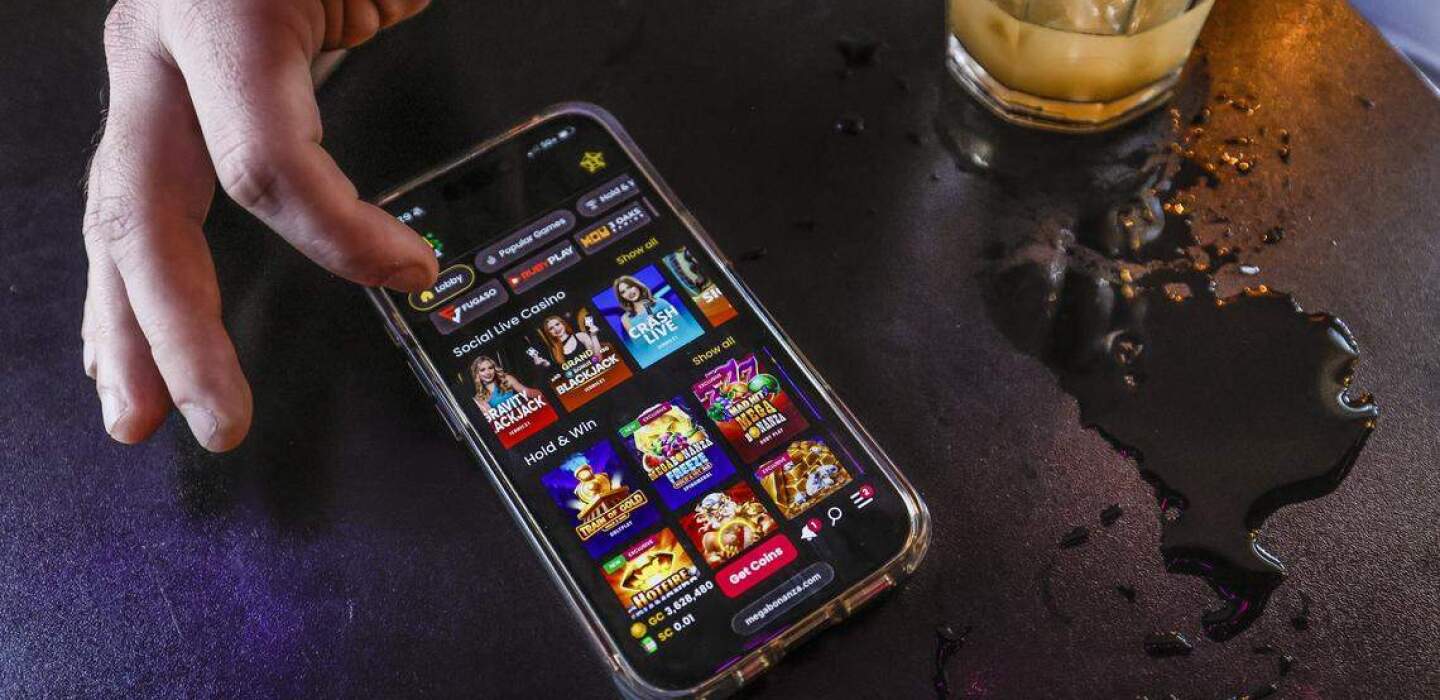
Online Sports Betting Is Fueling Financial Risk in Florida
Jason was hiding in a closet at work, glued to his phone. He was going “full tilt.” In gambling parlance, that means he lost a bet, was spiraling and would soon start wagering indiscriminately as he chased his money into a financial void.
It was Jan. 28, 2024, the AFC Championship game. Eyes wide and heart pounding, Jason watched as the clock ticked away, as the Kansas City Chiefs racked up points against his Baltimore Ravens, and as the odds, and score, tipped insurmountably in their favor. Bet after bet went bust. By game’s end, he was out nearly $5,000 — money he couldn’t afford to lose.
Then, “I just lost it,” said Jason, a 30-year-old who at the time worked at a rehab facility in Stuart, Florida, a coastal city about 40 miles north of Palm Beach.
He had to win it back. His hand dove for his pocket, fishing out his wallet, exhuming cards — credit, debit, whatever — and punching their digits into his favorite betting apps.
He spread $20,000 across a menu of prop bets — wagers on specific, in-game events that aren’t related to the final score, like what color Gatorade will be dumped on the winning coach’s head — as well as the final outcome of the NFC Championship later that evening.
Few went his way, and Jason went to bed that night with a $15,000 hole in his bank account.
For a generation of young Americans struggling with affordability and facing an uncertain economic future, online betting has emerged as a seductive shortcut to prosperity — if you can beat the house. Internet sports gambling is flourishing in Florida and the 31 other states that have legalized it, and few guardrails prevent problem users from swiping away hundreds or thousands of dollars. But even among states that have OK’d online sports betting, Florida stands out as one of the most permissive, least protective in the country, according to experts.
Before picking up serious sports betting in 2023, Jason said he had, through a combination of cheap rent, smart investments and a lot of overtime, squirreled away nearly $100,000. Now, his savings hover somewhere around $5,000.
“I don’t know if I’ll ever really be able to stop gambling,” said Jason, who asked the Miami Herald to only use his first name to protect his privacy as he looks for a new job.
But he wishes he could. It’s derailing his life.
“I’m so far financially back behind my peers,” he said.
The Florida Council on Compulsive Gambling reported a 138% increase in calls to its helpline between 2023 — when Florida’s legal online sportsbook, Hard Rock Bet, launched — and 2025. And those callers are increasingly young — 18- to 25-year-olds now account for 41% of the helpline’s calls, up more than 10 percentage points from 2023.
In the past, would-be bettors had to go to a casino or racetrack, or find a bookie. They might’ve taken out cash, held in their hands the money they were about to spend.
But the Supreme Court overturned a federal ban on sports betting in 2018, leaving states to decide whether and how to legalize sports gambling.
Florida opened the door three years later.
“With online sports betting, it seems like the addiction comes on rather fast,” said Janet Gerner, a South Florida-based therapist who specializes in gambling addiction. She said her patients often “end up in a trance,” swiping on bets as if they were scrolling social media — frictionless gambling on a device that for many is already a borderline prosthetic extension.
For gamblers, especially younger ones who are just starting to earn and build the savings that will undergird their retirements, that can mean life-altering losses of wealth and financial stability.
It’s young men, particularly those from 18 to mid-20s, who are at heightened risk of developing gambling addictions.
“Young men are more prone to risky behavior — full stop,” said Jonathan Cohen, sports-betting policy lead at the American Institute for Boys and Men. “They’re biologically primed for it, not to mention they’re already sports fans.”
Plus, he added, more and more of those young men are beset by a sort of financial nihilism — the feeling that whatever money they are able to make and save through more traditional avenues, like a steady job, won’t be enough to achieve major economic milestones.
“Imagine you have $10,000 in the bank,” Cohen said. “That’s not enough to buy a house. It’s not enough to pay off your student loans, and it’s not enough to start a business.”
But it is enough cash to spread across hundreds of moonshot bets that could theoretically pay off big.
“They’re performing at the lower end of the labor market,” said Cohen, “so might as well sort of pursue the American Dream through the only way that you can see available.”
Jason could relate. Soon after he started gambling online, he hit a hot streak — “the worst thing that can happen to a gambler,” he reflected — and made north of $20,000 in a month.
“I’m thinking, like, why am I even working these jobs where I’m making $19 an hour when I can just, you know, bet $5,000 on a ping-pong game and make $2,000 in half an hour?”

(AL DIAZ/TNS)
Hooked ‘Instantly’
Florida embraced online sports betting in 2021, when Gov. Ron DeSantis and the Seminole Tribe inked the Gaming Compact, an accord that granted the tribe a monopoly on sportsbooks in the state through July 2051.
Two years later, Florida’s mobile sports betting application, Hard Rock Bet, hit the market for good.
Jason downloaded it soon after.
What he entered was a relatively unguarded — and, as he described it, “predatory” — gambling ecosystem.
“There’s not a lot of restrictions on sports betting in Florida,” said Jennifer Kruse, executive director of the Florida Council on Compulsive Gambling. “And the costs are not just to the gambler themselves — they’re to everyone: to family members, friends, society.”
Meanwhile, the state’s making money. Florida takes 13.75% of the Seminole Tribe’s net winnings from sports betting, which, for this fiscal year, are estimated to top $2.6 billion. Florida’s cut is a projected $359 million — $55 million more than the state netted last year from taxes on alcohol.
Hard Rock Digital, which declined to comment for this story, does not publish data on the problem gambling activity of its users, and Florida has not commissioned a comprehensive study of gambling addiction in more than a decade.
But data from other states that have legalized online sports gambling — as well as the surge in calls to Florida’s problem gambling helpline — suggests that gambling addiction is a greater problem than is publicly understood, and that it’s metastasizing fast.
Research from the UCLA Anderson School of Management found that within two years of legalizing online gambling, states that did so saw, on average, a 28% increase in bankruptcy likelihood among their residents and an 8% increase in debt collection amounts.
It’s not hard to fathom that increased access to online betting would lead to higher rates of gambling addiction. After all, betting companies make money when people use their apps, which “are designed to be as addictive as possible,” said Nicholas Reville, cofounder and executive director of the nonprofit Center for Addiction Science, Policy, and Research.
“There’s some portion of the population when they’re exposed to these apps … they are going to become addicted,” he said.
Jason, who’s no stranger to addiction, was part of that group. As a teen, he fell into a drug-curious crowd, and it wasn’t until years later, in early 2019, that he finally kicked his heroin problem.
Newly clean, he got a job at a rehab facility, helping others who were in the thick of what he had just gone through. His coworkers were all sober, and that helped with his sobriety. But they gambled, so he did too.
The money started to give his sports-watching experience a little kick. “I genuinely love watching sports,” he said, “and when I add some money on top of it, it’s, like, multiplicative in the excitement and emotion.”
In 2023, a colleague approached Jason at work, his phone open to the newly launched Hard Rock Bet app.
“He’s like, ‘Check this out — if you lose your first bet, you get $100 back,’” Jason recalled. He was referring to the “bonus bets” that sites offer to entice gamblers; you upload your own money, and the site will match it with some amount of in-app cash — unwithdrawable funds that can only be spent betting on their platform.
Jason put $100 down. He lost. He did it again, this time with the $100 bonus bet Hard Rock had given him. He lost again. “I got so pissed, I immediately just started throwing all this money at it,” he said.
“It got me instantly.”
‘No Boundaries’
If you move beyond small talk with a gambling policy expert, you’re likely to hear the term “friction,” which essentially refers to any barrier to gambling.
“There are no boundaries anymore,” said Gerner, the South Florida therapist.
Since online sports gambling’s rollout in Florida, she reports seeing more young men in more debt than ever before.
For Jason, the friction of traveling to a casino and physically putting down money makes all the difference. “I can walk away when it’s in person,” he said. “It’s a much different mentality than losing your life savings on your couch.”
The removal of such barriers broadens exposure to online betting, said Kruse of the Florida Council on Compulsive Gambling.
And while some of that exposure is from word of mouth, much of it comes from ads. Social media users, television watchers, highway drivers — most Americans, really, have been exposed at one point or another to a betting ad.
And those spots follow a familiar recipe: warm light — it’s always sunny when you’re betting — vibrant colors, smiles, phones in hand with wagers at the ready. Some mention of bonus bets that whiffs of free money. Perhaps a celebrity or two or five.
The message? “Make money on what you know — it’s a skill-based activity,” said Dr. Timothy Fong, a professor of psychiatry who co-directs UCLA’s Gambling Studies Program. “And those things are completely false, completely baloney.”
The advertising doesn’t stop once you’re in. If you’re like Jason, and you shell out enough money, at least on Hard Rock Bet, you might be assigned a “VIP Account Manager,” also known as a host.
“We’re running a big promotion,” one of Jason’s Hard Rock Bet hosts, Vincent, texted him in 2024. “If you deposit 10k you’ll get 1k back in bonus bet.”
Jason didn’t take Vincent up on the offer. But he did say he accepted comped hotel rooms at Hard Rock casinos, tickets to football and basketball games, and concert seats — all arranged through the VIP hosts he drew through the sheer volume of his gambling, before he was banned from the app in 2024 over a banking dispute.
“The [casino] always makes their money back,” he said of the perks. “They’re just placating me.”
State regulations do little to protect problem gamblers like Jason from falling into addiction and losing much, if not all, of their money.
Florida’s framework for regulating online gambling ranks among the five weakest in the country, according to a 2024 National Council on Problem Gambling report. Only 11 of the council’s 82 recommended policies are explicitly referenced in the 2021 Gaming Compact, the legal structure governing online betting in Florida.
In its own ranking of states’ online gambling regulations, the Center for Addiction Science, Policy and Research gave Florida a 49/100 — an “F” grade.
Florida’s most meaningful protections typically kick in after someone’s gambling has already become a problem and therefore are “totally ineffective” from a prevention standpoint, said Reville, CASPR’s executive director.
“Calling a hotline after you’ve lost all your money, going to gambling counseling after you have a divorce and lost your home — these are things you do after [the casinos] have taken all your money,” he said. “We need to intervene before people lose everything.”
State-mandated bet or loss limits — restrictions on how much money someone can wager or lose in a period of time before their account is temporarily locked — could prevent devastating losses and introduce enough friction to help brake someone’s slide into addiction, he said.
Banning in-game micro-bets — a torrent of wagers on the outcome of specific plays, which are basically akin to roulette spins — could do preventative wonders, said Reville.
Massachusetts is debating a bill that would outlaw such bets, as well as ban sports-betting ads during televised sports games, impose daily betting limits for most gamblers and more than double the tax rate that sportsbooks pay on their net wins.
Asked whether the governor would support additional consumer protections, DeSantis’ office referred the Herald to the Florida Gaming Control Commission, which did not respond to multiple requests for comment.
The Cost of Inaction
Protections or no, Kate, Jason’s wife, doesn’t think online sports gambling should be legal at all.
Kate — who asked to be identified by her middle name — only found out the extent of her husband’s online sports betting addiction last month. They had been thinking about having a baby. That’s on ice for the foreseeable future, at least until Jason’s gambling is under control.
She says she doesn’t think people take gambling addiction seriously, and she doesn’t get why. Maybe it’s because the data on problem gambling is limited.
Florida hasn’t conducted a thorough, statewide study of gambling addiction since 2011, a decade before online sports betting was even legalized.
But other states have.
In 2022, 6.3% of Oklahomans met the criteria for gambling disorder, while 24% were considered “at risk,” according to the Oklahoma Association on Problem Gambling and Gaming.
In Maryland, nearly 6% of residents exhibit disordered gambling behavior, up from 4% two years prior, a 2024 study backed by the Maryland Department of Health found. That’s well above the 2% of Florida adults who were last recorded 15 years ago as exhibiting problem gambling symptoms.
Both states scored higher than Florida on CASPR’s online gambling regulatory rankings, and in Oklahoma, online sports gambling isn’t even legal.
Kate doesn’t need any extra data to grasp the threat posed by unfettered online betting.
Though she makes good money — more than $100,000 a year as an accountant — “everything’s expensive,” and even before Jason’s gambling problem surfaced, she had been concerned about whether she’d have enough of a nest egg to retire comfortably.
More than anything, though, she’s mourning the marriage she had hoped for. “When I got married, it was like, everything is one. We’re in it together. What’s mine is yours, what’s yours is mine.” Now she’s contending with the fear that her husband, in a tilted fit, might drain their savings.
“All that I’ve worked for, worked really hard for, like, I want to be able to trust him with it, that he’s not going to just go through it,” she said as she sat with Jason at a café on a recent evening.
“I never expected marriage to …” she trailed off, looking at Jason, who was fiddling with his wedding ring. “I don’t know, like, I don’t want to say ‘divorce,’ but I also cannot do this forever.”
Forever’s a long time, and Jason doesn’t know if he can kick gambling for that long.
“I could stop doing heroin. I can confidently say I will never do heroin again. But gambling … ” He looked across the table at his wife.
“I don’t know.”
Problem gambling? Here’s where to find help
This story was produced with financial support from supporters including The Green Family Foundation Trust and Ken O’Keefe, in partnership with Journalism Funding Partners. The Miami Herald maintains full editorial control of this work.
©2026 Miami Herald. Visit miamiherald.com. Distributed by Tribune Content Agency, LLC.