

Life Isn’t Easy in the OnlyFans Economy
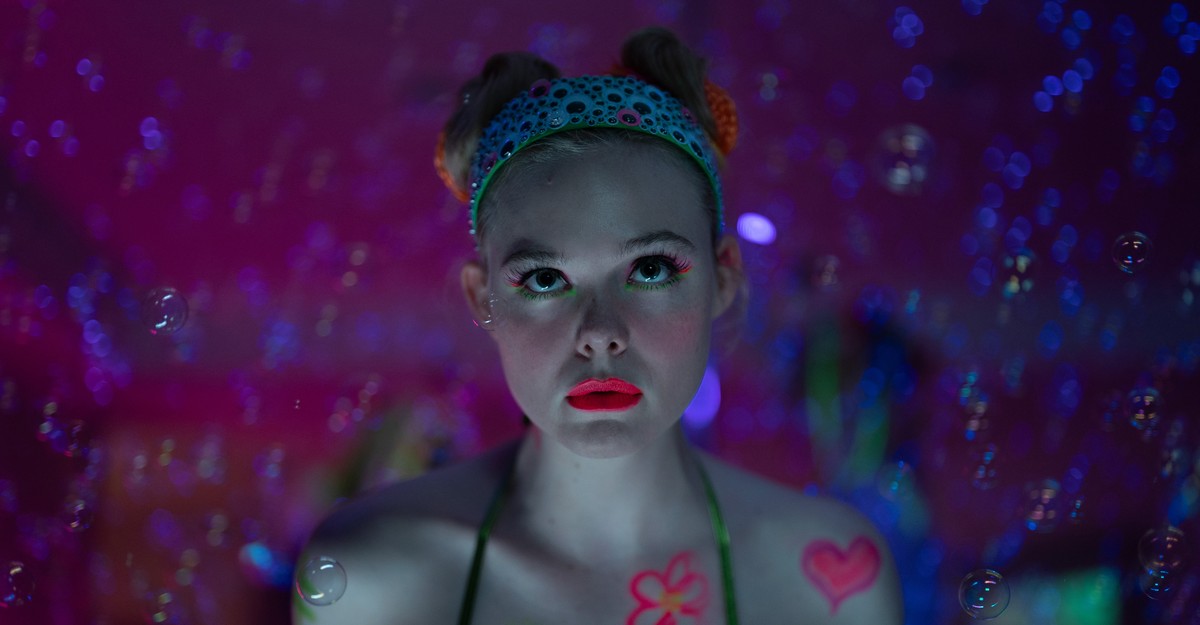
On-screen, the actor Elle Fanning has the cherubic, moon-eyed guilelessness of a storybook princess or an animated woodland creature, the kind that belies a character much more tenacious than she first appears. In the new Apple TV series Margo’s Got Money Troubles, based on the 2024 novel by Rufi Thorpe, Fanning plays an imaginative and naive college student named Margo, and it doesn’t take long for a predator to come sniffing around. In this case, it’s a sad-sack, married literature professor named Mark (played by Michael Angarano), who locks in on Margo and—correctly—identifies her writing potential. “I’m meeting him for coffee,” Margo tells her best friend over FaceTime. “He thinks my writing is brilliant.” (If your eyes roll at this point, they’re supposed to.)
The TV titan David E. Kelley (Ally McBeal, Big Little Lies), who created the show and wrote the first three episodes, zips through the inevitable scenes that follow: Mark and Margo end up in bed, where she’s not enthralled by him so much as enchanted by how he makes her feel about herself. Margo vomits at her waitressing job without realizing what it portends. By the beginning of the second episode, Margo has dropped out of school and is the totally broke single mother to a colicky baby, Bodhi, who cries so committedly that two of Margo’s roommates move out. She can’t continue waitressing without child care, and she can’t pay for child care without a job. Her mother, Shyanne (Michelle Pfeiffer), is a lacquered and brittle femme fatale who, having raised Margo alone, declines to repeat things with Bodhi. Truly, the show emphasizes, Margo is out of options, except for a specific and potentially lucrative career that beckons through her laptop screen. And so, desperately in need of rent money and diapers, she signs up for OnlyFans.
The erotic-creator model has been entrenched in the American economy since the early months of the coronavirus pandemic, so the fact that TV has taken this long to really consider it is a little surprising. Margo’s Got Money Troubles premiered the same week as the third season of HBO’s nihilistic teen drama Euphoria, in which Sydney Sweeney’s dead-eyed Cassie has taken to the popular subscription service, dressing up as a seductive puppy and even a pacifier-sucking baby. “People make money doing this,” she tells her fiancé, simply. She doesn’t need money but wants it, and in the world of Euphoria, where sex is often nothing more than currency, that’s enough.
It’s hard to sufficiently emphasize how different a show Margo’s Got Money Troubles is—how sweet-natured, humane, and tender it is toward its characters and their plight, and how astute about the mechanics of the modern-day attention economy. Margo is credulous, yes, and her questionable decisions stack up like dominoes when the show has barely begun, but she’s also creative, practical, and immensely in love with her child. She’s supported by her roommate, Susie (Thaddea Graham), a fantasy cosplayer and wrestling fan, and her formerly absentee father, Jinx (Nick Offerman), who arrives at Margo’s door not long after leaving rehab for an opioid addiction and seeing a string of panicked texts from her.
Offerman, radiating the majestic vulnerability of a forlorn mountain, is spectacular, and his bond with Bodhi helps Margo dive deeply into her new pursuit. At first, she offers to compare photos of people’s penises to Pokémon for tips, employing both her critical and descriptive skills. (“Your penis is a Tentacruel! With bulging pink glans and glittering mushroom-blue veins, your penis is filled with a quiet menace.”) But soon, she comes up with a persona—Hungry Ghost, named after a poem Mark wrote her—and a schtick, and becomes convinced that she can turn her side hustle into a real career.
Whatever you might be thinking about OnlyFans, the show wants to tweak it. “So it’s pornography,” Jinx says to Margo, wrinkling his nose, when she explains to him how she’s supporting her family. “It’s not pornography,” Margo replies. “Sometimes there’s some nudity.” Most of the work she does involves that most relentless of 21st-century labors: building a following. Methodically, Margo’s Got Money Troubles underscores just how closely Margo’s work aligns with other creative jobs, such as Jinx’s career as a wrestler and even David E. Kelley’s duties as a showrunner.
Margo writes scripts, plans costumes and makeup, blocks scenes, and dreams up plot arcs for her erotic-alien alter ego. Fanning is frequently nude on the show, but rarely in the context of her work online; more often, she’s nude as a new mother, frantically trying to feed a child who won’t latch. (“He just spits them out with such vicious contempt!” Margo sobs, alternating between watching YouTube tutorials on breastfeeding and shrieking with frustration—a scene that yanked me right back to the endurance tests of early parenthood.) Slyly, the series reveals all the ways in which nudity is or isn’t sanctioned, bodily labor affirmed or condemned.
By the point in the show where Margo is derogatively labeled a “sex worker” by disapproving lawyers and social workers, we’ve seen so much of who she really is that the label seems wholly insufficient and unfairly loaded—if selling yourself as a character on the internet is that awful, let he who is without sin cast the first stone. Kelley even allows two of Margo’s OnlyFans collaborators, played by Lindsey Normington and Rico Nasty, to criticize her “internalized whorephobia” when she insists that she’s making art, not porn. Margo’s Got Money Troubles seems interested in questioning the other labels society loves to pummel people with too: “single mother,” “addict,” “Hooters waitress.” Maybe OnlyFans is popular because people get to choose their designation for themselves, and to imagine a persona as expansive as they want it to be. (They can also do this while working from home and setting their own hours, accommodations that the American economy isn’t remotely interested in offering parents.)
I’ll tell you my fantasy: a world in which women’s creative work is engaged and rewarded even when it isn’t sexualized or catering to men who tip, and in which erotic desire isn’t so often informed by market forces. In the meantime, it’s hard to watch this charming, wholesome show and not support Margo’s endeavors, not weep at her family coming together to endorse her as a mother. For a dully cynical take on the OnlyFans economy, there’s Euphoria, but for a more affirming consideration, Margo is well worth the subscription.